Better Strategy for Ultimate-X Video Poker
TLDR: play 5+5 on the initial hand, but only play 5+0 on any hand with multipliers.
I recently looked into Ultimate-X video poker for the first time, on the off chance it just might be something I’d want to play. My knowledgeable friend told me the published info didn’t seem entirely comprehensive, which made me even more curious.
I looked up the game at the WoO pages, and saw that Mike Shackleford had collaborated with a Prof. Gary Koehler from the University of Florida, who wrote a very detailed academic paper detailing the solution of the game. He identifies it as a Markov Decision Problem, describes the state space, and shows the iterative equations used to arrive at a numerical solution for the optimal return of the game, for various pay tables, multipliers, and multi-line configurations.
My Solution (Transient Analysis)
I thought about the problem, and how I’d solve it, before fully reading the equations in the Koehler paper. I just wanted to set up the iterative equations and see if it converged to the right answer. I saw the problem as starting in the 1x multiplier state, and transitioning to the other {2x, 3x, 4x, 5x, 7x, 11x} states on “wins”, otherwise transitioning to an absorbing state (0x) on a “loss”. Every subsequent win is a transition to the next multiplier state. On average, the the system quickly terminates in the 0x absorbing state, because the probability is high of not winning any given hand.
For example, the diagram below shows a example of a transient path through the Markov state space. The player pays 5+5 coins and starts in the 1x state. In the example, he wins the first hand, and gets a 5x multiplier. He plays another hand with 5+5 coins, etc., until he loses, and path finishes in the absorbing 0x state.
Multiplier
 state

  11x |
   7x |
   5x |             o
      |           /   \
   3x |          /      \
   2x |        /          o
      |      /             \
   1x |     o                \
      |                        \
   0x |                          o----------> absorbing
       +------------------------------------------------> time
           t=0    t=1    t=2    t=3
            1x     5x     2x     0x
It’s straight-forward to compute the optimal EV of a video poker game when you know what the payouts are. In the case of Ultimate-X, you have a current multiplier (m), applied to your payout for winning hand rank (r), plus you get a multiplier m’ for your next hand based on your current winner. So, if you knew what the expected value is for every multiplier, you can construct the equation(s):
where H are all possible dealt hands, R are the winning hand ranks, i is one of the 32 possible ways to play the hand, and m'(r) is the multiplier awarded on the next hand for winning rank r.
Note my equations take into account the absorbing 0x terminal state, because R is only the set of winners, with multipliers > 1. There’s no return to the 1x state. Note that, V(m) is interpreted as the total net return for an initial 2 unit bet starting in state m, until the all the possible paths converge to the 0x state. This is a transient analysis, and very simple to describe in the equations. The -2 in the equation represents the cost of playing 2 units for the next hand, assuming it’s still correct to pay for the possibile multipliers given your awarded m (which may be as high as 11x!). We’ll see if this is a correct assumption.
Single-Line Jacks-or-Better
Thanks to the Koehler paper, I used the numerical iteration process he described that simply calculates the next set of V(m) values for each multiplier using the current V(m) values, then iteration again, until the values converge. I initialized the V(m) values each with (m*ev0 + 1), where ev0 is the optimal return of the base game w/o multipliers, and the +1 is for the extra cost for a chance at next multipliers.
Table 1 below shows the results for a 9/6 Jacks or Better Single-Line Ultimate-X game with 2/2/2/12/10/7/4/3/2/1 multipliers. This game is actually available nearby me, and the high ev0 = 0.995439 inspired me to do this analysis. It intuitively feels like I should consider playing just 5+0 credits on a hand that already has a high 12x multiplier.
| m | V(m) | 2*ev0 + 1 | Should pay for multipliers? |
| 12 | 12.927089 | 12.945269 | Better to play 5+0 |
| 10 | 10.936397 | 10.954390 | Better to play 5+0 |
| 7 | 7.950974 | 7.968073 | Better to play 5+0 |
| 4 | 4.967557 | 4.981756 | Better to play 5+0 |
| 3 | 3.973817 | 3.986317 | Better to play 5+0 |
| 2 | 2.980889 | 2.990878 | Better to play 5+0 |
| 1 | 1.989899 | 1.995439 | Better to play 5+0 |
Table 1. Iterative results for my Markov equations assuming 5+5 play for all hands (Jacks-or-Better 9/6).
The results show a per unit EV = 1.989899/2 = 0.99495. This is actually lower than the base 9/6 game return of 0.995439. The reason for this underperformance becomes clear when we compare the V(m) [the expected return on a 2 unit bet] vs. just playing a 1 unit bet (5+0) normal game (= 2*ev0 + 1). The table shows you’re better off playing just 5+0 when you have a multiplier.
The optimal return for the game then becomes V(1) when setting V(m) = 2*ev0 + 1 for all m > 1. In other words, the analysis is straight forward. We found that paying for the multipliers on winning hands is sub-optimal. Just finish out the hand with a standard 5+0 bet. The EV calculation then becomes straight-forward, setting the equations with these m*ev0 values.
Setting the V(m) values to these constants for m > 1 then yields V(1) = 1.99515. This yields an EV = 1.99515/2 = 0.997576 per unit bet, and improvement over the base game. Thus, it is worth paying the extra +5 coin in for the chance at the multipliers on the initial hand, but it’s not worth paying the extra +5 coins once you have a multiplier.
“Game” vs “Hand”
A quick note here the interpretation of the return of 1.99515 on a “game” which costs 2 units to play. A ‘game’ either lasts 1 or 2 hands. When you win the 5+5 initial hand, the cost of the 2nd hand is already included in the EV calculation (recall the -2 term in the equations). When you lose the 1st hand, there’s no 2nd hand.
The Koehler Equations (Steady-State Analysis)
In the equations presented by Koehler in his paper, he assumed that a player that would continue playing with optimal decisions for a 2 unit (5+5) bet indefinitely (non-discounted). In his equations, a game is always one hand. He computes the steady state per-hand optimal return (g), then subtracts it off from every V(m), which are then interpreted as a “relative bias” for state m. In his equations, he solves for the steady-state probabilities of being in state m, Pr(m). He then computes g as the average of e(m) = (V(m) + g) over all multiplier states.
I implemented his equations and came up with the exact same results he gets for various pay tables and multipliers.
Implementing his equations, my program converged up with a return of 1.994316/2 = 0.9972 for the same single-line 9/6 Jacks-or-Better game with the multipliers listed above. This is a lower number than my 0.9976 return. Plus, with my ‘only play 5+0 on multiplier hands’ strategy, the ‘cost per click’ is lower. (A simple calculation based on the 68.33% no-win rate reveals a (0.00368 unit)/deal cost for my strategy, vs. a (0.00568 unit)/deal cost for betting 5+5 every hand.)
deals/game =
2*(1 - pr(lose)) + 1*pr(lose) =
2 - pr(lose) =
2 - 0.68333 =
1.31667
and cost per click = (1-1.995152) units-per-game / (1.31667 clicks-per-game) = 0.00368 units/click. (Per click of the “deal” button.)
We Get Identical Optimal Decisions
I compared the optimal decision points for every multiplier state for a various games, pay tables, and multipliers, and found that they were always identical for all possible hands.
So, you can play the same 1x (5+5) strategy you’ve always played; it doesn’t change. It’s simply lower cost to play 5+0 on all multiplier hands. Clearly, this is the case in single-line.
Note that playing perfectly becomes much simpler with the ‘only bet 5+0 on multiplier hands’ strategy. You only need to know 1x 5+5 strategy (doesn’t change), and basic strategy for multiplier hands (widely published). You do not need to know a separate strategy for 12x, 10x, 7x, 4x, 3x, 2x, etc. multiplier hands.
Below is my 1x (5+5) strategy for 9/6 Jacks-or-Better with 2/2/2/12/10/7/4/3/2/1 multipliers. It should be very similar to any other correct published strategy for this Ultimate-X game.
Royal Flush          800   2x
Straight Flush        50   2x
Four of a Kind        25   2x
Full House             9  12x
Flush                  6  10x
Straight               4   7x
Three of a Kind        3   4x
Two Pair               2   3x
Jacks or Better        1   2x
Nothing                0   1x


                                            Costs: Rule      Cumulative
                                  Hold Royal Flush, 0.000000, 0.000000
                               Hold Straight Flush, 0.000000, 0.000000
                                 Hold all w/ quads, 0.000000, 0.000000
                                   Hold Full House, 0.000000, 0.000000
                             Hold four Royal cards, 0.000000, 0.000000
                                        Hold flush, 0.000000, 0.000000
                                     Hold straight, 0.000000, 0.000000
               Hold open-ended straight flush draw, 0.000000, 0.000000
                  Hold gutshot straight flush draw, 0.000000, 0.000000
                                        Hold trips, 0.000000, 0.000000
                                    Hold two pairs, 0.000000, 0.000000
                     Hold 4 suited w/ 3 high cards, 0.000000, 0.000000
                     Hold 4 suited w/ 2 high cards, 0.000000, 0.000000
                      Hold pair of Jacks or better, 0.000000, 0.000000
                     Hold 4 suited w/ 1 high cards, 0.000000, 0.000000
                               Hold 4 suited cards, 0.000000, 0.000000
                     Hold 3 suited cards w/ 3 high, 0.000000, 0.000000
                            Hold three Royal cards, 0.000000, 0.000000
                     Hold open-ended straight draw, 0.000000, 0.000000
                                    Hold one pairs, 0.000000, 0.000000
                      Hold three SF cards w/ 0 gap, 0.000000, 0.000000
                  Hold 3 SF draw with 2 high cards, 0.000001, 0.000001
               Hold gutshot draw with 4 high cards, 0.000000, 0.000001
               Hold gutshot draw with 3 high cards, 0.000005, 0.000006
                     Hold 3 suited cards w/ 2 high, 0.000000, 0.000006
                                    Hold QJ-suited, 0.000000, 0.000006
                                    Hold KJ-suited, 0.000000, 0.000006
                                    Hold AJ-suited, 0.000000, 0.000006
                                    Hold KQ-suited, 0.000000, 0.000006
                  Hold 3 SF draw with 1 high cards, 0.000000, 0.000006
                                  Hold KQJ-offsuit, 0.000000, 0.000006
                         Hold two high Royal cards, 0.000000, 0.000006
                      Hold three SF cards w/ 1 gap, 0.000000, 0.000006
               Hold gutshot draw with 2 high cards, 0.000000, 0.000006
                      Hold three SF cards w/ 2 gap, 0.000040, 0.000045
                                   Hold QJ-offsuit, 0.000111, 0.000156
                     Hold 3 suited cards w/ 1 high, 0.000000, 0.000156
                                   Hold KQ-offsuit, 0.000001, 0.000157
                                    Hold JT-suited, 0.000002, 0.000159
                                   Hold KJ-offsuit, 0.000001, 0.000161
                                    Hold QT-suited, 0.000006, 0.000167
                Hold gutshot draw with 1 high card, 0.000013, 0.000180
                                   Hold AK-offsuit, 0.000000, 0.000180
                                   Hold AQ-offsuit, 0.000000, 0.000180
                                   Hold AJ-offsuit, 0.000000, 0.000180
                                          Hold Ace, 0.000000, 0.000180
                              Hold two Royal cards, 0.000001, 0.000181
                                         Hold Jack, 0.000011, 0.000192
                                        Hold Queen, 0.000012, 0.000204
                                         Hold King, 0.000013, 0.000216
                        Hold gutshot straight draw, 0.000015, 0.000231
                               Hold 3 suited cards, 0.000000, 0.000231
                                       Discard all, 0.000001, 0.000232
Table 2. My 1x (5+5) strategy for 9/6 JoB with 2/2/2/12/10/7/4/3/2/1 multipliers.
Multi-Line
While the advantages to ‘don’t pay for multipliers when you already have one’ strategy is fairly clear in a single-line game, it’s less clear for multi-line. The intuition is e.g., with 10-play, and you end up with just a few, low multipliers, might it be ok to play 5+5 anyway? We examine the question quantitatively here.
Ultimate-X is usually found with 3-, 5-, and 10- play multi-line versions. I understand single-line is relatively rare. For L-line multi-line games, the possible multiplier states of the Markov problem are all the combinations possible from L- independent multiplier outcomes. Shackleford noted the multiplier space can be reduced from their specific combination frequencies to just their sum total, making the computation much more efficient.
To examine the cost of L-multiline with the simple (error-free) strategy of betting only 5+0 for any next hand with multipliers, we look at the definition of ‘game’ in the single-line analysis. There the calculated EV was for a game consisting of either 1-hand (5+5 and no winner), or 2-hands (5+5 and 5+0 with multiplier). In a multi-line setting, you *have* to play L-hands even if you only have  winners where (w<L). So, you’re paying to play an additional (L-w) hands at 1 unit (5+0). You need to add this (L-w)(1 – ev0) to the cost of the multi-line game.
The table below shows the computation of the average number of multiplier hands for optimal play of the 9/6 Jacks-or-Better game with the above multipliers.
3-lines:
Pr( 0 multipliers) =   0.297471
Pr( 1 multipliers) =   0.334309
Pr( 2 multipliers) =   0.142562
Pr( 3 multipliers) =   0.225658

average multipliers:  1.30/3

5-lines:
Pr( 0 multipliers) =   0.162587
Pr( 1 multipliers) =   0.280643
Pr( 2 multipliers) =   0.226265
Pr( 3 multipliers) =   0.100548
Pr( 4 multipliers) =   0.023922
Pr( 5 multipliers) =   0.206035

average multipliers:  2.16/5

10-lines:
Pr( 0 multipliers) =   0.043801
Pr( 1 multipliers) =   0.118474
Pr( 2 multipliers) =   0.180563
Pr( 3 multipliers) =   0.188652
Pr( 4 multipliers) =   0.142351
Pr( 5 multipliers) =   0.078935
Pr( 6 multipliers) =   0.032107
Pr( 7 multipliers) =   0.009374
Pr( 8 multipliers) =   0.001868
Pr( 9 multipliers) =   0.000228
Pr(10 multipliers) =   0.203647

average multipliers:  4.32/10
Table 3. Average number of multiplier hands received for optimal 5+5 play for 1x hand (9/6 Jacks-or-Better, 2/2/2/12/10/7/4/3/2/1 multipliers)
Thus, there’s an average cost for extra “completion hands” you have to pay for in multi-line not included in the single-line analysis. Estimating the average unit cost for a 10-line 9/6 Jacks-or-Better game using the average number of completion hands yields:
cost per 10-line game =
base games + completion hands =
[ (10)(2-1.99515) +  (10 - 4.32)(1-0.995439) ] units

= 0.00372 units per hand per deal
which is comparable to a (1 – 0.00372) = 0.9963 return on a per deal (per “click”) basis. This number is very close to the cost/click computed for single-line.
The problem with playing multi-line at 5+5 for every hand is that the Koehler analysis uses the optimal decision for every multi-line multiplier state (simplified to the sum of the multipliers). I doubt that anyone plays the correct 10-line strategy for the various combination of multiplier outcomes.
Of course while the average “completion hands” cost is low, there are cases where you think it might be ok to play 5+5 on all 10-lines when only one has a 2x multiplier. You can look at these potentially valuable corner-cases by adding up the costs of misplaying the wrong multiplier strategy for the multiplier hands and the completion hands. You can pick whatever strategy minimizes the total. I’d guess it’s a can of worms, but here’s some tables that can give you an idea of where to start.
                  Applied Strategy Multiplier

Actual m       1x       2x       3x       4x       7x      10x      12x
------------------------------------------------------------------------
   1x          0      0.0017   0.0054   0.0098   0.0252   0.0426   0.0546
   2x       0.0013      0      0.0006   0.0019   0.0082   0.0165   0.0224
   3x       0.0029    0.0005      0     0.0003   0.0033   0.0083   0.0121
   4x       0.0042    0.0013   0.0003      0     0.0014   0.0048   0.0075
   7x       0.0077    0.0039   0.0021   0.0010      0     0.0010   0.0020
  10x       0.0110    0.0068   0.0044   0.0029   0.0005      0     0.0001
  12x       0.0115    0.0072   0.0049   0.0033   0.0006   0.0000      0

cost of playing baseline (5+0) strategy instead of 1x (5+5) strategy: 0.0141854
cost of playing 1x (5+5) strategy instead of optimal (5+0) strategy on multiplier hand (per unit x): 0.00609375
Table 4. Average cost of mis-applying the wrong multiplier strategy to a hand with a given actual multiplier (9/6 Jacks-or-Better, 2/2/2/12/10/7/4/3/2/1 multipliers)
Conclusions and Interpretations
This work is an extension of the results published by Shackleford and Koehler. It probably answers the question that others already had considered: what if I didn’t pay the extra +5 coin in when I already had a multiplier? (Especially a large multiplier on a single-line game.) I set up my equations in a different way, that represented a more direct, transient analysis instead of the steady-state (non-discounted) problem that Koehler analyzed. The converged numbers showed that playing 5+5 on multiplier hands was slightly non-optimal. The resulting solution was a direct substitution of the fixed values (m*ev0 + 1) into my equations.
The play costs less on a per click (click of the ‘deal’ button) basis, which is probably a fair way to compare the two approaches. In multi-line, the “only play 5+0 when you have any multipliers” is not optimal, but the average cost is low. The rate of errors approaches zero, because it’s easy to learn and apply a single 1x 5+5 strategy vs. trying to play correctly for every possible sum of multipliers. So in addition to being quantitatively better on a ‘cost per click’ basis, the actual cost in practice will be significantly lower for the 5+5 / 5+0 strategy, because the applied strategy error rate is much lower.
Let me know what you think. Have you thought of this before? Do you already play like this? Is there something I not comparing correctly? (Yes I know people don’t really want to hit ‘Max Bet’ half the time, and the other half hit ‘Bet One’ five times.)
Casino Hold’Em Basic Strategy and Practice

Click to practice Casino Hold’Em basic strategy
Although the game Casino Hold’Em has been around for years, mostly online as far as I know, in recent years it’s become a more popular game than either Ultimate Texas Hold’Em or Texas Hold’Em Bonus in live-dealt games from Evolution.com. There’s usually 100+ players on a table, while Ultimate only gets a small fraction of that. This makes sense because: 1) it’s a faster game, 2) it’s got more of a “poker feel” that rewards good hands and decisions.
Up to now, no one’s taken the time to work out and publish a basic strategy for the game. This is because no easy strategy falls out of the analysis, especially the type with a few simple rules that table game players prefer. I wanted to develop a reasonable strategy, easy to remember, and that makes sense in poker terms. Here’s what I came up with. It returns within 0.29% of the ideal 2.16% house edge:
2x any pair or better, else
2x any flush draw, else
2x any open-ended / double-gut draw, else
2x suited 9-or-better w/ runner-runner flush draw, else
2x nut kicker, else
2x any tripped flop, else
2x any flop with two non-qualifiers (22X, 23X, 33X), else
On a paired flop, 2x any gutshot, or 4th nut kicker or better, else fold
Fold to suited flop, else
2x any gutshot with two qualifiers, else
Fold to a no-gap flop (e.g., 9-8-7), else
2x any two hole cards greater than mid flop card, else
2x 2nd nut kicker, else
2x 3rd nut kicker vs flop with 2/3, else
2x 3rd nut kicker with overcard*, else
2x 3rd nut kicker with runner-runner flush draw, else
2x 3rd nut kicker with two qualifiers vs no-reach rainbow* flop, else
2x 4th nut kicker vs no-reach rainbow* flop with 2/3, else
2x 4th nut kicker with overcard* vs no-reach rainbow* flop, else
2x 5th nut kicker with runner-runner flush draw vs no-reach flop with 2/3, else
Fold all others
Where:
*overcard = (low hole card > low flop card)
two qualifiers = both hole cards 4 or higher
no-reach = no possible dealer straight on flop
rainbow = flop all different suits OR you have the runner-runner flush draw
Click on the above image to practice the Casino Hold’Em basic strategy with randomly dealt starting hands. Click whether you think the right decision is either 2x or Fold. The program will correct you based on the actual EV[2x], which must be greater than EV[Fold] = -1 to play. The program will also tell you what the Basic Strategy decision is, based on the starting cards.
In practice, many will learn to play almost perfectly learning from the numbers and the hands. You’ll reference the strategy table initially, then decisions become automatic. The important thing is actually see the value of the hands, in order to learn correctly.
Chase The Flush Easy Advanced Strategy

AGS’s Hold’Em-style flush game has recently arrived at my local Viejas Casino, and now it’s all I play anymore. It’s fun and relaxing to just play symbols and colors, and there’s a lot more different outcomes than in simple Ultimate Texas Hold’Em. Structurally, it’s similar, where the player paces equal Ante and X-Tra wagers (similar to UTH’s Ante = Blind) before the hand begins. The players and dealer then each receive three hole cards, which is more interesting than UTH’s two hole cards, because of the increased ways to make a hand.
I did the analysis for AGS back in 2017 when they developed the game, and I’ve previously posted all the details about the house edge and the original bonus. I included a basic strategy for the game in that original post, but now that I’ve played it at length, I think I can present a much more concise description of a nearly optimal strategy.
To summarize the rules, the player posts an equal Ante and X-Tra bonus bet before the hand begins. Each player and the dealer each receive three hole cards. There are four community cards, exposed via a 2-card flop, then a 2-card turn/river. The player may go all-in with a 3x Play bet pre-flop, or with a 2x bet after the flop, or with a 1x bet after the turn/river. Otherwise the player folds and loses his Ante and X-Tra bets. The dealer qualifies with a 3-card Nine-high or better hand, otherwise the Ante pushes. The Play bet always receives even-money action, and the X-Tra bonus pays odds when the player beats the dealer with a 4-card flush or better. The only hand for the main game are flushes (i.e., not straight flushes, or any other rank) rated by the number of cards of the same suit in a hand, followed by their descending card ranks.
Fortunately, the near-optimal strategy works out to be very straight-forward, and plays fairly automatically. You know what to look for in advance of each step, and how to react to what cards hit the board. Basically, you preflop raise (3x) strong starting hands, generally 2x/1x bet a 3-card flush (except for a few exceptions), and occasionally 1x call a two-card flush against a rainbow board. The exceptions are few and very specific, and will make sense to you as soon as you encounter them.
You can practice this game online on AGS’ website.
Improved and Intuitive Strategy
Preflop, you should 3x the following strong hands:
Bet 3x:
    any three suited cards
    any suited Ace
    suited King with sufficiently high offsuit kicker:
        KQs.3+, KJs.4+, KTs.5+, K9s.5+, K8s.6+, K7s.7+,
        K6s.7+, K5s.7+, K4s.7+, K3s.8+, K2s.8+
    suited Queens w/ high kickers:
        QJs.J+, QTs.J+, Q9s.J+, QXs.Q+
    suited Jack with King+ offsuit kicker
    suited Ten with Ace offsuit kicker
    three high rainbow cards:
        AA.4+, KK.J+, AK.7+, AQ.T+
Else check
Then, after the flop:
Bet 4+ card flush:
    always
Bet 3-card flush:
    flop:
        offsuit board:
            when have both suits of board
            when 3-card flush > other board suit
            with 9-6-x flush or better
        suited board:
            with flush hole card SIX or higher
    river:
        rainbow board:
            always
        2-suited + 2-suited board:
            when < 15 single dealer cards beat you
        2-suited + 2-offsuit board:
            any card of majority board suit
            any 3-card flush > 2-suited board cards
            any 3-card flush when 2-suited board cards < NINE
            any qualifier > board suits not part of your flush
        3-suited + 1-offsuit board:
            play any 3-card flush > board
            play board if offsuit board card is <= 3-card flush
Bet 2-card flush:
    flop:
        offsuit board:
            when have both board suits, and these two 2-card flushes make:
                nut 2-card flush
                2nd-nut 2-card flush & 8th nut 2-card flush or better
                3rd-nut 2-card flush & 5th nut 2-card flush or better
    river:
        when rainbow board and < 10 single dealer cards that beat you

Else check/fold
Why It’s Fun
You may have noticed that UTH has become very crowded these days, and everyone knows the game well enough to take all the fun out of it. The games are usually expensive, with minimums at $10-$15-$25 Antes, because of its popularity. And I don’t have to tell you how bad that game can run, especially when the boards miss your 4x raising hands.
Chase The Flush is kind a return to the days when Ultimate was new, and nobody knew how to play. It’s kind of fun to see people learning a new game, trying out new strategies. UTH has become a bit boring, and less communal. People selfishly call out for their specific card(s) to hit the board, which would probably hurt you. In Chase The Flush, multiple people make various hands out of all kinds of boards. This is probably due to the fact that players hold three hole cards instead of two.
Also interesting is that the 7-card flush (pays 250:1 on both the X-Tra and the Same Suit Bonus) and the 6-card flush (pays 20:1 on the X-Tra, and 50:1 on the Same Suit Bonus) hit much more frequently than their Royal and Straight Flush counterparts on UTH. It’s perceptible. Also the Same Suit Bonus hits about 25% of the time, but at my local casino (Viejas), they’ve lowered the payouts a bit, and the house edge is substantially higher than the typical UTH Trips side bet.
At my local casino, they always seem to have a $5 minimum table, and sometimes it’s not very full, and you can enjoy having some more personal space than at a packed UTH table. Also, because of the 3x (instead of 4x) preflop raise, the game tends to feel like it’s less volatile (until you hit a nice 6-card flush or better, which generally happens every session).
How to Play Quickly
Once you’ve played a bit and understand the strategy, you’ll probably come up with some kind of similar ways of remembering your hand so you don’t have to constantly look at them to decide what to do. Normally, when I 3x raise, I just tuck the cards and forget what I have, and wait for showdown. Otherwise, if I have “rainbow” cards, I just remember the one suit I don’t have. Then, I’ll know if I flop a 3-card flush, or flop two 2-card flushes. If one of the suits I don’t have hits the flop, then chances are I’ll fold if any more hit the turn or river.
If my hole cards are two of one suit, and one of another suit, I’ll mentally note something like “spades, heart”. That way, if both hit the flop, I’ll automatically bet, and otherwise I’ll know if I flop a 3-card flush that I might bet. Similarly, remembering “spades, heart”, I’ll know if I have a 3-card flush or better or not on the river.
Same Suit Bonus (w/ 3-Card Straight Flush Payout)
| Outcome | Combinations | Frequency | Payout | Return |
|---|---|---|---|---|
| 6-or-7 Card Straight Flush | 1,624 | 0.000012 | 500 | 0.006069 |
| 5 Card Straight Flush | 39,312 | 0.000294 | 100 | 0.029385 |
| 4 Card Straight Flush | 636,272 | 0.004756 | 20 | 0.095119 |
| 7 Card Flush | 6,664 | 0.000050 | 250 | 0.012415 |
| 6 Card Flush | 256,620 | 0.001918 | 50 | 0.095908 |
| 5 Card Flush | 3,550,872 | 0.026542 | 5 | 0.132709 |
| 3 Card Straight Flush | 6,736,184 | 0.050351 | 3 | 0.151053 |
| 4 Card Flush | 22,152,936 | 0.165587 | 1 | 0.165587 |
| Nothing | 100,404,096 | 0.750491 | -1 | -0.750491 |
| Total | 133,784,560 | 1.000000 | -0.062246 |
Advanced Blind Strategy for 6 Card Poker
I’ve been playing a lot of Six-Card Poker at my local casinos, as it’s pretty relaxing to play the Ante bet and the Aces Up bonus. Occasionally, I’ll play the 2-Way Bad Beat bonus, depending on my mood, and the people at the table. But generally, its 10.8% house edge takes all the fun out of that side bet.
On the other hand, I don’t mind giving up a little house edge in order to play some hands blind, especially when the dealer’s three upcards look harmless. It’s pretty funny, given that most people spend a lot of time squeezing their hands, looking for enough to call the dealer. Instead, I realized that for certain weak dealer upcards, it only costs about 5% of reduced EV to call the hand blind. This may sound like a lot, given that I won’t play the Bad Beat bonus because of it’s 10.8% house edge. But overall, I only call about 22% of the hands blind, which total to a 1.0% penalty per hand relative to perfect strategy. It’s worth all the fun, the lulz, and the effort saved.
The table below breaks down the blind call strategy for the given hierarchy of dealer upcard types, prioritized in top-down order. Note that each row of the table pulls all the remaining hands encompassed by the description type, and the rest fall down through the conditions below. I suggest playing blind for only the bottom two rows of the table, which add up to 22% of all hands dealt, with total a per-hand cost of 1.0% of the Ante. I only play blind against J-high or lower, not paired, not all suited, that don’t reach to a straight. You can play more hands, but at the costs listed in the table. (Note the cost of playing all hands blind adds up to about 18% of the Ante.)
| Dealer Upcard Type | Frequency | Blind Call Cost | Total Cost |
| Three-of-a-Kind, else | 0.0023 | -94.2% | -0.0022 |
| any pair, else | 0.1695 | -55.8% | -0.0946 |
| any Ace, else | 0.1910 | -19.3% | -0.0369 |
| any King, else | 0.1591 | -11.7% | -0.0186 |
| any Queen, else | 0.1304 | -6.7% | -0.0087 |
| all three suited, else | 0.0218 | -8.3% | -0.0018 |
| no-gap (e.g., 4-5-6), else | 0.0161 | -8.4% | -0.0013 |
| one-gap (e.g., 4-5-7), else | 0.0435 | -6.6% | -0.0029 |
| two-gap (e.g., 4-6-8, or 4-5-8), else | 0.0490 | -5.6% | -0.0027 |
| other two suited, else | 0.1304 | -4.8% | -0.0063 |
| all other (rainbow) | 0.0869 | -4.6% | -0.0040 |
| Total | 1.0000 | -0.1800 |
For the 22% of hands I play blind, most would have been played by basic strategy anyways. Only 18% of these blind calls would have been folds. Generally, it adds a bit of excitement to see your hand after the dealer’s, and usually, you don’t end up regretting the blind call. I don’t care about the cost, I play these hands blind. It usually makes for a fun table. Other people start playing blind too.
Multiplier BlackJack @ Jamul Casino
You know what we all need, besides a +EV game, or some ridiculously countable side-bet? We need more fun at a blackjack table. We also sometimes need a miracle just to get even at a blackjack table. Both of these are offered by the new Multiplier Blackjack game at my local Jamul Casino, in Jamul, CA.
I did the math for the game inventors about 6 years ago. I understand the game won the Best-in-Show award at the table games conference, and is growing in casino placements around the country. It’s finally available in San Diego county, and I checked it out last night. Woo-hoo, it’s fun, and I actually won at a blackjack table for once!
The idea behind the game is simple. All the rules are the same as Blackjack, but when you win against a dealer bust, you’re paid odds based on the dealer bust card. The payouts are higher for a low bust card, and decrease to 1-to-2 for a picture card. When the dealer busts with a 10-spot card (Ten), your winning wager just pushes. Of course, the game excitement comes when you’re hoping for a dealer bust with a Six (pays 4-to-1), or any other non-10 valued card.
| Dealer Bust-Card | Payout |
|---|---|
| Six | 4-to-1 |
| Seven | 3-to-1 |
| Eight | 3-to-2 |
| Nine | 3-to-2 |
| Jack/Queen/King | 1-to-2 |
| Ten | push |
Why It’s Fun
Regular blackjack is boring for a lot of people. I almost never play it, because I just don’t care about even-money games. I walk by all the blackjack tables. I’ll look at some of the odds-paying side bets, but it’s still not worth the effort of playing the main blackjack game.
The potential 4-to-1 payout of Multiplier Blackjack makes the game fun. I really don’t care if I sometimes win 1-to-2 on a dealer bust with a picture, because it’s still a win. It’s all part of the build-up towards a 4-to-1, or 3-to-1 win. And, if that win comes on a multiply split hand with a double or two, that’s really exciting. (In fact, that happened during my first short session, where I re-split Deuces to three hands, had a double-after-split, and the dealer busted with an Eight.)
I also like the way the table layout has betting spots for both regular blackjack, and Multiplier Blackjack. That way, the player has the option of either standard blackjack, or the multiplier version. This makes it easy for the casino to introduce the game to the player, pretty much at no floor-space cost. This layout itself is a new innovation, where the player can choose between different blackjack versions on-the-fly, or weight wagers differently for the same hand.
As I mentioned before, there are sometimes during a session when an odds payout becomes attractive (or necessary).
Basic Strategy
The house edge for a six-deck shoe game with Late Surrender (LS), double after split (DAS), re-split up to 4 hands (SP4) including Aces (SPA4) is 1.92%. So, pretty much for the cost of a 6-to-5 blackjack game, you get a lot of fun, and up to a 4-to-1 payout on wins.
I generated a basic strategy table for the Multiplier Blackjack rules, a six-deck shoe, and the above pay table. There are a few differences from standard blackjack, notably the hits with hard-12 against a dealer 2-4 upcard. There are a few more doubles with hard 9 and even hard 8 against a dealer 6 upcard. Overall, the play is a little more aggressive, including splitting 4-4 against a dealer 5 or 6 upcard.
| Hand | Dealer Upcard | |||||||||
|---|---|---|---|---|---|---|---|---|---|---|
| 2 | 3 | 4 | 5 | 6 | 7 | 8 | 9 | 10 | A | |
| Soft Totals | ||||||||||
| A-10 | S | S | S | S | S | S | S | S | S | S |
| A-9 | S | S | S | S | S | S | S | S | S | S |
| A-8 | S | S | S | S | D | S | S | S | S | S |
| A-7 | S | S | D | D | D | S | S | H | H | H |
| A-6 | H | H | D | D | D | H | H | H | H | H |
| A-5 | H | H | H | D | D | H | H | H | H | H |
| A-4 | H | H | H | D | D | H | H | H | H | H |
| A-3 | H | H | H | D | D | H | H | H | H | H |
| A-2 | H | H | H | H | D | H | H | H | H | H |
| Hard Totals | ||||||||||
| 20 | S | S | S | S | S | S | S | S | S | S |
| 19 | S | S | S | S | S | S | S | S | S | S |
| 18 | S | S | S | S | S | S | S | S | S | S |
| 17 | S | S | S | S | S | S | S | S | S | Rs |
| 16 | S | S | S | S | S | H | H | R | R | R |
| 15 | S | S | S | S | S | H | H | H | R | R |
| 14 | S | S | S | S | S | H | H | H | H | H |
| 13 | H | S | S | S | S | H | H | H | H | H |
| 12 | H | H | H | S | S | H | H | H | H | H |
| 11 | D | D | D | D | D | D | D | D | D | H |
| 10 | D | D | D | D | D | D | D | D | H | H |
| 9 | H | H | D | D | D | H | H | H | H | H |
| 8 | H | H | H | H | D | H | H | H | H | H |
| 7 | H | H | H | H | H | H | H | H | H | H |
| 6 | H | H | H | H | H | H | H | H | H | H |
| 5 | H | H | H | H | H | H | H | H | H | H |
| Pairs | ||||||||||
| A-A | P | P | P | P | P | P | P | P | P | P |
| T-T | S | S | S | S | S | S | S | S | S | S |
| 9-9 | S | P | P | P | P | S | P | P | S | S |
| 8-8 | P | P | P | P | P | P | P | P | P | Rp |
| 7-7 | P | P | P | P | P | P | H | H | H | H |
| 6-6 | H | P | P | P | P | H | H | H | H | H |
| 5-5 | D | D | D | D | D | D | D | D | H | H |
| 4-4 | H | H | H | P | P | H | H | H | H | H |
| 3-3 | H | H | P | P | P | P | H | H | H | H |
| 2-2 | H | H | P | P | P | P | H | H | H | H |
Countability
I checked the sensitivity of the house edge to the removal of a single card from the 6-deck shoe, to see if the game was somehow especially vulnerable to card-counting, because of the odds payout. The sensitivity numbers (the effect-of-removal, or EORs) were of pretty standard magnitude. And, because of the high initial house edge, it takes a much more distorted shoe to attain any +EV opportunities. So, it looks like the game is fairly uncountable.
| Single Removed Card Rank | EOR |
|---|---|
| Deuce | +0.000931 |
| Trey | +0.001052 |
| Four | +0.001308 |
| Five | +0.001347 |
| Six | -0.000787 |
| Seven | -0.001300 |
| Eight | -0.000785 |
| Nine | -0.001285 |
| Ten | +0.000853 |
| Jack/Queen/King | -0.000082 |
| Ace | -0.001042 |
Premium Hold’Em

I noticed another new AGS game in my nearby Harrah’s Casino, called Premium Hold’Em, extending their products of 3-hole card poker games against the dealer. I kind of enjoy squeezing these hole cards, catching minimal glimpses of colors and symbols, and making (correct) decisions without knowing my full hand. Sometimes, this leaves me with emergency outs after seeing the dealer’s hand.
Plus, once you’ve played enough Ultimate Texas Hold’Em (UTH), all those decisions become automatic, and all you seem to notice is that string of miracle dealer hands which constantly scoop the table. UTH can be boring *and* painful.
So, what’s new with AGS’s Premium Hold’Em? Well, first, there’s the novelty and the squeezing of your three hole cards. Next, the all-in preflop raise is lowered to 3x, which should reduce the variance a bit (from UTH’s 4x). Then, the entire community board is dealt out at once as a four card “flop”. Finally, you can either 2x, 1x, or fold after seeing your entire hand! (Compare to UTH’s 2x decision before the turn+river.) Of course, the dealer has three unseen hole cards, but the 2x option is still more favorable than in UTH. Overall, these advantages are offset by the lowered 3x preflop raise, and the higher pair-of-treys Dealer qualifier. Bottom lime, the house edge of Premium Hold’Em is lower than UTH, at 2.06% of an Ante.
Oh, and the bonus side bet pays down to Jacks Up (two pairs), and has a low house edge of 4.87%. Again, this offers lower variance than the UTH Trips side bet.
Basic Strategy
I wanted to try out the game, so I worked out a Basic Strategy. I worked it down to the detail that I like, using hand features that make sense to me. The table is organized by the two decision points, and divided into mutually exclusive categories for the Player hand, and also for the board. For each determined sub-category, the selected betting rules should be followed top-down, looking for the first matched condition, or else falling through to the bottom action.
The betting rules are meant to be concise and unambiguous, but I’ll elaborate on some of them below, to clarify with examples.
The Basic Strategy is sub-optimal by only 0.28% from the ideal 2.06% house edge.
You can practice the game for free at the AGS website.
| Decision | Player Hand | Board | Prioritized Betting Rules |
|---|---|---|---|
| Preflop
(3x All-In or Check) |
|||
| Trips | 3x all Three-of-a-Kind hands. | ||
| Pair | 3x pair of FIVE’s or better, else
check all others. |
||
| 3-Suited | 3x A-T-x all suited or higher, else
3x three suited cards all NINE or higher, else check all others. |
||
| other | 3x A-J-T ranks or all higher, else
check all others. |
||
| River
(2x, 1x, or Fold) |
|||
| Royal Flush,
Straight Flush |
2x all hands | ||
| Four-of-a-Kind | |||
| quads on board | 2x with 1st or 2nd nut kicker, else
1x with 7th nut kicker or better, else fold all others |
||
| other | 2x all hands | ||
| Full House | 2x all Full Houses | ||
| Flush | 2x all Flushes | ||
| Straight | |||
| 4-flush | 1x Straight against 4-flush board | ||
| other | 2x all Straights | ||
| Three-of-a-Kind | |||
| trips on board | 2x trips on board with nut kicker in the hole, else
1x trips on board with 2nd or 3rd nut kicker in the hole, else fold all others |
||
| 4-flush | 1x Three-of-a-Kind against scare flush | ||
| other | 2x all hands | ||
| Two Pairs | |||
| double-paired | 2x two better pairs, else
2x nut kicker, else 1x 2nd or 3rd nut kicker, else fold all others |
||
| paired | 2x “top pair” or “overpair”, else
2x “bottom pair” with 3rd nut or better kicker, else 1x all others |
||
| 4-flush or
open-ended |
1x all hands vs scare board | ||
| other | 2x all hands | ||
| One Pair | |||
| pair on board | 1x with nut kicker in the hole, else
1x with 2nd nut kicker in the hole and 2-flush max board, else fold all others |
||
| 4-flush or
open-ended |
1x 2nd pair or better, else
fold all others |
||
| gutshot | 1x bottom pair or better, else
fold all other underpairs |
||
| other | 2x 2nd pair or better, when SIX’s or better, else
1x bottom pair or better, else 1x qualifying underpair, else Fold all other underpairs |
||
| High Card | |||
| 4-flush or
4-straight |
Fold all hands | ||
| other | 1x Ace-King with nut kicker in the hole vs rainbow board, else
fold all others |
||
Typical play is actually pretty easy, and the Basic Strategy is intuitive and easy to learn. The top part of the table tells you what the 3x preflop raising hands are. They occur about 15.7% of the time, and are easy to remember.
All the river decisions for hands Three-of-a-Kind and higher are simple and intuitive. Thankfully, you should 2x bet *all* full houses and flushes, independent of the board. The only time you slow down with a straight is when you 1x it against a 4-flush board. Notice you still 2x the idiot end straight against an open-ended board, and you still 2x a baby flush against a 4-flush board. And you still 2x a flush against a double-paired board.
You’ll slow down with Three-of-a-Kind when they’re on board. You will 2x them with a nut (best) kicker in the hole. For example, say you’re holding Kh 9s 6h, and there’s trips on board with 8s 8c 8h Ad. You have the nut (best) kicker in the hole (Kh), so you can still 2x your hand. However, if your hole cards were Qh 9s 6h, you should only 1x the hand since your Qh is only 2nd nut kicker. You could still 1x call with Jh 9s 6h (3rd nut kicker), but you would fold with anything lower than the 3rd nut kicker.
If you have Three-of-a-Kind and the board is a scare flush (4-flush), then you can still 1x your hand. For example, if your hole cards were 7d 3s 3h and the board was 3c Kc Jc 6c, you’d only 1x your trip 3’s.
You’ll generally 2x your two pairs, unless the board is dangerous. So, against a scare flush (4-flush) or a scare straight (open-ended) board, you’ll just 1x your two pairs. You should 2x raise your two pairs any time you can beat a double-paired board, or even if you just have the nut kicker. If the board is paired, you’ll 2x raise your top pair or over pair. You can 2x raise with bottom pair, just as long as you have 3rd nut kicker or better. You’ll never fold two pairs when you beat the board. The only time you’ll fold with two pairs is when you’re playing the board, and don’t have 4th nut kicker or better.
Note: “bottom pair” on a paired board means you’ve paired the lowest singleton on the board. For example, say the board is 3s 3h Kd 7h. If you’re holding a 7, you’ve made bottom pair on the board. If you’re holding a K, you’ve made top pair on the board. If you have a pair of wired Aces, they’d be an over pair to the board. If you have a pair of wired Deuces, they’d be an under pair to the board. Also, if you held a pair of wired Fives in the hole, they’d be an under pair to the board too (lowest board singleton is a Seven).
There are a few occasions when you can 2x raise one pair against a safe board (no 4-flush or 4-straight board, including gutshot board). Against a safe board, you can 2x raise one pair if it’s an over pair, top pair, or second pair.
Generally speaking, you’ll at least 1x call any pair made with the board. You will fold 3rd or bottom pair against a scare board. You’ll only call a wired under pair to the board if it’s qualifying, and there’s no 4-flush or 4-straight on board.
You can 1x call playing one pair on board, if you have the nut kicker. You can also 1x call the pair on board if you hold the 2nd nut kicker, and the board is 2-flush or less.
There’s only one case to 1x bet a no-pair hand on the river. You should 1x play an Ace-King high hand against a rainbow flop when holding the nut kicker, and the board isn’t 4-cards to a straight. For example, if your hole cards were Qh 8d 3s and the board was Ac Kh 9d 4s, then you should 1x your hand, because your Qh hole card is the nut kicker.
Collusion Analysis
The game is not vulnerable to even 5 confederates colluding at a full-table sharing perfect information. Ideal decisions using all known player hole cards (15 of them at a full table) yield only about a +1.4% improvement over Basic Strategy (about +0.5% from counter-strategy pre-flop decisions, and about +0.9% from counter-strategy river decisions).
Bonus Side Bet
An optional bonus on your final hand, or the Dealer’s final hand, is available before the hand begins. The table below shows the payouts and their frequencies and returns. The house edge is a reasonable 4.87%, and it pays down to Jacks Up (two pairs), instead of the UTH Trips or better bonus.
| Outcome | Combinations | Frequency | Payout | Return |
| ROYAL_FLUSH |
4,324 |
0.000032 |
50 |
0.001616 |
| STRAIGHT_FLUSH |
37,260 |
0.000279 |
30 |
0.008355 |
| FOUR_OF_A_KIND |
224,848 |
0.001681 |
10 |
0.016807 |
| FULL_HOUSE |
3,473,184 |
0.025961 |
6 |
0.155766 |
| FLUSH |
4,047,644 |
0.030255 |
4 |
0.121020 |
| STRAIGHT |
6,180,020 |
0.046194 |
3 |
0.138581 |
| THREE_OF_A_KIND |
6,461,620 |
0.048299 |
2 |
0.096597 |
| Two Pairs (J’s Up+) |
173,854,08 |
0.129951 |
1 |
0.129951 |
| other |
95,970,252 |
0.717349 |
-1 |
-0.717349 |
| total |
133,784,560 |
1.000000 |
-0.048656 |
|
| expected |
133,784,560 |
Detailed Stats
The total outcomes for every possible starting hand, for every possible flop, and every possible dealer hole cards are shown in the table below, following optimal decisions. The player will 3x about 15.7% of his hands, will 2x about 37.4% of his hands, will 1x about 23.9% of the hands, and will fold about 23.0% of the hands.
| Outcome | Combinations | Frequency | Net | Return |
| Win 3x Play w/ ROYAL_FLUSH vs. qualified dealer |
879,320,772 |
0.000013 |
504 |
0.006670 |
| Win 3x Play w/ STRAIGHT_FLUSH vs. qualified dealer |
2,149,315,348 |
0.000032 |
104 |
0.003364 |
| Win 3x Play w/ FOUR_OF_A_KIND vs. qualified dealer |
55,353,208,088 |
0.000833 |
14 |
0.011663 |
| Win 3x Play w/ FULL_HOUSE vs. qualified dealer |
602,898,278,304 |
0.009074 |
7 |
0.063516 |
| Win 3x Play w/ FLUSH vs. qualified dealer |
237,450,980,932 |
0.003574 |
5.5 |
0.019655 |
| Win 3x Play w/ STRAIGHT vs. qualified dealer |
191,445,164,564 |
0.002881 |
5 |
0.014406 |
| Win 3x Play w/ THREE_OF_A_KIND vs. qualified dealer |
575,993,062,524 |
0.008669 |
4 |
0.034675 |
| Win 3x Play w/ TWO_PAIRS vs. qualified dealer |
2,246,740,264,764 |
0.033814 |
4 |
0.135256 |
| Win 3x Play w/ ONE_PAIR vs. qualified dealer |
1,066,642,147,548 |
0.016053 |
4 |
0.064213 |
| Lose 3x Play vs. qualified dealer |
3,231,042,644,372 |
0.048628 |
-5 |
-0.243140 |
| Tie 3x Play vs. qualified dealer |
30,011,251,504 |
0.000452 |
0 |
0.000000 |
| Win 3x Play w/ ROYAL_FLUSH vs. non-qualified dealer |
201,445,188 |
0.000003 |
503 |
0.001525 |
| Win 3x Play w/ STRAIGHT_FLUSH vs. non-qualified dealer |
430,781,892 |
0.000006 |
103 |
0.000668 |
| Win 3x Play w/ FOUR_OF_A_KIND vs. non-qualified dealer |
3,718,604,400 |
0.000056 |
13 |
0.000728 |
| Win 3x Play w/ FULL_HOUSE vs. non-qualified dealer |
87,580,605,564 |
0.001318 |
6 |
0.007909 |
| Win 3x Play w/ FLUSH vs. non-qualified dealer |
65,138,805,780 |
0.000980 |
4.5 |
0.004412 |
| Win 3x Play w/ STRAIGHT vs. non-qualified dealer |
62,396,153,160 |
0.000939 |
4 |
0.003756 |
| Win 3x Play w/ THREE_OF_A_KIND vs. non-qualified dealer |
292,929,250,596 |
0.004409 |
3 |
0.013226 |
| Win 3x Play w/ TWO_PAIRS vs. non-qualified dealer |
508,732,581,216 |
0.007657 |
3 |
0.022970 |
| Win 3x Play w/ ONE_PAIR vs. non-qualified dealer |
1,045,415,883,192 |
0.015734 |
3 |
0.047201 |
| Win 3x Play w/ HIGH_CARD vs. non-qualified dealer |
71,345,648,256 |
0.001074 |
3 |
0.003221 |
| Lose 3x Play vs. non-qualified dealer |
22,949,828,544 |
0.000345 |
-4 |
-0.001382 |
| Tie 3x Play vs. non-qualified dealer |
1,115,495,892 |
0.000017 |
0 |
0.000000 |
| Win 2x Play w/ ROYAL_FLUSH vs. qualified dealer |
902,421,300 |
0.000014 |
503 |
0.006832 |
| Win 2x Play w/ STRAIGHT_FLUSH vs. qualified dealer |
13,145,193,656 |
0.000198 |
103 |
0.020377 |
| Win 2x Play w/ FOUR_OF_A_KIND vs. qualified dealer |
48,452,947,496 |
0.000729 |
13 |
0.009480 |
| Win 2x Play w/ FULL_HOUSE vs. qualified dealer |
891,034,206,768 |
0.013410 |
6 |
0.080462 |
| Win 2x Play w/ FLUSH vs. qualified dealer |
1,208,401,617,832 |
0.018187 |
4.5 |
0.081840 |
| Win 2x Play w/ STRAIGHT vs. qualified dealer |
1,833,221,994,724 |
0.027590 |
4 |
0.110362 |
| Win 2x Play w/ THREE_OF_A_KIND vs. qualified dealer |
1,548,010,040,012 |
0.023298 |
3 |
0.069894 |
| Win 2x Play w/ TWO_PAIRS vs. qualified dealer |
5,325,367,541,112 |
0.080148 |
3 |
0.240444 |
| Win 2x Play w/ ONE_PAIR vs. qualified dealer |
2,347,190,713,200 |
0.035326 |
3 |
0.105977 |
| Lose 2x Play vs. qualified dealer |
5,884,001,322,956 |
0.088556 |
-4 |
-0.354223 |
| Tie 2x Play vs. qualified dealer |
356,306,998,604 |
0.005363 |
0 |
0.000000 |
| Win 2x Play w/ ROYAL_FLUSH vs. non-qualified dealer |
164,326,140 |
0.000002 |
502 |
0.001242 |
| Win 2x Play w/ STRAIGHT_FLUSH vs. non-qualified dealer |
2,738,580,240 |
0.000041 |
102 |
0.004204 |
| Win 2x Play w/ FOUR_OF_A_KIND vs. non-qualified dealer |
1,966,734,000 |
0.000030 |
12 |
0.000355 |
| Win 2x Play w/ FULL_HOUSE vs. non-qualified dealer |
49,091,947,236 |
0.000739 |
5 |
0.003694 |
| Win 2x Play w/ FLUSH vs. non-qualified dealer |
339,829,796,400 |
0.005115 |
3.5 |
0.017901 |
| Win 2x Play w/ STRAIGHT vs. non-qualified dealer |
618,260,337,144 |
0.009305 |
3 |
0.027915 |
| Win 2x Play w/ THREE_OF_A_KIND vs. non-qualified dealer |
144,904,859,028 |
0.002181 |
2 |
0.004362 |
| Win 2x Play w/ TWO_PAIRS vs. non-qualified dealer |
1,898,618,140,944 |
0.028575 |
2 |
0.057149 |
| Win 2x Play w/ ONE_PAIR vs. non-qualified dealer |
2,363,506,427,088 |
0.035571 |
2 |
0.071143 |
| Win 1x Play w/ FOUR_OF_A_KIND vs. qualified dealer |
349,955,952 |
0.000005 |
12 |
0.000063 |
| Win 1x Play w/ STRAIGHT vs. qualified dealer |
6,321,867,792 |
0.000095 |
3 |
0.000285 |
| Win 1x Play w/ THREE_OF_A_KIND vs. qualified dealer |
55,773,134,484 |
0.000839 |
2 |
0.001679 |
| Win 1x Play w/ TWO_PAIRS vs. qualified dealer |
677,790,208,140 |
0.010201 |
2 |
0.020402 |
| Win 1x Play w/ ONE_PAIR vs. qualified dealer |
1,790,737,887,912 |
0.026951 |
2 |
0.053902 |
| Lose 1x Play vs. qualified dealer |
10,014,543,966,612 |
0.150721 |
-3 |
-0.452164 |
| Tie 1x Play vs. qualified dealer |
195,881,895,144 |
0.002948 |
0 |
0.000000 |
| Win 1x Play w/ STRAIGHT vs. non-qualified dealer |
1,944,063,612 |
0.000029 |
2 |
0.000059 |
| Win 1x Play w/ THREE_OF_A_KIND vs. non-qualified dealer |
521,670,744 |
0.000008 |
1 |
0.000008 |
| Win 1x Play w/ TWO_PAIRS vs. non-qualified dealer |
57,782,013,408 |
0.000870 |
1 |
0.000870 |
| Win 1x Play w/ ONE_PAIR vs. non-qualified dealer |
2,716,947,685,944 |
0.040891 |
1 |
0.040891 |
| Win 1x Play w/ HIGH_CARD vs. non-qualified dealer |
218,296,927,728 |
0.003285 |
1 |
0.003285 |
| Lose 1x Play vs. non-qualified dealer |
142,599,511,272 |
0.002146 |
-2 |
-0.004292 |
| Tie 1x Play vs. non-qualified dealer |
21,633,803,136 |
0.000326 |
0 |
0.000000 |
| Fold |
15,265,300,263,840 |
0.229747 |
-2 |
-0.459493 |
| total |
66,444,101,724,000 |
1.000000 |
-0.020583 |
|
| expected |
66,444,101,724,000 |
Chase The Flush
Ok, I’ll just come out and say it. AGS’s (relatively) new Chase-the-Flush game “Makes Gambling Great Again” 🙂 I actually did the game development math on this a few years ago, when I wasn’t gambling much. But this weekend I discovered a table at my local Hollywood Jamul Casino, so I worked out the Basic Strategy. And guess what? It’s a fun and elegant game! It has a similar structure to Ultimate Texas Hold’Em, with an equal Ante and “Blind” (called the X-Tra Bonus), and 3x/2x/1x Play decisions. But, the game is much more fun, because of the novel flush decisions, and because it’s a lot less frustrating and dread-inducing than the loved/hated UTH. (Hint: the X-Tra pays off more frequently than the Blind, and a 3x pre-flop raise doesn’t miss the board as often as a 4x UTH bet.)
The Rules
The layout below shows the betting spots and payouts of the main game, and the pay table of the optional, independent Same Suit Bonus. The game is played with a standard 52-card deck, where each player and the dealer receives three hole cards and shares a four-card community board to make their best-of-seven flush hand.
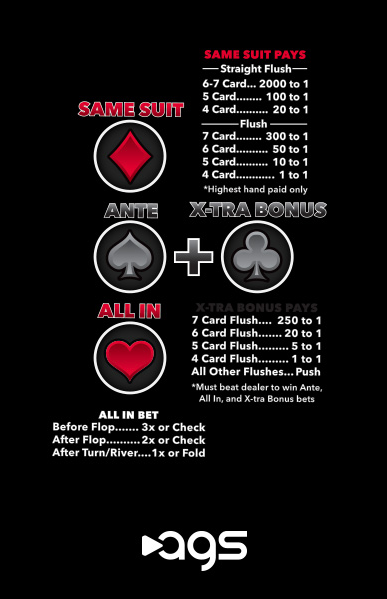
The Player wagers an Ante and equal X-Tra Bonus bet before the hand begins. Each Player and the Dealer receive three hole cards. A Player may wager a 3x All-In bet based on his hole cards, or he may check and see the two-card flop. The flop community cards are dealt, and a previously checking Player may now wager a 2x All-In bet, or check again. The final two community board cards are dealt, and a previously checking Player must now wager a 1x All-In bet, or else fold his hand.
Each Player and the Dealer forms the highest flush made from their three hole cards and the four card community board. The Dealer qualifies with a 3-card Nine-high flush or better. If the Dealer doesn’t qualify, the remaining Antes are pushed back to the Player. The qualified Antes and the All-In bet then receive even-money action against the Dealer hand. The Player must beat the Dealer to receive the X-Tra Bonus payout listed in the pay table. If the Dealer’s hand beats the Player’s hand, the X-Tra Bonus loses. All bets push on a tie.
The House Edge
The house advantage for the main Chase-the-Flush game is only 2.65% of an Ante. That’s very reasonable, and is comparable to the UTH house edge. The Basic Strategy yields a practical -2.80% return to the player. The Same Suit Bonus for the pay table in the above layout has a reasonable house edge of 5.67%.
Basic Strategy
I crafted out as simple a Basic Strategy as possible, in terms of how people intuitively view their hands during the game. The following strategy shows the betting conditions for each of the 3x (pre-flop), 2x (flop), and 1x (river) decision points. Check your hand for any of the betting requirements listed per decision point. If your hand doesn’t match any of the listed conditions for the decision point, then you shouldn’t bet it.
You can practice the game for free at the AGS website.
| Decision | Betting Requirements |
|---|---|
| 3x
(“pre-flop”) |
Pair Aces or Kings with minimum singleton:
AA.4+, KK.J+ |
| Three suited cards | |
| Suited Ace | |
| Suited King with minimum singleton:
KQs.3+, KJs.4+, KTs.5+, K9s.5+, K8s.6+, K7s.7+, K6s.7+, K5s.7+, K4s.7+, K3s.8+, K2s.8+ |
|
| Suited Queen with minimum singleton:
QJs.J+, QTs.J+, Q9s.J+, QXs.Q+ |
|
| Suited Jack with King+ singleton | |
| Suited Ten w/ Ace singleton | |
| Rainbow AK.7+, AQ.T+, AJ.J+ | |
| Check all others | |
| 2x
(“flop”) |
4-card flush or better |
| 3-card flush w/ 2-card flush using both board suits | |
| 3-card flush vs offsuit board | |
| 3-card qualifier using suited board with Six+ hole card | |
| Nut 2-card flush using hole A or K plus another 2-card flush | |
| Two 2-card flushes using board w/ Jack+ average hole cards | |
| Check all others | |
| 1x
(“river”) |
4-card flush or better |
| 3-card flush vs rainbow board | |
| 3-card flush using the 2 suited cards of a 3-suit board | |
| 3-card flush higher than suited cards of a 3-suit board | |
| 3-card qualifier higher than singleton of a 3-suit board | |
| 3-card flush against double-suited board w/ less than 15 one-card beats | |
| 2-card flush against rainbow board w/ less than 10 one-card beats | |
| Fold all others |
For optimal play, you’ll 3x raise about 23.8% of your hands, bet 2x on the flop about 24.9% of the time, 1x call on the river about 35.2% of the time, and otherwise fold about 16.1% of the time.
3x Pre-flop Examples
You should 3x Play any suited Ace. For example, Ac-2c-2d has a EV(3x) of +68.6% and an EV(check pre-flop) of +59.9%. So, it’s still worth +8.7% to 3x raise the hand instead of checking it.
You should 3x any pair of Aces with a Four or better kicker. However, the hand is only +EV for A-A-6 or higher.
You should 3x a suited King with a sufficiently high singleton (i.e., the offsuit card). For example, Kd-9d-6c has a EV(3x) of +45.2% and an EV(check pre-flop) of +43.3%, showing it’s slightly better to 3x raise the hand than check it.
You should 3x raise a rainbow AK, AQ, or AJ if the 3rd card is sufficiently high. This means you should 3x AK8o, AQTo, AJJo etc. You should check AK5o, AQ9o, AJTo, etc.
2x Flop Examples
The Basic Strategy bets almost all 3-card flushes on the flop. The only exception is when the board is suited, and you’re using a hole card less than a Six to make the flush, AND you don’t have another 2-card flush. Otherwise, you’re betting all other 3-card flushes (or better). For example, say you’re holding Kh-7d-5c and the flop is Ac-2c. You shouldn’t bet your 3-card flush, because your 5c kicker is less than a Six. Notice however, if you were instead holding Kh-7h-5c, you’d 2x Play your 3-card club flush with Five kicker, because you also have a two card Kh-7h flush.
You can 2x bet a 2-card “nut” flush when you have any another 2-card flush. For example, if you’re holding Ac-6d-5h and the flop is 5c 7d, you have the 2-card “nut” (i.e., highest possible) flush in clubs, along with another 2-card flush (7d-6d). You should 2x Play this hand, because one of your hole cards makes the “nut” 2-card flush with a board card, and your hand makes another 2-card flush. Note you shouldn’t bet your Ac-7d-6d hand with a board of 8c-Ah, because many single dealer heart cards (Nine or higher) beat your 2-card flush.
You can also bet two 2-card flushes that use both offsuit board cards with two hole cards averaging a Jack or higher. For example, you can 2x Play your Kh-Qs-2d when the board flops a heart and a spade.
1x River Examples
The Basic Strategy bets almost all 3-card flushes on the river. The only exception is when you’re playing a single small hole card to make your hand, and the board is double-suited. In most of these cases, there are 15 or more single dealer cards that’ll beat your hand.
Otherwise, if the board is rainbow, you’ll always 1x Play any 3-card flush.
If the board has only two cards of one suit, and you have any 3-card flush, there are always less than 15 single dealer cards that’ll beat your hand, so you’ll always 1x play any 3-card flush.
If the board has a 3-card flush on board, you’ll 1x Play the board since Basic Strategy says to always call when there are less than 15 single dealer cards that’ll beat your hand (there are only 10 remaining cards of the flush suit). However, you can get a little fancy, and fold if the board singleton is higher than the 3-card flush AND you don’t hold any cards of the singleton suit.
You can play a very high 2-card flush against a rainbow board if there are less than 10 single dealer cards that’ll beat your hand. This usually means you can play a very high 2-card flush using the highest board card if it’s not paired on board. For example, if the board is 9s-7h-6d-5c, you can 1x Play a Kh in the hole, since the only single dealer cards that will beat your Kh-7h is an As, Ks, Ah, Ad, Ac (5 of them).
Same Suit Bonus
While straight flushes don’t have any meaning in the main game, they are included in the pay table (along with 4+ card regular flushes) in the optional Same Suit Bonus bet. The resulting payouts are very attractive, and add a nice dimension to the game. The breakdown of the 7-card hand outcomes is listed in the table below, and show a total house edge of 5.67% (good as far as bonuses go).
| Outcome | Combinations | Frequency | Payout | Return |
|---|---|---|---|---|
| 6-or-7 Card Straight Flush | 1,624 | 0.000012 | 2000 | 0.024278 |
| 5 Card Straight Flush | 39,312 | 0.000294 | 100 | 0.029385 |
| 4 Card Straight Flush | 636,272 | 0.004756 | 20 | 0.095119 |
| 7 Card Flush | 6,664 | 0.000050 | 300 | 0.014899 |
| 6 Card Flush | 256,620 | 0.001918 | 50 | 0.095908 |
| 5 Card Flush | 3,550,872 | 0.026542 | 10 | 0.265417 |
| 4 Card Flush | 25,735,424 | 0.192365 | 1 | 0.192365 |
| Nothing | 103,557,792 | 0.774064 | -1 | -0.774064 |
| Total | 133,784,560 | 1.000000 | -0.056694 |
Optimal Play Statistics
The following table breaks down the total outcomes for the main Chase-the-Flush game, over all possible starting hands, using optimal decisions. The total return in the lower right corner shows a house edge of 2.65% of the Ante.
| Outcome | Combinations | Frequency | Net | Return |
| Win 3x Play w/ 7-card flush against qualified dealer |
20,439,619,200 |
0.000051 |
204 |
0.010459 |
| Win 3x Play w/ 6-card flush against qualified dealer |
534,992,418,432 |
0.001342 |
24 |
0.032207 |
| Win 3x Play w/ 5-card flush against qualified dealer |
4,296,578,849,136 |
0.010777 |
9 |
0.096997 |
| Win 3x Play w/ 4-card flush against qualified dealer |
16,130,726,914,176 |
0.040462 |
5 |
0.202309 |
| Win 3x Play w/ 3-card flush against qualified dealer |
16,796,416,174,704 |
0.042132 |
4 |
0.168527 |
| Lose 3x Play against qualified dealer |
30,809,847,740,400 |
0.077283 |
-5 |
-0.386413 |
| Push 3x Play against qualified dealer |
2,751,669,318,312 |
0.006902 |
0 |
0.000000 |
| Win 3x Play w/ 6-card flush against unqualified dealer |
24,404,889,600 |
0.000061 |
23 |
0.001408 |
| Win 3x Play w/ 5-card flush against unqualified dealer |
1,075,217,004,000 |
0.002697 |
8 |
0.021576 |
| Win 3x Play w/ 4-card flush against unqualified dealer |
6,377,470,048,800 |
0.015997 |
4 |
0.063988 |
| Win 3x Play w/ 3-card flush against unqualified dealer |
12,970,988,479,440 |
0.032536 |
3 |
0.097608 |
| Win 3x Play w/ 2-card flush against unqualified dealer |
1,600,580,385,168 |
0.004015 |
3 |
0.012045 |
| Lose 3x Play against unqualified dealer |
1,162,087,560,552 |
0.002915 |
-4 |
-0.011660 |
| Push 3x Play against unqualified dealer |
478,678,665,600 |
0.001201 |
0 |
0.000000 |
| Win 2x Play w/ 6-card flush against qualified dealer |
227,291,635,008 |
0.000570 |
23 |
0.013113 |
| Win 2x Play w/ 5-card flush against qualified dealer |
4,704,150,904,080 |
0.011800 |
8 |
0.094398 |
| Win 2x Play w/ 4-card flush against qualified dealer |
21,499,155,021,948 |
0.053928 |
4 |
0.215712 |
| Win 2x Play w/ 3-card flush against qualified dealer |
14,714,103,160,440 |
0.036908 |
3 |
0.110725 |
| Lose 2x Play against qualified dealer |
32,751,544,964,688 |
0.082153 |
-4 |
-0.328613 |
| Push 2x Play against qualified dealer |
622,124,227,116 |
0.001561 |
0 |
0.000000 |
| Win 2x Play w/ 5-card flush against unqualified dealer |
187,837,403,616 |
0.000471 |
7 |
0.003298 |
| Win 2x Play w/ 4-card flush against unqualified dealer |
6,488,002,635,144 |
0.016274 |
3 |
0.048823 |
| Win 2x Play w/ 3-card flush against unqualified dealer |
16,304,458,158,816 |
0.040898 |
2 |
0.081795 |
| Win 2x Play w/ 2-card flush against unqualified dealer |
987,169,878,672 |
0.002476 |
2 |
0.004952 |
| Lose 2x Play against unqualified dealer |
710,513,189,700 |
0.001782 |
-3 |
-0.005347 |
| Push 2x Play against unqualified dealer |
79,383,252,492 |
0.000199 |
0 |
0.000000 |
| Win 1x Play w/ 5-card flush against qualified dealer |
393,192,506,064 |
0.000986 |
7 |
0.006904 |
| Win 1x Play w/ 4-card flush against qualified dealer |
10,828,061,228,676 |
0.027161 |
3 |
0.081482 |
| Win 1x Play w/ 3-card flush against qualified dealer |
20,718,789,206,988 |
0.051970 |
2 |
0.103941 |
| Lose 1x Play against qualified dealer |
68,485,489,408,332 |
0.171787 |
-3 |
-0.515362 |
| Push 1x Play against qualified dealer |
7,086,006,696,552 |
0.017774 |
0 |
0.000000 |
| Win 1x Play w/ 5-card flush against unqualified dealer |
5,385,180,384 |
0.000014 |
6 |
0.000081 |
| Win 1x Play w/ 4-card flush against unqualified dealer |
1,985,444,394,456 |
0.004980 |
2 |
0.009960 |
| Win 1x Play w/ 3-card flush against unqualified dealer |
26,514,857,520,000 |
0.066509 |
1 |
0.066509 |
| Win 1x Play w/ 2-card flush against unqualified dealer |
1,746,004,992,372 |
0.004380 |
1 |
0.004380 |
| Lose 1x Play against unqualified dealer |
2,094,365,166,192 |
0.005253 |
-2 |
-0.010507 |
| Push 1x Play against unqualified dealer |
362,165,402,664 |
0.000908 |
0 |
0.000000 |
| folds |
64,139,016,142,080 |
0.160885 |
-2 |
-0.321769 |
| total |
398,664,610,344,000 |
1.000000 |
-0.026470 |
|
| expected |
398,664,610,344,000 |
Ultimate Casino War
 I saw this new variant of Casino War at Barona Casino, where they player gets an option to swap his card and make a 1x Raise bet. Of course, the catch is the dealer gets two cards, and gets to use the highest one. I wanted to see what the strategy and house edge were, and to check if it was at all countable out of the One-2-Six CSM they use.
The rules are pretty simple. You’re dealt one card face up, and the dealer is dealt two cards face down. The dealer will use his highest card. You have the option to replace your card with the next card out of the shoe (CSM), but you must wager an additional 1x bet to do make this swap. Finally, you may wager an optional 1x Raise on your final hand.
The dealer reveals his hand, and all your bets receive action against the dealer high card. Wins win a Six or lower pay 2:1, else it pays even-money. Ties push, and there’s no “going to War”.
For a 6-deck CSM game, the house edge is a fair 2.56%.
The basic strategy is pretty simple. You should swap an Eight or lower card. You should Raise a Jack or higher final card.
I checked the countability in a CSM by assuming perfect play given 16 known cards before every hand. The EV barely changes by +/- 0.3%, and thus is never +EV.
| Outcome | Combinations | Frequency | Net | Return |
|---|---|---|---|---|
| Win 3x bet with drawn A | 165,477,312 | 0.035607 | 3 | 0.106820 |
| Win 3x bet with drawn K | 138,914,496 | 0.029891 | 3 | 0.089673 |
| Win 3x bet with drawn Q | 114,674,112 | 0.024675 | 3 | 0.074026 |
| Win 3x bet with drawn J | 92,756,160 | 0.019959 | 3 | 0.059877 |
| Lose 3x bet with drawn card | 163,441,152 | 0.035169 | -3 | -0.105506 |
| Tie 3x bet with drawn card | 97,187,328 | 0.020912 | 0 | 0.000000 |
| Win 2x bet with drawn T | 73,160,640 | 0.015742 | 2 | 0.031485 |
| Win 2x bet with drawn 9 | 55,887,552 | 0.012026 | 2 | 0.024051 |
| Win 2x bet with drawn 8 | 40,772,160 | 0.008773 | 2 | 0.017546 |
| Win 2x bet with drawn 7 | 28,274,400 | 0.006084 | 2 | 0.012168 |
| Win 2x bet with drawn 6 | 18,057,600 | 0.003886 | 4 | 0.015542 |
| Win 2x bet with drawn 5 | 10,121,760 | 0.002178 | 4 | 0.008712 |
| Win 2x bet with drawn 4 | 4,466,880 | 0.000961 | 4 | 0.003845 |
| Win 2x bet with drawn 3 | 1,092,960 | 0.000235 | 4 | 0.000941 |
| Lose 2x bet with drawn card | 1,409,976,288 | 0.303394 | -2 | -0.606788 |
| Tie 2x bet with drawn card | 88,157,160 | 0.018969 | 0 | 0.000000 |
| Win 2x bet with original A | 306,488,448 | 0.065949 | 2 | 0.131898 |
| Win 2x bet with original K | 257,453,856 | 0.055398 | 2 | 0.110796 |
| Win 2x bet with original Q | 212,690,880 | 0.045766 | 2 | 0.091532 |
| Win 2x bet with original J | 172,199,520 | 0.037053 | 2 | 0.074107 |
| Lose 2x bet with original card | 301,682,880 | 0.064915 | -2 | -0.129830 |
| Tie 2x bet with original card | 179,437,536 | 0.038611 | 0 | 0.000000 |
| Win 1x bet with original T | 135,979,776 | 0.029260 | 1 | 0.029260 |
| Win 1x bet with original 9 | 104,031,648 | 0.022385 | 1 | 0.022385 |
| Lose 1x bet with original card | 409,808,160 | 0.088181 | -1 | -0.088181 |
| Tie 1x bet with original card | 65,156,976 | 0.014020 | 0 | 0.000000 |
| Total | 4,647,347,640 | 1.000000 | -0.0256406 | |
| Expected | 4,647,347,640 |
According to Dan Lubin, there’s a version that pays 2:1 for a win with a Six, 3:1 for a win with a Five, 5:1 for a win with a Four, and 8:1 for a win with a Trey. For a 6-deck game, these payouts reduce the house edge to 1.27%. The basic strategy remains the same. Still, the game never gets +EV with only 16 known cards.
| Outcome | Combinations | Frequency | Net | Return |
|---|---|---|---|---|
| Win 3x bet with drawn A | 165,477,312 | 0.035607 | 3 | 0.106820 |
| Win 3x bet with drawn K | 138,914,496 | 0.029891 | 3 | 0.089673 |
| Win 3x bet with drawn Q | 114,674,112 | 0.024675 | 3 | 0.074026 |
| Win 3x bet with drawn J | 92,756,160 | 0.019959 | 3 | 0.059877 |
| Lose 3x bet with drawn card | 163,441,152 | 0.035169 | -3 | -0.105506 |
| Tie 3x bet with drawn card | 97,187,328 | 0.020912 | 0 | 0.000000 |
| Win 2x bet with drawn T | 73,160,640 | 0.015742 | 2 | 0.031485 |
| Win 2x bet with drawn 9 | 55,887,552 | 0.012026 | 2 | 0.024051 |
| Win 2x bet with drawn 8 | 40,772,160 | 0.008773 | 2 | 0.017546 |
| Win 2x bet with drawn 7 | 28,274,400 | 0.006084 | 2 | 0.012168 |
| Win 2x bet with drawn 6 | 18,057,600 | 0.003886 | 4 | 0.015542 |
| Win 2x bet with drawn 5 | 10,121,760 | 0.002178 | 6 | 0.013068 |
| Win 2x bet with drawn 4 | 4,466,880 | 0.000961 | 10 | 0.009612 |
| Win 2x bet with drawn 3 | 1,092,960 | 0.000235 | 16 | 0.003763 |
| Lose 2x bet with drawn card | 1,409,976,288 | 0.303394 | -2 | -0.606788 |
| Tie 2x bet with drawn card | 88,157,160 | 0.018969 | 0 | 0.000000 |
| Win 2x bet with original A | 306,488,448 | 0.065949 | 2 | 0.131898 |
| Win 2x bet with original K | 257,453,856 | 0.055398 | 2 | 0.110796 |
| Win 2x bet with original Q | 212,690,880 | 0.045766 | 2 | 0.091532 |
| Win 2x bet with original J | 172,199,520 | 0.037053 | 2 | 0.074107 |
| Lose 2x bet with original card | 301,682,880 | 0.064915 | -2 | -0.129830 |
| Tie 2x bet with original card | 179,437,536 | 0.038611 | 0 | 0.000000 |
| Win 1x bet with original T | 135,979,776 | 0.029260 | 1 | 0.029260 |
| Win 1x bet with original 9 | 104,031,648 | 0.022385 | 1 | 0.022385 |
| Lose 1x bet with original card | 409,808,160 | 0.088181 | -1 | -0.088181 |
| Tie 1x bet with original card | 65,156,976 | 0.014020 | 0 | 0.000000 |
| Total | 4,647,347,640 | 1.000000 | -0.0126955 | |
| Expected | 4,647,347,640 |
DJ Wild Poker
 DJ Wild is a new “deuces wild” poker game against the dealer, using a standard 52-card deck plus one additional Joker. The game is pretty simple, where you wager an Ante and equal Blind bet before receiving a five card hand. You then decide to either 2x Play the hand, or fold. The Dealer also receives a five card hand, and always qualifies. The Ante and Play bets receive even money action against the Dealer hand, but the Blind only pays for a straight or better. The Blind pays nice odds for rare hands, but only pays about 6% of your hands.
The full analysis of the game shows a house edge of about 3.5% of an Ante.
When I first looked at this game, it looked like easy pickings for a table full of colluding advantage players. The confederates would silently share the number of Deuces or Jokers they held in their hands (using simple chip signaling). The whole table would know the number of outstanding Wild cards seen. Each player would 2x Play if they had better than the minimum hand needed for the given Wild count. It looked like the game was toast.
So, I quickly coded it all up to find the theoretical 6-way collusion edge. I was shocked to find that even perfect info sharing only yielded +0.5% between 6 players. You’d expect more of an edge on a perfect 2x Play decision and the always-qualifying Ante. Plus, you get the chance to “save” the Blind bet with a weak hand when the Wild count is high.
Anyways, I worked out a simple 6-way collusion strategy, just in case it turned out to be slighly +EV. The strategy just uses separate minimum calling hands for each Wild count (0 thru 5). The strategy below only decreases the house edge to 1.1%.
| Wild Count | Minimum Play Hand |
|---|---|
| 0 | Pair Jacks |
| 1 | Pair Nines |
| 2 | Pair Sevens |
| 3 | Pair Fours |
| 4 | Ace-King high |
| 5 | Ace high |
Well, at least we know now. No one needs to lose any sleep over this game.
Arizona Stud @ Red Wind Casino, WA
 Arizona Stud is a new poker-based table game debuting at the Red Wind Casino in Olympia, WA next week (6 Aug 2014). In this game, both the Dealer and the player each receive three hole cards. The player must discard one of his hole cards before the flop, while the Dealer must use exactly two hole cards to make a hand. After the player discards, he may wager a Play bet of 2x-4x the Ante, or check pre-flop. The two card flop is then revealed, as well as one of the Dealer’s hole cards. If the player checked pre-flop, he must then make a 1x Play bet, or fold. Finally, the community river card and all Dealer hole cards are revealed. The Dealer qualifies with a hand of AK-high or better. The Ante pushes if the Dealer doesn’t qualify. The Play bet always receives even-money action against the Dealer hand.
The set of all possible outcomes for the optimal player is listed in the table below. The total in the lower right corner shows a house edge of 1.34% of the Ante. Note that you should either 4x bet pre-flop, or check. You should never only bet 2x.
| Outcome | Combinations | Frequency | Net | Return |
|---|---|---|---|---|
| Win 4x Play w/ ROYAL_FLUSH against qualified dealer | 59,240,916 | 0.000001 | 5 | 0.000005 |
| Win 4x Play w/ FULL_HOUSE against qualified dealer | 89,284,476,240 | 0.001605 | 5 | 0.008025 |
| Win 4x Play w/ FLUSH against qualified dealer | 10,295,059,284 | 0.000185 | 5 | 0.000925 |
| Win 4x Play w/ STRAIGHT against qualified dealer | 13,761,723,420 | 0.000247 | 5 | 0.001237 |
| Win 4x Play w/ THREE_OF_A_KIND against qualified dealer | 674,048,087,712 | 0.012117 | 5 | 0.060586 |
| Win 4x Play w/ TWO_PAIRS against qualified dealer | 1,233,004,030,272 | 0.022165 | 5 | 0.110827 |
| Win 4x Play w/ ONE_PAIR against qualified dealer | 3,533,244,131,304 | 0.063516 | 5 | 0.317580 |
| Win 4x Play w/ HIGH_CARD against qualified dealer | 44,095,696,596 | 0.000793 | 5 | 0.003963 |
| Lose 4x Play against qualified dealer | 5,323,636,585,296 | 0.095701 | -5 | -0.478507 |
| Push 4x Play against qualified dealer | 90,869,346,720 | 0.001634 | 0 | 0.000000 |
| Win 4x Play w/ ROYAL_FLUSH against unqualified dealer | 20,545,164 | 0.000000 | 4 | 0.000001 |
| Win 4x Play w/ FLUSH against unqualified dealer | 4,736,232,972 | 0.000085 | 4 | 0.000341 |
| Win 4x Play w/ STRAIGHT against unqualified dealer | 5,959,832,148 | 0.000107 | 4 | 0.000429 |
| Win 4x Play w/ THREE_OF_A_KIND against unqualified dealer | 350,836,147,584 | 0.006307 | 4 | 0.025227 |
| Win 4x Play w/ TWO_PAIRS against unqualified dealer | 28,557,204,480 | 0.000513 | 4 | 0.002053 |
| Win 4x Play w/ ONE_PAIR against unqualified dealer | 2,530,675,447,344 | 0.045493 | 4 | 0.181973 |
| Win 4x Play w/ HIGH_CARD against unqualified dealer | 1,146,771,919,728 | 0.020615 | 4 | 0.082461 |
| Lose 4x Play against unqualified dealer | 25,248,339,684 | 0.000454 | -4 | -0.001816 |
| Push 4x Play against unqualified dealer | 25,026,495,696 | 0.000450 | 0 | 0.000000 |
| Win 1x Play w/ ROYAL_FLUSH against qualified dealer | 94,841,496 | 0.000002 | 2 | 0.000003 |
| Win 1x Play w/ STRAIGHT_FLUSH against qualified dealer | 541,732,152 | 0.000010 | 2 | 0.000019 |
| Win 1x Play w/ FOUR_OF_A_KIND against qualified dealer | 6,309,658,080 | 0.000113 | 2 | 0.000227 |
| Win 1x Play w/ FULL_HOUSE against qualified dealer | 45,729,841,680 | 0.000822 | 2 | 0.001644 |
| Win 1x Play w/ FLUSH against qualified dealer | 51,704,956,552 | 0.000929 | 2 | 0.001859 |
| Win 1x Play w/ STRAIGHT against qualified dealer | 90,255,233,808 | 0.001622 | 2 | 0.003245 |
| Win 1x Play w/ THREE_OF_A_KIND against qualified dealer | 591,850,723,248 | 0.010640 | 2 | 0.021279 |
| Win 1x Play w/ TWO_PAIRS against qualified dealer | 1,068,681,540,840 | 0.019211 | 2 | 0.038423 |
| Win 1x Play w/ ONE_PAIR against qualified dealer | 4,443,972,518,832 | 0.079888 | 2 | 0.159776 |
| Win 1x Play w/ HIGH_CARD against qualified dealer | 188,023,085,280 | 0.003380 | 2 | 0.006760 |
| Lose 1x Play against qualified dealer | 10,848,202,319,420 | 0.195015 | -2 | -0.390029 |
| Push 1x Play against qualified dealer | 161,798,077,992 | 0.002909 | 0 | 0.000000 |
| Win 1x Play w/ ROYAL_FLUSH against unqualified dealer | 14,941,584 | 0.000000 | 1 | 0.000000 |
| Win 1x Play w/ STRAIGHT_FLUSH against unqualified dealer | 220,863,744 | 0.000004 | 1 | 0.000004 |
| Win 1x Play w/ FLUSH against unqualified dealer | 23,880,526,848 | 0.000429 | 1 | 0.000429 |
| Win 1x Play w/ STRAIGHT against unqualified dealer | 48,873,031,380 | 0.000879 | 1 | 0.000879 |
| Win 1x Play w/ THREE_OF_A_KIND against unqualified dealer | 34,291,273,536 | 0.000616 | 1 | 0.000616 |
| Win 1x Play w/ TWO_PAIRS against unqualified dealer | 301,557,935,124 | 0.005421 | 1 | 0.005421 |
| Win 1x Play w/ ONE_PAIR against unqualified dealer | 3,348,961,937,952 | 0.060203 | 1 | 0.060203 |
| Win 1x Play w/ HIGH_CARD against unqualified dealer | 2,842,212,690,936 | 0.051094 | 1 | 0.051094 |
| Lose 1x Play against unqualified dealer | 1,090,180,312,308 | 0.019598 | -1 | -0.019598 |
| Push 1x Play against unqualified dealer | 100,426,510,008 | 0.001805 | 0 | 0.000000 |
| folds | 15,186,972,477,600 | 0.273011 | -1 | -0.273011 |
| total | 55,627,620,048,000 | 1.000000 | -0.013402 | |
| expected | 55,627,620,048,000 |
The basic strategy for the game is listed in the table below, which returns a 1.70% house edge. The player should 4x his hand about 27% of the time, 1x call about 46% of the time, and fold the remaining 27% of the time.
The game looks like fun. The strategy is actually pretty simple, but you get to make the occasional decision. I’ll actually be in Seattle next week (my first time), so I’ll try to check out the game. Maybe I could hit a nice bad beat for once.
| Decision | Strategy |
|---|---|
| discard | Hold pair, else hold two highest cards. Advanced exception: hold highest and lowest cards when suited, AND highest two cards aren’t suited, AND highest card is Eight or better, AND middle card is Six or lower, AND lowest card is only one rank below middle card. |
| 4x / check | 4x raise any pair, else 4x raise suited Ace and Nine or better, else 4x raise Ace and Ten or better, else check. |
| 1x / fold | 1x call three-of-a-kind, else 1x call any pair beating the dealer by more than a kicker, else 1x call same pair as dealer plus Ten or better kicker, else 1x call open-ended straight flush draw, else 1x call flush draw or any straight draw when beating the dealer, else 1x call flush draw or open-ended straight draw when dealer has no pair, else 1x call with higher hand (Jack or better kicker), else fold all others. |
The optional 2 Pair Plus Bonus bet pays for the final hand made by the player. The house edges for the various offered paytables are listed below.
| Player Hand | Paytable A | Paytable B | Paytable C | Paytable D |
|---|---|---|---|---|
| Royal Flush | 500-to-1 | 500-to-1 | 500-to-1 | 500-to-1 |
| Straight Flush | 200-to-1 | 200-to-1 | 200-to-1 | 200-to-1 |
| Four-of-a-Kind | 100-to-1 | 100-to-1 | 100-to-1 | 80-to-1 |
| Full House | 50-to-1 | 50-to-1 | 40-to-1 | 40-to-1 |
| Flush | 30-to-1 | 25-to-1 | 30-to-1 | 30-to-1 |
| Straight | 20-to-1 | 20-to-1 | 20-to-1 | 20-to-1 |
| Three-of-a-Kind | 6-to-1 | 6-to-1 | 6-to-1 | 6-to-1 |
| Two Pairs | 4-to-1 | 4-to-1 | 4-to-1 | 4-to-1 |
| others | lose | lose | lose | lose |
| House Edge | 3.03% | 5.12% | 5.53% | 6.58% |
The Player Bad Beat Bonus bet pays when a player’s Jacks-or-Better hand is beat by the Dealer. The following table shows the optimal outcomes for the strategy maximizing the Bad Beat Bonus return. The house edge for the optimal Bad Beat Bonus strategy is 8.00%.
| Player Beat Hand | Combinations | Frequency | Payout | Return |
|---|---|---|---|---|
| Straight Flush | 142,560 | 0.000000 | 1000 | 0.000008 |
| Full House | 1,324,642,176 | 0.000071 | 500 | 0.035719 |
| Flush | 2,719,437,696 | 0.000147 | 300 | 0.043998 |
| Staight | 1,597,456,728 | 0.000086 | 200 | 0.017230 |
| Three-of-a-Kind | 49,285,841,520 | 0.002658 | 30 | 0.079740 |
| Two Pairs | 257,968,615,536 | 0.013912 | 20 | 0.278245 |
| Jacks-or-Better | 923,384,598,264 | 0.049798 | 8 | 0.398385 |
| other | 17,306,259,281,520 | 0.933327 | -1 | -0.9333273 |
| total | 18,542,540,016,000 | 1.000000 | -0.080002 |
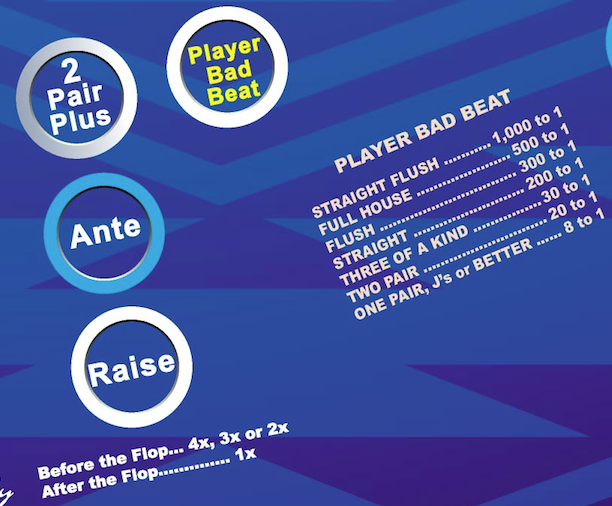







leave a comment