Session Outcome Distributions for 5x Card Craps
I wanted to know what kind of variance to expect during my card craps sessions playing 5x Don’t Pass odds with a 3 roll window. So I calculated the cumulative distributions for a few strategies, based on a 100 bet bankroll (e.g., $500 @ $5 min Don’t Pass bet), a +100 bet goal (quit if double up), and a 200 game session limit (might take hours). I used simulations to find the probability density function for a single game (hand) of craps, then convolved it the number of session hands (given bankroll and goal) to get the final session distribution. Finally, I plotted the cumulative distribution function, since it’s easier to read for gambling purposes.

Card Craps Session Outcome Distributions
First, I compared regular dice to card craps, both laying 5x DP odds every roll. As the two curves show, they’re very similar, although the card craps game (magenta, -0.1%) returns better than normal dice (red, -1.36%). In both cases, you have more than a 20% chance of busting out (e.g., -$500 @ $5 pass line bet) or doubling up. (If you closely compare the dice and card curves, you’ll see the cards have almost an equal chance of busting out or doubling up, while the dice show a bias towards busting out.)
Next, I found that card craps performs equally well laying 5x odds with a 3-roll window or a 6-roll window. This is a nice find, since it’s pretty easy to implement the 3-roll windowed count, but practically impossible to count with a 6-roll window. [If you look closely, the 6-roll window (green) performs a little better than the 3-roll window (blue)]. The session distribution function shows about a 12% chance of busting out or doubling up. If you see where the cumulative distributions cross 50%, you’ll see that the card craps games are slightly +EV, and the dice game is of course -EV.
Not surprisingly, playing 5x DP odds with card craps has less variance than actual dice. This results mostly from the lower average bet (4.56 units/roll) for a 3-roll window, compared to dice (6.37 units/roll).
Having calculated this cumulative distribution function, I’ll probably play 5x DP with a 3-roll count, and grind out the player reward points. That’s probably the best reason to play, because you’ll easily make the Elite membership level, with it’s $20/day Free Play award. You’ll also probably make more in reward points (1 point = 1 cent) at the game than in +EV (maybe $0.005/roll). Of course, there’s always the satisfaction of beating the house, whatever that’s worth to you.
Simplified Card Craps Counting
Lately, I’ve been drawn back to the card craps (PlayCraps™) game at my local Viejas Casino, mostly because I’m willing to lay more odds now with my newfound bankroll. They’ve changed the constant shuffle machine (CSM) to the ShuffleMaster® 126 model, which has a lot more internal slots than the previous shuffler. I thought this might hurt the don’t pass advantage, but I updated my simulator parameters (now 40 slots, and 312 cards) and the results remained as good as before. Most importantly, I added a MIN_RESERVOIR_DEPTH parameter, which is the minimum number of cards in the chute (reservoir) before the CSM drops another slot. I set it to 5 cards, and experimented with various counting window depths, and max odds to find a strategy I was comfortable with.
I found that a window size between 3 and 6 rolls prior rolls didn’t make much of a difference. This was a nice result, because it’s practically impossible to remember more than two prior rolls, and the management won’t let me record rolls with paper and pen anymore 😦 I also found that laying 5x odds is enough to gain about +0.25% over the house. (10x odds yields an 1.8% edge.) Again, this is nice, because 5x is the limit of my comfort zone. So, I’ll bet $5 on the Don’t Pass line, and use a 3-roll window to determine when to lay 5x odds.
| Point | Roll Values | Lay Conditions | Notes |
|---|---|---|---|
| 4 | +4 if both die <= 3 (“low”) -4 if both die >= 4 (“high”) 0 otherwise (“neutral”) |
count >= 0 in last 3 rolls |
Lay when #(low rolls) >= #(high rolls) in window. |
| 5 | -4 if both die 5 or 6 (“ugly”) -1 if one die 5 or 6 (“bad”) +2 otherwise (“good”) |
count > 0 in last 3 rolls |
Lay if two of last three rolls are “good”. (Two “good” + one “ugly” = no edge.) |
| 6 | -5 if boxcars (“ugly”) -2 if one die 6 (“bad”) +1 otherwise (“good”) |
count >= 0 in last 3 rolls |
Lay if at most one “bad” roll in last 3. (At most one six-spot in last 3 rolls.) |
8 | -5 if snake-eyes (“ugly”) -2 if one Ace (“bad”) +1 otherwise (“good”) |
count >= 0 in last 3 rolls |
Lay if at most one “bad” roll in last 3. (At most one Ace in last 3 rolls.) |
| 9 | -4 if both die 1 or 2 (“ugly”) -1 if one die 1 or 2 (“bad”) +2 otherwise (“good”) |
count > 0 in last 3 rolls |
Lay if two of last three rolls are “good”. (Two “good” + one “ugly” = no edge.) |
| 10 | +4 if both die >= 4 (“high”) -4 if both die <= 3 (“low”) 0 otherwise (“neutral”) |
count >= 0 in last 3 rolls |
Lay when #(high rolls) >= #(low rolls) in window. |
Note that a simple counting scheme emerges from the roll types (“good”, “bad”, “ugly”) and the small window. The 4/10 are very easy to play (i.e., know when to lay DP odds). A neutral count for the 4/10 still yield a +0.15% DP odds edge. If the count gets to +12 (e.g., all three rolls “low”), the DP odds edge averages about +0.5%.
The 5/9 points also work out easily. You need 2 out of the last 3 rolls to be “good”. If there’s one “ugly” roll (-4) and two “good” rolls (+2) in the window, you’re DP odds are neutral. The 5/9 points are “fair” in that a neutral count yields no bias against the point. If all three rolls in the window are “good”, then your +6 count yields about a +0.2% DP odds edge. If you have two “good” rolls (+2), and one “bad” roll (-1) in the window, the +3 count yields about a +0.1% DP odds edge.
Finally, the 6/8 points are very easy to play as well. If two of the last three rolls are “good” (+1) and one is “bad” (-2), the neutral count still yields a DP odds edge of +0.1%. If all three rolls are “good”, the +3 count yields a DP odds edge +0.2%.
You don’t have to worry about being perfectly exact on all your counts. Usually, when I play, I pay attention to how the previous hand ended. That way, I know the roll before the come-out. The important thing is to have an adequate bankroll, and the will to lay against all points when the count is good. You’ll find that things average out well, and a game is enjoyable with enough bankroll and a +0.25% (@ 5x) tailwind.
(Was) Best Promotion Ever @ Viejas!
I just enjoyed a month of free money from my local Viejas Casino, where they offered a “Hot Hand Bonus” on table games during selected times in July. They intended to give away these prizes (up to 720 envelopes from $20 to $100) fairly to players at their table games. However, they overlooked an angle that allowed me (and my friends) to collect the majority of them. While they didn’t give away all the prizes, and I didn’t take advantage of every opportunity, I still collected approx. $7000 of prize money (plus $2500 from a Royal Flush!). I can get used to this kind of winning, but this type of vulnerable “promotion” doesn’t come along very often.
They tried to fairly balance the prizes between the different table games by making the cost per prize (in house edge) the same. So they gave a prize (an envelope containing from $20 to $100) for the following Hot Hands:
- 7-7-7 or 6-7-8 in Blackjack, min $10 bet
- straight or better in Three Card Poker, min $10 Ante
- trips or better in Four Card Poker, min $10 Ante
- win with As in Casino War, min $10 bet
- $5 Ace-Deuce or `Yo in craps
- etc.
The average house edge per Hot Hand varies between $8.50 – $12.50 per hand, so with a minimum prize of $20, they’re all +EV. However, when you take into account the speed of the game, and the fact that there are only 45 prizes/shift for the morning and swing shifts, it becomes obvious to play craps for the prizes. At Viejas, the craps table is often empty, and one morning during the promotion, I had the table to myself. I simply played $5 Ace-Deuce and $5 `Yo each roll, as fast as possible. It didn’t take much more than an hour for me to win all 45 prizes, and net a $1650 profit, after $275 in dealer tokes. The poor floor supervisor had to write my name, player card number, table, hand, and drawn prize in a log book each time I hit a Hot Hand (Ace-Deuce or `Yo). Luckily, they could just use the quote symbol all down the page.
I was really shocked that they didn’t change the rules of the promotion after that incident. After all, they did change the rules mid-promotion after my friend and I cleaned out all the Hot Hand bonuses on the craps game when the requirement was any $10 hard way bet. (We bet each hardway $10, every roll.) The following week they changed the rules to a $5 Ace-Deuce and `Yo. Of course, this just made things easier, because it kept the average cost per prize the same ($10/prize), but greatly reduced the variance ($10 risk per roll, compared to $40 risk per roll)! Anyway, they didn’t change the rules a second time, probably because they realised the promotion was about to end, and they’d fix it the next time. So yesterday was the last day of the promotion, and I won $900 and $800 from the craps Hot Hands during the morning and swing shifts, respectively. I didn’t get all the prizes, because someone would occasionally bet with me and win a prize, or prizes went to other tables.
This was the best promotion ever. It’ll never happen again, at least not at Viejas. Since the average prize was somewhere around $40, that’s like a $5 Ace-Deuce or `Yo bet paying (15+8)-to-1. Normally, this bet pays 15-to-1, where 17-to-1 are true odds. It’s pretty easy to see how the Ace-Deuce and `Yo paying 23-to-1 is heavily in your favor. Still, I was the only one doing it, because the variance is high enough to scare people off. All they see is me betting $10 per hand, and only occasionally hitting. They just see me throwing $10 at the dealer every roll to put my bet back up, which is lightning fast in a heads-up CSM card craps game. If you don’t have a deep enough bankroll, you can go bust quickly. (It unfortunately did happen to a player who reads this blog, when no Ace-Deuce or `Yo came out for almost 20 rolls.)
Betting Bottom Pair on Flop (UTH)
In Ultimate Texas Hold’Em (UTH), I wondered if it was ever worth checking bottom pair on the flop (basic strategy says to 2x bet), given other player hand info. E.g., if none of the other 5 players paired the board, should you check bottom pair? I ran simulations to compare the value of 2x betting bottom pair, vs. checking on a 6 player table.
| Total table board hits (excluding bottom pair) | ||||||
|---|---|---|---|---|---|---|
| 0 | 1 | 2 | 3 | 4 | 5 | 6 |
| +10% | +15% | +20% | +25% | +30% | +35% | +40% |
This shows that even if no one else hits middle or top pair on the board (i.e., players are holding 10 cards that don’t hit middle or top board cards), it’s still worth 10% of the Ante to 2x bet bottom pair on the flop, compared to checking. It was useful to see these results, because it shows the value of the other players hitting the board, as expected. I wasn’t sure about betting bottom pair when everyone else missed, but the simulations show its still a good bet.
Collusion Performance for Ultimate Texas Hold’Em
I finally got around to simulating the effects of player collusion in Ultimate Texas Hold’Em. Implementing preflop collusion, and the improved 2nd nut kicker and 3rd nut kicker strategies, the house edge is reduced from 2.2% to 1.6% for 6 players. While this is a small average gain, the real benefit comes from the reduced variance gained by not raising marginal hands when copied with other players.
By checking marginal copied hands, the session outcome distribution improves as shown below. Assuming a bankroll of 200 Antes, a goal of 20 Antes, and a maximum session length of 250 hands, the improved strategy reduces the probability of busting out from .20% down to .13%. The probability of reaching your 20 Ante win is reduced from 69% to 68%, but the distribution for the in-between cases improves as shown.
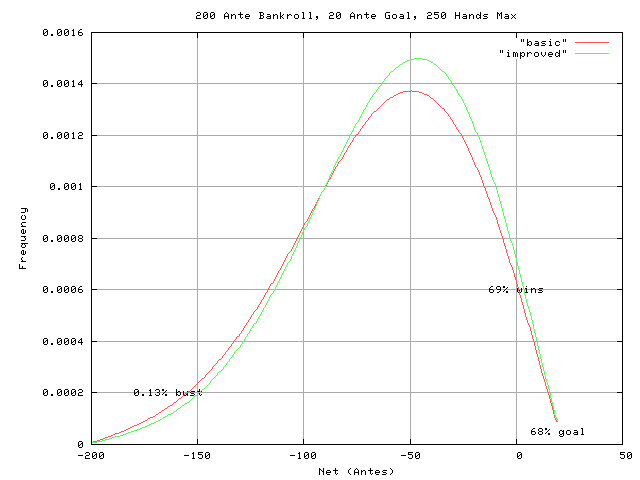
Session outcome probabilities for 200 Ante bankroll, 20 Ante goal, 250 max hands.
[Note: the low-variance strategy used for the distribution does not raise any basic strategy preflop checking hands; it is designed to minimize variance, and simulates at 2.2% house edge.]
3rd Nut Kicker on Paired Board (UTH)
I looked a little deeper into the case of calling (1x bet) on the river with 3rd nut kicker against a paired board. Basic strategy (i.e., no other info known) says to call this hand. However, by taking into account how much the other players have “hit” the board, you can improve this decision. Similar to the 2nd nut kicker on an unpaired board analysis, the decision comes down to how many total “good” cards the players hold, relative to the table size. The table below provides an advanced strategy of when to call with 3rd nut kicker given easily obtained table info. A “good” player card is anything that hits the board, or 2nd nut kicker or better.
| players | total player board hits & kickers | notes | ||||||
|---|---|---|---|---|---|---|---|---|
| 0 | 1 | 2 | 3 | 4 | 5 | 6 | ||
| 6 | -25% | -15% | -5% | +5% | +20% | +30% | +45% | fold if ≤ 3 good player cards |
| 5 | -12% | -5% | +6% | +17% | +28% | +42% | +54% | fold if ≤ 2 good player cards |
| 4 | -4% | +5% | +17% | +27% | +38% | +49% | fold if ≤ 1 good player cards | |
| 3 | +5% | +15% | +25% | +35% | +45% | always call | ||
| 2 | +13% | +23% | +33% | always call | ||||
| 1 | +22% | always call | ||||||
Practically, this advanced strategy is very intuitive, and you’ll find it agrees with your experience. When no one hits the board, or even has a playable kicker, your chances of winning with a minimum kicker go down considerably. However, when everyone hits the board, sometimes multiply (e.g., full house), your chances increase considerably. The table above quantifies this effect, and shows you the relative strength of your hand for the range of scenarios.
Overall, you’ll find the 3rd nut kicker on a paired board decision comes up about 2.5% of the time. While it’s not really frequent, it’s a decision that most players mull over. Knowing the advanced strategy will help you make your final decision quicker, and with more confidence.
Mississippi Stud Folding Strategy
I’ve been playing +EV Mississippi Stud lately at my local Barona Casino, where all player hands are shown. I’ve found the key to playing the +EV strategy quickly is knowing the folding points, and looking ahead a street or two. I remember the folding points by street and high outs, which is pretty easy. I still play with the strategy table in my hand. The stronger your starting hand, the least amount of help (outs) you’ll need from the community cards. This means that you’ll never fold the strongest hands (5 high outs or better), and strong hands (3 or 4 high outs) will typically go to 4th street before you need to make a decision. I’ve made a flow diagram showing this folding decision. It highlights the key folding decision points, arranged by street and high outs.
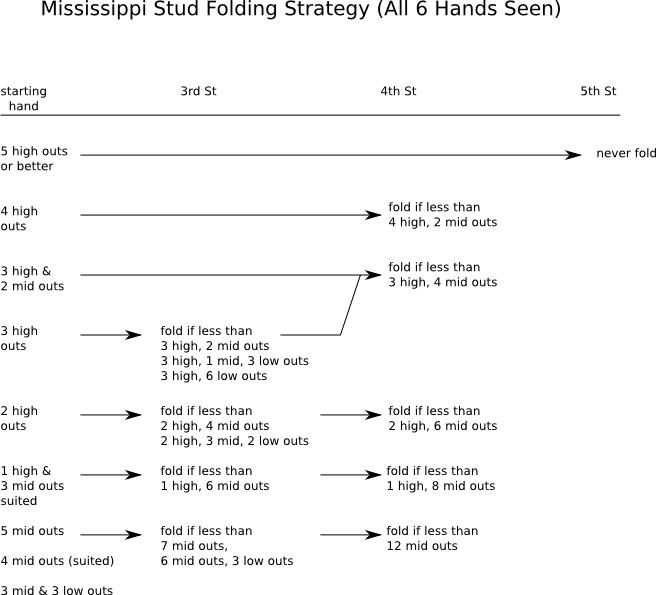
Folding strategy for Mississippi Stud, all 6 player hands known.
Don’t use this chart at the tables. Just use it to understand the folding points better, and to learn to play faster. Understand that you’ll never fold a hand with 5 high outs. And with 3 high and 2 mid outs, you won’t have to think until 4th Street. Furthermore, you’ll never fold a hand with 3 high and 4 mid outs. However, if your starting hand has less than 3 high and 2 mid outs, you’ll need immediate help on 3th Street. Chances are, you’ll need more help on 4th Street. And you’ll probably need at least 3 high and 4 mid outs to see 5th Street. It’s uncommon when you end up calling with 2 high and 6 mid outs on 5th Street, and very rare to call then with 1 high and 8 mid outs.
Online Mississippi Stud Practice Game (+EV)
After spending a lot of time playing UTH, I found that there’s an acceptable way to share hole card information with the table. While the dealer, floorman, and surveillance might say something if you flash your hole cards (or play them face up), they don’t care if you verbally share info. Furthermore, if you’re discreet about it, or speak another language, and don’t slow down the game, no one will probably even know you’re doing it.
With this in mind, the value of ShuffleMaster’s Mississippi Stud just went up for everyone. While the game is already played face up at my nearby Barona Casino, now everyone can enjoy the +1.5% EV game at a full table of cooperating players. (See my Simplified 6 Player +EV Strategy, and my 4 Player Collusion Strategy.) In the meanwhile, you can practice the game here for free. It suggests the improved strategy as listed in my player reference card. Of course, you can play your hand any way you want to. Also, you can just hit the “Auto” play button to quickly play 1000 hands using the advanced strategy.
Click on the screenshot below to play:

The older Java game. You must have Java 1.6 installed on your computer (check your version).
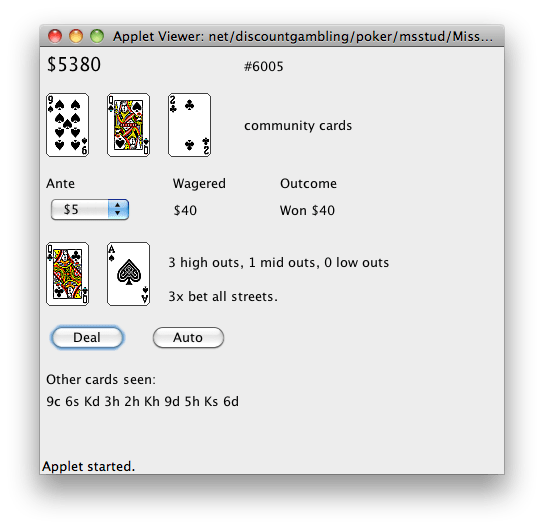
Mississippi Stud Game Screenshot
Session Outcome Distributions for UTH w/ Trips Bet
Last night while playing Ultimate Texas Hold’Em, I finally decided to play the Trips bet every hand, just for the fun of it. I played for a few hours, and left while I was winning about $20. (Most of that was due to two dealer mistakes, where I pushed against the dealer hand, but they paid my Blind bet anyways.) Anyways, if I only play a few hours, its worth it to play the Trips bet, since it adds to the camaraderie of the table. The dealer also seems to care more about you when you bet the Trips (probably because that’s when they get toked). I figured the Trips bet adds to the variance of the game, but I calculated the session outcome distribution for 100 hands just to make sure:

Session outcome distributions with and without the Trips bet.
Yep, more variance, more cost, and more fun.
Online Ultimate Texas Hold’Em Practice Game
Finally, you can now play Ultimate Texas Hold’Em online with my new practice game. The main purpose of this game is to allow people to practice different betting strategies, and to learn for free. Learning UTH in the casino can be very costly, since most people don’t bet their hands like they should. I put in basic strategy hints in the game which gently suggests when to bet.
Click on the screenshot below to play the game:

Or you can still play the older but simpler and faster Java game (check that you have Java 1.6):

Ultimate Texas Hold'Em Practice Game (Screenshot)







 Discount Gambling
leave a comment