Card Craps Simple Explanation
I love the card craps at Viejas, not because I’m ever going to win any money there, but because it’s so obviously countable. However, it’s almost impossible to explain to anyone why the odds are different than dice, or why the game is countable. After all, they use a Constant Shuffle Machine (CSM) with 312 cards, right? So, once again, I’m going to explain how the card buffering in the exit chute of the CSM makes the game easily countable.
A picture is worth a thousand words. Example code and simulations are the proof of the pudding. All the code used in this example is available on github, where you can browse or download it.
You can read up on the details of card craps @ Viejas. Here’s how they play it. They use a normal craps layout, but replace the dice with two cards (1 thru 6), dealt out of a 312-card CSM. They take two cards out of the shuffler, call the roll, then muck the two cards back into the CSM. They allow 10x pass/dont odds on all points.
The reason why the CSM screws up the game (favors the dont’s) is that on the comeout, the two cards that just made the point have no chance of coming out on the next roll. Nor do they have any realistic chance of coming out in the next few rolls. This is because a CSM buffers a dozen or more cards in the chute where the dealer pulls the cards from. This buffer is necessary to deal blackjack. (Imagine the dealer waiting for the machine to drop one shuffled card at a time.)

Dice Baseline
Ok, so download the example code, compile and run it with the -d option for normal dice. The results are just as you’d expect. The pass line returns -1.42%, and the dont pass returns -1.36%, and odds and counting don’t make any difference:
>./cardcraps -d
using normal dice
...
1665000000 games:
pass flat: -0.0142, pass10x: -0.0144, pass w/count: -0.0142,
dont flat: -0.0136, dont10x: -0.0134, dont w/count: -0.0135
It takes billions of games to settle out the averages (especially when playing 10x odds), so don’t worry about the 1/100th of percents.
A) 36-Card Deck Is Same As Dice
At Pala Casino, they use a 36-card deck (one card per roll), and a simple deck shuffler. No buffer. Each card has a picture of two dice. The shuffler spits out one card from the red deck, one card from the blue deck. The player “roll” chooses between the blue or red card. Exact same odds as craps. At Pala, no one ever says anything like “How many cards are in there?”, or “This machine deals a lot of sevens!”.
B) 2-Card Roll Hurts Pass Odds
Now, let’s try the case B in the above diagram. We use the -c option to select an ideal shuffler, and -m 0 option to indicate no buffered cards in the chute.
>./cardcraps -m 0 -c
using CSM with 52 dice sets, and minBufferDepth of 0 cards
...
1265000000 games:
pass flat: -0.0137, pass10x: -0.0266, pass w/count: -0.0170,
dont flat: -0.0137, dont10x: -0.0053, dont w/count: -0.0075
This shows that even without a buffer, making a dice roll from two cards out of a perfectly shuffled 312-card shoe favors the don’t pass odds. You can use a simple spreadsheet to show this. The point is that you’ll distort the well-known dice roll distribution by using 2 cards dealt from a shoe. It’s a simple exercise to prove (a simple spreadsheet will give you the exact numbers).
Note the pass line player loses more by taking odds. The don’t pass player improves his return by laying 10x odds. That doesn’t happen in a regular dice game. In a dice game, taking or laying odds is fair (0 EV).
C) CSM Is Countable
At Viejas, they use a ShuffleMaster 126 CSM loaded with 312 cards. If you ever open the top (used to happen a lot when they had jams), you’ll see a buffer of approximately 16 cards in the exit chute. This distorts the game, and in general favors the Don’t Pass odds. Sometimes, a good count makes the pass odds +EV.
We’ll run the simulator for the CSM with a minimum buffer depth of 16 cards:
>./cardcraps -m 16 -s
using model of ShuffleMaster 126 CSM with 52 dice sets, and minBufferDepth of 16 cards
using window size of 6 rolls
...
2083000000 games:
pass flat: -0.0147, pass10x: -0.0420, pass w/count: -0.0011,
dont flat: -0.0126, dont10x: +0.0042, dont w/count: +0.0130
Now you see the pass line player is severely penalised for taking odds. I don’t think someone taking 10x odds on every point would think they’ve increased the house edge from a nominal 1.4% to a whopping 4.2% (of the flat bet). And we see that a don’t pass player laying 10x odds on every point now has a small 0.4% advantage over the house. Of course, there’s a lot of variance laying 10x odds to win an average (0.4%)(flat bet). Using a simple (and fun!) count, the don’t player has a 1.3% advantage over the house.
You can use the -v option in the cardcraps program to generate the statistics on the odds bet vs the count for each point. I ran the program, and plotted the results (don’t pass odds advantage; pass odds are inverted):

The correlation between the count and the next roll out of the CSM is clear. The count is simple and important! Quite often, you have a +/- 1-2% advantage in laying odds or taking odds. Where else can you play a craps game where the previous 6 rolls have a significant effect on the next roll?! The graph was generated with a fair simulator (using a Mersenne Twister 64-bit PRNG with a period of 2^19937-1).
Even though the game is +EV, the edge is small relative to the variance. No one will grind out any money from this game. However, it is a lot of fun to watch the rolls, know the count, and guess the outcome. Plus, the game is dealt on a table, so you get to sit and watch the rolls. And it’s probably 10x faster than a craps game with dice. You could get a roll every 5 seconds if you’re heads up with the dealer.
The count provides a fun, small predictor of the next roll out of the CSM. If you like counting, and/or predicting the next roll in craps, then you have to check out the card craps game. Here’s a video that shows how I play the game @ Viejas:
Bad Beat Bonus @ Ultimate Texas Hold’Em
 A reader recently asked about the new two-way Bad Beat Bonus in Ultimate Texas Hold’Em. It’s pretty easy these days to crunch out the numbers, so I took an hour to work this one out. After all, I might see the bet somewhere, and I’m becoming a sucker for bonus bets lately 🙂
Well, at a 14.8% house edge, I’ll probably look for a better paytable before I play this bet. Has anyone seen any other paytables out there?
| Losing Hand | Frequency | Probability | Payout | Return |
|---|---|---|---|---|
| Royal Flush | 0 | 0.000000% | 0 | 0.000000 |
| Straight Flush | 10,300,592 | 0.000370% | 7500 | 0.027776 |
| Four-of-a-Kind | 471,040,512 | 0.016935% | 500 | 0.084677 |
| Full House | 8,435,225,376 | 0.303275% | 50 | 0.151637 |
| Flush | 19,434,208,592 | 0.698725% | 30 | 0.209618 |
| Straight | 18,271,076,976 | 0.656907% | 20 | 0.131381 |
| Three-of-a-Kind | 64,049,759,448 | 2.302804% | 9 | 0.207252 |
| Two Pairs | 399,099,149,640 | 14.348956% | -1 | -0.143490 |
| One Pair | 1,366,512,556,968 | 49.130722% | -1 | -0.491307 |
| High Card | 791,967,420,480 | 28.473892% | -1 | -0.284739 |
| push | 113,130,263,816 | 4.067413% | -1 | -0.040674 |
| Total | 2,781,381,002,400 | 100.0000% | -0.147868 |
Six Card Poker @ Venetian, Las Vegas
 On my trip to Vegas last month, I saw this new game at the Venetian, and all I could think of was collusion. I figured it had to be beatable, since the dealer shows half his hand (3 upcards), which should exploitable given confederate card information. Well, I finally got around to looking at it, and of course, its not as exploitable as I hoped.
The game is pretty simple, where both dealer and player get 6 cards to make a 5-card poker hand. There’s only an Ante, and a 1x Play bet. The dealer shows 3 upcards, and you decide to either 1x Play or fold your hand. If the dealer doesn’t qualify with Ace-King, then the Ante pushes regardless of the player hand. The 1x Play bet always receives even-money action against the dealer hand. The Wizard of Odds provides a basic strategy, and lists the house edge at 1.27%.
I figured 6-player collusion would help you know when to play Ace-high, and maybe help you fold a pair when a lot of dealer outs remain that beat you. But first, I simulated a bunch of hands finding the optimal decision given confederate card info. This gave me a very close approximation to the ideal edge obtained by perfect collusion. This 6-player edge amounted to only +1.17%. This isn’t much, especially since any actual collusion strategy approaching this limit would be impractically complex.
At this point, I only made a half-hearted attempt at finding a practical collusion strategy. There’s so many cards involved, its difficult to come up with a workable signalling system. Also, I looked over the collusion decision points, and it wasn’t simple to identify the conditions for making a counter decision to basic strategy. For what it’s worth, I came up with the following “simple” 6-player collusion strategy that simulates at +0.15%:
- Call two pairs or better, else
- Call one pair unless there are 7 or more dealer one-card outs remaining that beat you, else
- Call Ace-high when 2 or more Aces and Kings seen with 9 upcard copies, else
- Call Ace-high with 4 or more Aces and Kings seen with 8 upcard copies, else
- Call Ace-high with 6 or more Aces and Kings seen with 7 upcard copies,
- else fold
Update: I worked out an improved 6-way collusion strategy that yields a +0.43% return with only a couple simple rules.
Lucky Lucky Blackjack Sidebet (+EV)
 Well, here’s another massively countable side bet that some people might be interested in (advantage players, casino floor supervisors, and the game publisher), but that I’ll never play. I think after this one, designers will know to check their games for vulnerabilities, especially when there’s oversized items in the paytable. And we’ll remember, “It’s not a sucker bet if the count is good.”
Again, Eliot Jacobson pointed this one out to me. (But, if Barona had this side bet, I’d have already looked at it.)
The Lucky Lucky blackjack side bet is played with your first two dealt cards, and the dealer upcard. On these three cards, you get paid for various ways to make 21, and for any 20 and 19 total. The most countable version of this side bet is for the double-deck version with the paytable below. The game is also countable for the 6 deck shoe game, but it’s only 60% as profitable.
| Hand | Frequency | Probability | Payout | Return |
|---|---|---|---|---|
| suited 678 | 32 | 1.757238E-4 | 100 | 0.01757238 |
| 777 | 56 | 3.075166E-4 | 50 | 0.01537583 |
| other 678 | 480 | 0.00263586 | 30 | 0.07907569 |
| suited 21 | 936 | 0.00513992 | 15 | 0.07709880 |
| other 21 | 14904 | 0.08184334 | 3 | 0.24553003 |
| any 20 | 13792 | 0.07573694 | 2 | 0.15147388 |
| any 19 | 13344 | 0.07327680 | 2 | 0.14655362 |
| others | 138560 | 0.76088389 | -1 | 0.76088389 |
| total | 182,104 | 1.00000000 | -0.02820366 |
As usual, I program a function that tells me the EV for any given shoe composition. Then I simulate millions of hands, calculating the ideal EV of the side bet at the beginning of each hand. I sum up the times when the side bet is +EV, and find the average +EV bet and +EV frequency. For the double-deck Lucky Lucky, I got
double-deck, cut card @ 75th card
ideal +EV frequency: 0.2769, ideal EV/bet: +0.0591
which is not a practical counting scheme, but the theoretical limit if you used a computer that took into account all info (suits, etc.).
Then I calculated the Effect-of-Removal (EORs) of a given card on the EV, in order to make counting tags. (Outside the gambling world, people would call “EORs” sensitivities, and “tags” coefficients.)
| Card | EOR | Tag |
|---|---|---|
| Deuce | +0.007853 | +1 |
| Trey | +0.006066 | +1 |
| Four | +0.004099 | +1 |
| Five | +0.003171 | 0 |
| Six | -0.010422 | -2 |
| Seven | -0.017270 | -2 |
| Eight | -0.012616 | -2 |
| Nine | +0.002515 | 0 |
| Ten/Face | +0.006270 | +1 |
| Ace | -0.008477 | -1 |
So, setting the trueCount threshold to 2.4 (bet Lucky Lucky when the trueCount is >= 2.4), you get the practical results in double deck:
practical frequency: 0.2640, average EV/bet: +0.0561
6 Deck Shoe Version
The 6 deck shoe paytable is better than the double deck version, as it pays 200:1 for a suited 777. The EORs are similar, and I came up with the same count tags as the double deck game. Using a trueCount threshold of 2.1, the practical counting scheme yields:
ideal +EV frequency: 0.2311, ideal average EV/bet: +0.0432
practical frequency: 0.2217, practical average EV/bet: +0.0409
which is only 61% of the profit rate as the double-deck game.
Texas Hold’Em Bonus Simple Strategy

I’ve wanted to make a simplified Texas Hold’Em Bonus strategy for a while, for the occasional trips to Vegas, and for the occasional person looking for it. The first strategy I posted was way too complex to remember, and was only useful as a reference guide. While the game ideally returns a -2.037% EV, and my old complex strategy returns -2.3%, the new simple strategy below returns a respectable -2.9%.
I made the strategy based on what I normally look for when playing Hold’Em carnival games (like Ultimate Texas Hold’Em). The most common cases are addressed, and I include some less frequent, though interesting situations that you’ll probably want to know about. The strategy is actually very simple, and very easy to remember.
| Bet | Requirements |
|---|---|
| Pre-Flop | Fold 23o thru 27o, else |
| 2x bet all others | |
| Flop | Bet two pairs or better, else Bet your pair with any board undercards, else Bet your pair with any draw, else Bet bottom pair unless board suited, else |
|
Bet any combo flush and straight draw, else Bet 5th nut flush draw or better, else Bet an open-ended straight draw with both hole cards 8 or higher, else |
|
|
Bet 2nd nut kicker against a tripped board, else Bet nut kicker against a paired board, else Bet 1st and 4th nut kickers against a non-suited board, else |
|
| Check all others | |
| Turn | Bet your two pairs or better, except for a pocket underpair with no draws, else Bet your pair (except bottom or underpair) if not a scare board, else |
|
Bet nut kicker if the board is double-paired, else If not scare board, bet nut kicker with open-ended straight draw, or 4th nut flush draw, else |
|
| Check all others |
where “scare board” means open-ended or 4-to-a-flush on the turn, and “your” hand means your hand that beats the board.
Texas Hold’Em Plus Deluxe @ Palms, Las Vegas
 You know there’s too many Hold’Em based carnival games out there when their names start to include words like “Plus” or “Deluxe”. Well, this game that I saw earlier this month at the Palms Casino has them both. I took a rack card home, and finally got around to analyzing the game. (Check the game publisher for current placements.)
The game is interesting, because it allows you to discard and replace one of your hole cards before deciding to see the flop. However, you have to pay to see each street (1x to see flop, 1x to see turn, 1x to see river), otherwise you fold. The Ante in the game resembles the Blind in Ultimate Texas Hold’Em, where it only pays for a player’s winning hand according to a paytable, when both hole cards play. But, there’s no qualifier on the dealer hand, so your Flop, Turn, and River bets all get even money action against the dealer hand.
I worked out a fairly simple strategy for the game, which simulates at 3.0% house edge. That’s not too bad, and is comparable with UTH and Texas Hold’Em Bonus.
Rules
- The Player must wager an Ante before the hand begins.
- Each Player and the Dealer receives two hole cards.
- The Player may discard one of his hole cards, and receives a replacement card from the deck.
- The Player either 1x bets to see the Flop, or folds.
- The Flop is dealt to the community board.
- The Player either 1x bets to see the Turn, or folds.
- The Turn is dealt to the community board.
- The Player either 1x bets to see the River, or folds.
- The Dealer turns up his hand, and the Flop, Turn, and River bets receive even-money action against the Dealer hand.
- If the Player beats the Dealer, the Ante pays according to the paytable if both player’s hole cards play, else the Ante pushes; if the Dealer beats the Player, the Ante loses.
| Hand | Payout |
|---|---|
| Royal Flush | 100:1 |
| Straight Flush | 20:1 |
| Four-of-a-Kind | 10:1 |
| Full House | 1:1 |
| Flush | 1:1 |
| Straight | 1:1 |
| Others | push |
Strategy
The following strategy is fairly simple, and probably doesn’t sacrifice much EV. I’ll guess that the optimal strategy (non-colluding) is better by less than 0.5%, at most.
Discard
Never break a pocket pair. Use the following table to decide whether to replace your lowest hole card:
| Hand | Decision |
|---|---|
| AXs, KXs, QXs, JXs, TXs | Discard 7 or under. |
| 9Xs, 8Xs | Discard 6 or under. |
| 7Xs | Discard 5 or under. |
| 6Xs, 5Xs, 4Xs, 32s | Discard lowest. |
| AXo, KXo, QXo, JXo | Discard 9 or under. |
| all others | Discard lowest. |
Flop Bet
Play any pair. Play any suited hole cards, except for 72s, 62s, and 32s. Play T2o or better. Play offsuit {9,8,7,6} with a 5 or better. Fold all others.
Turn Bet
You bet almost all hands on the flop. Bet any hand that beats the board, bet any draw, bet if trips on board. If the board is paired, bet your 86 or better hole cards. If the board is suited, bet your Jack hole card or better, else bet your 96 or better hole cards.
River Bet
You bet most hands on the turn. Bet any hand that beats the board, bet any draw, bet if trips on board, bet if board is double-paired, bet if scare straight on board. Bet your 8-high hole card or better. You can still bet garbage hole cards if the board is paired, and the on-board kicker is 3rd nut or better.
Bonus Bet
The game also has a final hand bonus with the paytable below. It’s interesting that the bonus bet allows you the discard, and it still pays on “folded” hands. However, the discard strategy for the main game is not optimal for the bonus bet. The bonus bet simulates at a 9.9% house edge using the discard strategy for the main game. If you optimize the discard strategy for the bonus bet, then you’ll reduce the house edge to about 3.5% (while destroying your main game EV).
| Hand | Payout |
|---|---|
| Royal Flush | 250:1 |
| Straight Flush | 100:1 |
| Four-of-a-Kind | 40:1 |
| Full House | 10:1 |
| Flush | 6:1 |
| Straight | 4:1 |
| others | lose |
My Blind Review
I have no idea if this game is any fun. I haven’t played it. I know I don’t like the 9.9% house edge on the Bonus bet, but I don’t play most bonus bets either. Of course, you can mess around and bet $5 on the Ante and $100 on the Bonus, and discard for bonus (never break suited cards or pairs; keep 0-gap connectors except for AK, KQ, 43, 32, A2; otherwise keep the card closest to an 8 and discard the other). That’ll get the floorman’s attention.
It’s simple enough to follow the above strategy, but it’s not very poker-like. You make a lot of “crying calls” with nothing (e.g., you call to draw to a pair of 8’s on the river, even against a scare board). I guess the discard option is fun, but I can see breaking A7s, and getting a worse hand more than half the time.
If anyone out there tries it, tell us how you liked it.
Three Card Hold’Em @ Golden Nugget, Las Vegas
 Earlier this month, I saw a new 3-Card Hold’Em poker carnival game at the Golden Nugget in Las Vegas. I wrote down the rules, and finally got around to analyzing the game today. Coincidentally, I found a reader of this blog playing the game at the Nugget. We were joking about the game, when he flops the nut straight (he has AK, and the Flop is a Q). So he bets the Turn and River blind, and the board comes runner-runner spades. I figure he’s ok, because a straight beats a flush in 3-card poker. Then the dealer turns up her hole cards, and uses both of them to make a straight flush. Unbelievable.
Rules
The game is played between the dealer and each player. Each player and the dealer receives two hole cards, and combines them with the community cards on the “board” to make their best 3-card poker hand. You do not need to use any of your hole cards to make a hand (i.e., you may “play the board”).
- Player posts an Ante before the start of the hand.
- The Player and the Dealer are each dealt two hole cards.
- The dealer turns up the Flop card on the community board.
- The Player decides whether to 1x bet the Flop, or to fold his hand and lose his Ante.
- The dealer turns up the Turn card on the community board.
- The player decides to either 1x bet the Turn, or check.
- The dealer turns up the River card, then turns up his hole cards.
- The Dealer requires a pair of 4’s or better to qualify, else the Antes push.
- All remaining bets receive even-money action against the Dealer hand.
Strategy
I constructed a reasonably simple strategy, and was very surprised to see it simulate at only a -0.60% EV! This is pretty good for a carnival game, which usually has between a 2.5% to 3.5% house edge. My simple strategy isn’t very optimal, and I estimate the actual house edge is very close to 0. (The error EV of my simple strategy simulates around 0.5%, so an optimal strategy would yield close to 0 EV.)
On the Flop, you should always make the 1x bet (never fold your Ante).
On the Turn, use the following table to decide when to bet your hand, else check. You should only bet a pair under the stated conditions, and when your hand beats the board by more than just kickers, except when betting the nut flush draw.
(Glossary: “scare straight” means the board has connected cards; “scare flush” means the board is suited; “good straight draws” (GSDs) mean the number of River card ranks that make you a straight, excluding the “idiot end” straight draws. For example, if your hand is Kc 6h and the board is Qd 7s, then your 3 GSDs are {A,J,5}. Note that an 8 is not a GSD, but an “idiot-end” draw, because a dealer 9 would beat your 8-high straight. Basically, a GSD is an out that makes a straight which can’t be beat by a single dealer hole card.)
| Hand on Turn | Turn Bet Requirements |
|---|---|
| Straight or better | Always bet. |
| Flush | If scare straight AND scare flush board, only bet 4th nut flush. |
| One Pair | If not scare straight nor scare flush board, bet your pair of Jacks or better, else if not scare flush, bet your pair with 2 or more GSDs, else if not scare flush, nor scare straight, bet your pair with 4th nut flush draw or better, else if not scare flush, bet your pair of 6’s or better, if you have any GSDs and any flush draws, else if the board is paired, bet your nut flush draw. |
| No Pair |
If not scare straight and not scare flush, bet 4 GSDs and 9th nut flush draw or better, else if not scare straight and not scare flush, bet 2 GSDs and two flush draws with a 7th nut flush draw or better. |
This simple strategy decisions are occasionally wrong by more than 10% of the Turn bet, but overall, it works out well enough. The mistakes are pretty obvious when you look at them, it’s just not worth optimizing the strategy unless you want to play it seriously. The game will probably be gone in a few weeks anyway, I just wanted to see what a reasonably strategy would yield.
Bonus Bets
The Straight-or-Up bonus bet has a 4.49% house edge, which isn’t too bad, as far as side bets go.
| Hand | Payout | Frequency | Probability | Return |
|---|---|---|---|---|
| AKQ-suited + pair | 100 | 276 | 0.000106 | 0.010620 |
| AKQ-suited | 40 | 4428 | 0.001704 | 0.068150 |
| Straight Flush | 10 | 49628 | 0.019015 | 0.190953 |
| Trips | 9 | 58848 | 0.022643 | 0.203787 |
| Straight | 1 | 569268 | 0.219037 | 0.219037 |
| Others | -1 | 1916512 | 0.737415 | -0.737415 |
| Total | 2598960 | 1.000000 | -0.044868 |
The Pair-or-Suited side bet on your two hole cards is a little better, costing only about a 4.8% house edge.
| Hand | Payout | Frequency | Probability | Return |
|---|---|---|---|---|
| AK-suited | 30 | 4 | 0.003017 | 0.090498 |
| AA | 20 | 6 | 0.004525 | 0.090498 |
| KK | 10 | 6 | 0.045249 | 0.045249 |
| Pair | 4 | 66 | 0.049774 | 0.199095 |
| Suited | 1 | 303 | 0.232278 | 0.232278 |
| other | -1 | 936 | 0.705882 | -0.705882 |
| Total | 1326 | 1.000000 | -0.048265 |
Barred From Barona: A Win-Win Outcome
Well, I finally got barred from table games at my local Barona Casino. Some of you may have seen this coming, and I probably should have too, especially after the multiple private warnings from their director of table games. When they first came by to talk to me, I didn’t think they’d worry about a $5 player like me. I mean I don’t even take my $5 action seriously. So when they talked to me, I thought they were just stopping by to talk shop (they work in a casino, I live in a casino). But I eventually got the vibe that they were kind of watching me. Well, they were certainly reading this blog, and the day I posted the Mississippi Stud calculator (all 6 hands seen), they came by and nicely told me I couldn’t play tables games anymore.
I figured they wouldn’t like that post. The calculator showed all the players hands face-up, like it’s played at Barona, and showed you the exact value of your hand, and the best decision (3x, 1x, or fold). I guess if the regulars saw it, and all started playing optimally, it’d be a problem. But that will never happen; I’ll bet any amount of money on it. People don’t play optimal strategy, that’s not why they’re there. People play the way they want to, and that’s the way it should be. I pretty much just wrote the calculator for myself, and one or two guys who wanted to see it.
At any rate, someone at Barona thought it best to bar me, and I can’t argue with their decision. I doubt I influenced any players about the game, but everyone got the idea that I played tight. (People also thought I played too aggressively at Ultimate Texas Hold’Em.) Worse-case, I took up a weekend seat playing tight $5 Antes, and locked out a bigger player when the game was full. Best-case, I “prop’ed” up the game on weekday nights, when an additional player helps build up critical mass in the game. (Everyone agrees it’s better to have more players and see more cards per hand.)
Like I said, being barred is a “win-win” situation. They’re happy, and don’t have to worry about me meddling with their Mississippi Stud game. I’m happy, since getting barred was the only way I’d stop playing 60 hrs/week there. So instead of coming back from the casino every night until 3am, I go downstairs and take hour-long walks through Little Italy and Balboa Park. Although it was pointless, it was easy playing a game with a 1.5% tailwind. It’s like being the house, but without all the expenses, and with comp’ed food. But it was just an attractive nuisance, something that draws you in, but ends up harming you.
Pai-Gow Tiles Tutorial
Last week I went to Vegas, and I mostly played $25 Pai-Gow Tiles. Over my 3 day trip, I played two hands of $5 UTH, two hands of $5 Crazy 4 Poker, one hand of $5 Texas Hold’Em Bonus, and maybe two dozen hands of $10 blackjack. Otherwise, I just played Pai-Gow tiles. It was the first time I played with a strategy, which I practiced on my trainer before the trip.
There were only a few other people that played the game. Often I was there by myself. The game isn’t hard to play, but there’s not a lot of beginner instruction out there, so it remains very mysterious to most people. So I made some video tutorials, to give people that jump-start to understanding the game. (Look for all my YouTube videos on Pai-Gow tiles.)
There’s a few reasons you should learn Pai-Gow tiles. First, it’s a lot of fun if you like games that require a little thought. Secondly, it’s a very cheap game. If you alternate hands as player and banker (e.g., when you’re heads up), the house edge is less than 1%. It even gets cheaper if the house doesn’t use quarters, and charges only $1 commission on a $25 win (4% commission). Finally, and perhaps most importantly, you get tons of degen “cred” by knowing this game well (especially if you’re lo-fan).
I played about 20 hours of $25 Pai-Gow Tiles at the MGM Grand, and got comp’ed for one night hotel stay (all I needed; my friend got comp’ed the other two nights), and I received $67 in cash comps towards our meals. Other than tokes, the average house vig came out to (20 hours)(30 hands/hour)($25/hand)(1%) = $150, which is about the value of my comps. I call that fair. Plus, I ended up winning on the trip, and came back with more money in my pocket than when I left.
Pai Gow Tile Practice Trainer
When I go with friends on 3-4 day trips to Vegas, I usually end up looking for a cheap game at some point during my 72 hours in the casino. Pai Gow Poker is cheap and slow, but it’s painfully boring. So the last few times we stayed at the Mirage, I started playing Pai Gow Tiles. I really like it now, because it’s a new game to learn, and I feel quite the degen pushing around the pretty little tiles.
The first times I played, I barely knew how to read a hand, and I didn’t learn any strategy. I often asked the dealer for the house way, which I later found out costs at least 0.5% compared to even a simple strategy. Besides, it’s much more fun to set your own hand (correctly). The Wizard of Odds has a very good calculator, but I still needed a practice trainer that taught a simple strategy.
So I wrote a trainer to teach myself, and other newbies, how to play the Wizard’s Simple Strategy. With some interactive practice, and just a little reading on the basics of the game, I hope that anyone can learn to play.
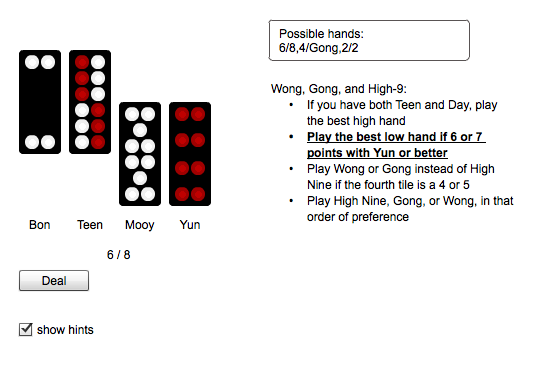
I wrote up a tutorial page on Pai Gow Tiles, if you need some background on the game.







 Discount Gambling
6 comments