Ultimate Texas Hold’em
 Ultimate Texas Hold’em is a ShuffleMaster table game based on the popular poker game. The description and rules of the game are found online. I didn’t find a basic strategy anywhere for the game, so I devised one myself using my own analysis program.
The game is very popular, because the house edge is reasonable, and because of the trips bet pay table. Most of the post-flop decisions are fairly normal (bet when you have something, otherwise check). However, there are some situations on the flop where you need to check bottom or small pocket pairs. Conversely, there are times when you bet a draw, or a good kicker. On the river, my strategy table tells you when to call 1x with good kickers. The following strategy simulates at 2.3% house edge, close to the 2.2% optimal strategy.

Basic Strategy Card for Ultimate Texas Hold'em.
Ultimate Texas Hold’em Basic Strategy
I find that people play quite differently from basic strategy. Granted, my site is the first to publish strategy for post-flop play, but I thought that people would instinctively figure it out. From what I’ve seen, people are very reluctant to raise pre-flop (4x) without a big pocket pair, or at least Ace + face. They’re very surprised to see me raise with J8s, or K5o. On the flop, people check pairs, waiting to just call on the river. Conversely, on the river, people frequently call with a bad kicker. Many of these mistakes cost 20% or more of the ante, or $1 of $5. So, to help out the fans of this game, I’m writing this basic strategy tutorial. Near-optimal play is very simple, and easy to master. With a little experience, you’ll play faster than the dealer. At a 2.2% (of the ante) house edge, the game is very cheap, since your average 4.2 unit bet reduces the house take to 0.5% of your action. It’s better than most blackjack games.
Preflop (4x)
It’s very simple to make the optimal pre-flop decision. If your starting hand is equal to, or better than the hands listed in the above table, you raise 4x, and you wait to see if you win. If your starting hand isn’t good enough to raise, then just check, and wait for the flop.
The hands that are good enough to raise 4x:
- pair of 3’s or higher
- Ace + anything
- any suited King, or King and 5 or higher
- Queen and 6 suited, or Queen and 8 or higher
- Jack and 8 suited, or Jack and Ten
It’s really important to raise your 4x preflop opportunities. The “play” bet is where you make all your money
| Bet | Required | Amount | Return | Notes |
|---|---|---|---|---|
| Ante | yes | 1x | -16.6% | dealer must qualify for player to win push if dealer doesn’t qualify (and player didn’t fold) |
| Blind | yes | 1x | -31.5% | pays winning hand on straight or better a.k.a. the “Rake” bet built-in “bonus” bet pays 500x for a Royal Flush, etc. |
| Play | player decision |
4x@preflop 2x@flop 1x@river |
+45.9% of ante | This is the player advantage bet, you should always bet when indicated, to overcome the Rake |
| Trips | optional | table limits | -1.904% for standard paytable | Not bad as far as “bonus” (“sucker”) bets go. |
The table below shows a few pre-flop decision points, and the difference between raising 4x and just checking. My program comes up with the exact same EVs as The Wizard of Odds, as we’re probably doing the exact same recursive calculations. It takes me about 16 hours to calculate each of these preflop points, and it took the Wizard 2 months of compute time to calculate the EV over each of the possible starting hands (pairs, suited & offsuit combinations).
| hand | EV(check) | EV(4x) | Notes |
|---|---|---|---|
| As 2s | +0.1665 | +0.3999 | raise with Ace anything |
| Kh 2h | -0.0799 | -0.0745 | raising K2s beats checking by 0.54% of the Ante bet |
| Kh 8d | -0.0040 | +0.1663 | checking makes it a loser; raising 4x makes it a winner |
| Qh 8d | -0.0926 | -0.0694 | raising Q8o beats checking by 2.3% of the Ante bet |
| Kh 5d | -0.1511 | -0.1176 | raising K5o beats checking by 3.35% of the Ante bet |
Flop (2x)
Betting Pairs
Generally, you bet (2x) any pair you’ve made on the flop. The only time you’d check your pair is if the board is suited, and you have a pair, no flush draw, and your kicker is smaller than the board (it’s pretty rare). Also, you should check your small pocket pair (4’s or smaller) if the board is paired, and all the board cards are bigger than your pair. And, you should check your pocket pair if the board is suited, unless you have a flush draw, or there are smaller cards on the board, as described in the strategy table. But other than those rare cases, you’re betting 2x on any pair you make.
| hand | board | EV(check) | EV(bet) | Notes |
|---|---|---|---|---|
| 2h 3d | Ah Kc 2s | -0.3492 | -0.2442 | bet any pair (non pocket) on an offsuit board |
| 2h 3d | Ah Ac 2s | +0.3974 | +0.5080 | bet any pair (non pocket) on a paired board |
| 2h 2c | Kc Qc 4c | -0.1657 | -0.1405 | bet any pair with a flush draw |
| 3c 5d | 3h 2h Th | -0.4781 | -0.4463 | bet mid or top pair on a suited board |
| 6c 9c | Ad Jd 6d | -0.5031 | -0.4768 | bet bottom pair on a suited board w/ 6th nut kicker |
| 3c 3d | 7h 7d Th | -0.1361 | -0.2446 | check pair < fives on paired board with no board undercards |
Betting Kickers
If you’re holding high cards (like Ace, or other “nut” kickers), and you didn’t 4x raise preflop, you can still 2x bet on a paired flop according to the basic strategy table. E.g., if you’re holding an Ace, and the board is paired, you should bet 2x now. But if the board isn’t paired, even if you have AK, you can’t bet your hand.
| hand | board | EV(check) | EV(bet) | Notes |
|---|---|---|---|---|
| Ah Kd | 4h 5s 9s | -0.6489 | -0.6570 | non-paired board, check nut kickers |
| Kh Jd | 5h 5s 9s | -0.3978 | -0.3927 | paired board, bet 2nd and 4th nut kickers |
| Ah 6d | 5h 5s 9s | -0.2430 | -0.1773 | paired board, bet 1st nut kicker |
Betting Straight Draws
Generally, you will only consider betting outside straight draws of JT98 or better. If the board isn’t paired or suited, then you can bet any JT98 or better draw, except the “idiot-end” (you have 98). If the board is paired, you can bet a T987 draw if your cards are T9, otherwise the first rule applies. If the board is suited, you can’t bet any straight draw unless you also have a flush draw. Also, only bet the straight draws mentioned when both your hole cards play, or your kicker is an overcard to the board.
Interestingly, you should bet a gutshot to an A-high straight when you have nut kicker. This is a combination kicker & straight draw bet, and while it doesn’t occur very frequently, it’ll probably occur to you that betting it is better than checking.
| hand | board | EV(check) | EV(bet) | Notes |
|---|---|---|---|---|
| 9s Td | Jh Qs 3s | -0.0060 | +0.0887 | bet low end of QJT9 outside straight draw |
| 9s 8d | Jh Ts 3s | -0.1644 | -0.1922 | check low end of JT98 outside straight draw |
| 9s Td | Jh 8s 3s | -0.0076 | +0.0470 | bet any JT98 outside straight draw other than “idiot-end” |
| 9s Td | 7h 8s 3s | +0.0113 | -0.0483 | check any straight draw less than JT98 |
| Ks Qd | Th 2h Jh | -0.2475 | -0.2495 | on a suited board, check all straight draws w/o flush draw |
| 3d Qd | Js Th 9c | -0.3452 | -0.4325 | check QTJ9 unless both hole cards are higher than 9 |
| Ks 3c | As Qh Td | -0.4229 | -0.3918 | bet a combination nut kicker and gutshot straight draw |
Betting Flush Draws
If the board isn’t paired or suited, can bet any 4th nut flush draw or better. Also, bet any 5th nut flush draw if there are any board cards smaller than your lowest card. The same goes for paired boards. Bet any 4th nut flush draw, or 5th nut draw and both your cards are higher than the board singleton.
When the board is suited, you may bet your flush draw depending on how high it is, and whether you have a kicker, pair, or other draw. If you are drawing to 2nd nut or better, you don’t need anything else to bet. If you’re drawing to 3rd nut flush, you need an board undercard, i.e., at least one card on the board is smaller than your kicker.
For lower flush draws, you need a good kicker to bet the flop. The example below shows 5th nut flush draw & 3rd nut kicker is good enough to bet. Note that failing to bet 5th nut flush draw & 2nd nut kicker will cost you almost 10% of your ante, i.e., $.50 for a $5 ante. That’s significant. As you can see, the house makes a very healthy profit on misplayed hands.
Finally, bet any pair with any flush draw.
| hand | board | EV(check) | EV(bet) | Notes |
|---|---|---|---|---|
| Qh 5d | 4h 7h 9h | +0.1697 | +0.2098 | bet 3rd nut flush draw with any board under card |
| Qh 3d | 4h 7h 9h | +0.1089 | +0.1067 | check 3rd nut flush draw with no board under cards |
| 7h Td | Ah Kh 8h | -0.0255 | -0.0082 | bet 5th nut flush draw with 3rd nut kicker |
| 7h Jd | Ah Kh 8h | +0.0660 | +0.1546 | bet 5th nut flush draw with 2nd nut kicker |
| Th 3h | 8h 2h Qs | +0.1807 | +0.1939 | bet 5th nut flush draw & any board undercards to your smallest card |
| 3h 2d | 2h 8h Th | +0.1614 | +0.3131 | bet any pair with any flush draw |
| Th 5h | 3h 3d 4h | +0.5343 | +0.5437 | bet 5th nut flush draw w/ overs on paired board |
Betting Combination Draws
On non-suited boards, you should bet most flush draws accompanied by open-ended straight draws.
| hand | board | EV(check) | EV(bet) | Notes |
|---|---|---|---|---|
| 8h 5h | 6d Kh 7h | +0.9417 | +1.0705 | bet flush draw & outside straight draw |
| 4h 6h | 5d Kh 3h | +0.9441 | +0.9551 | bet flush draw & outside straight draw |
| 3h 6h | 5d Kh 4h | +0.8933 | +0.8829 | check this combo draw (holding a 3) |
| 8c 5h | 6h Kh 7h | +0.4793 | +0.4091 | on suited board, check combo draws |
| Th 2s | 8h 9h 7h | +4.5938 | +4.5869 | check 5th nut flush w/ straight draw on suited board |
| 6h 5h | 3h 3d 4h | +5.1212 | +5.1371 | on paired board, bet outside straight flush draw w/ >65 in hand |
| 6h 5h | 8h 8d 7h | +4.9893 | +5.0284 | on paired board, bet outside straight flush draw w/ >65 in hand |
River (1x)
Made Hand on Board
If there’s a made hand on board (straight, flush, full house, straight flush), call to play the board for a probable push.
Beating the Board
If the board isn’t a scare board as described below, call any time you beat the board (by more than just kickers). This means call if you made any pair that plays. You don’t need to worry about any gutshot boards (there are 4 cards that make a dealer straight). The following example shows you should still call with deuces against a gutshot board:
| hand | board | EV(fold) | EV(call) | Notes |
|---|---|---|---|---|
| 2d 2h | 8c 9c 6c 5s Ah | -2.0000 | -1.9182 | bet under pair on a gutshot board |
Scare Boards
A scare flush board contains 4 cards to a flush (9 cards that make the dealer a flush), and a scare straight board contains a 4 card outside straight (8 cards make a dealer straight). If the scare board is also paired, you may call with nut kicker. Otherwise, you need at least bottom pair and 3rd nut kicker to call.
| hand | board | EV(fold) | EV(call) | Notes |
|---|---|---|---|---|
| Th 3s | 8c 9c 6c 3c Ah | -2.0000 | -1.9788 | scare board, bet bottom pair & 4th nut kicker |
| 7h 3s | 8c 9c 6c 3c Ah | -2.0000 | -2.0333 | scare board, fold bottom pair & 5th nut kicker |
| Kh Qs | 8c 9c 6c 3c Ah | -2.0000 | -2.2242 | scare board, fold nut kickers |
| Ah 2s | 3c 9c Jc 4c 4s | -2.0000 | -1.7485 | bet nut kicker on paired scare board |
| 2s 3h | Ks Qd Jh Tc Ts | -2.0000 | -2.1242 | cannot play scare board even if paired and 2nd nut board kicker |
In the first case, we have Th 3s, so we beat the board with a pair of 3’s. Our Th kicker is 4th nut (K = 1st, Q = 2nd, J = 3rd, T = 4th), so we can call. The expected value (EV) of this call is -1.9788, which is better than folding (-2 = lose ante and blind bets). Of course, we have to risk another bet to gain an additional (2-1.9788 = 2.12%) on this average losing hand. But, I find most people don’t have a problem calling the river with this hand, so I probably don’t need to convince you any further that its a good call.
In the next example, we’re holding 7h 3s, which is just one kicker level lower (we have bottom pair with 5th nut kicker). However, the hand is not good enough to call with, and we should fold it. If we call, we’re giving the casino an additional average edge of (2-2.0333 = 3.33%) on the ante. Just fold it, since the dealer just needs a flush card, or any higher pair card, or even the same pair with a better kicker.
In the last example, we have the top 2 kickers with Kh Qs against the scare board. But its still not enough, and calling is a big mistake, yielding an additional whopping (2-2.2242 = 22.42%) house edge on average for the call. For a $5 ante bet, calling gives the house an average $11 for the hand, while folding gives them only $10. I think some people might make this lay down, but few probably know how bad it is to make the call.
Gutshot Boards
When the dealer can make a gutshot straight from the board, you need at least 1st and 4th nut kickers to call.
| hand | board | EV(fold) | EV(call) | Notes |
|---|---|---|---|---|
| Kd Qh | 4s 5h 6d 8c 9d | -2.0000 | -2.1727 | check gutshot board without 1st and 4th nut kickers |
| Ad Jh | 4s 5h 6d 8c 9d | -2.0000 | -1.9788 | bet gutshot board with 1st and 4th nut kickers |
| 2d 2h | As Kc Qd Jh 9s | -2.0000 | -1.8333 | bet any pair against a gutshot board |
| 2d 3h | As Kc Qd Jh 9s | -2.0000 | -2.1242 | cannot play unpaired gutshot board itself |
| 2s 3h | As Qd Jh Tc Ts | -2.0000 | -1.8576 | play paired gutshot board with 2nd nut kicker |
Calling with Kickers
On the river, you may call with just a kicker, depending on how high it is, and what the board looks like.
No pair board
When there’s no pair on the board, you may call with 2nd nut kicker if either both your cards play, or there is no possible flush on board. If there’s a possible flush, then you need nut kicker to call. You can never just play the board. In this case, the most you can win is the 1x call bet, since you can not win the ante bet with nothing. You are hoping to push the ante if the dealer doesn’t qualify, even if he outkicks you. The payoff is good if you win, since you’ll win the 1x bet, and save the Ante and Blind.
| hand | board | EV(fold) | EV(call) | Notes |
|---|---|---|---|---|
| Jh 2c | Kc Qc 4d 8s 7h | -2.0000 | -1.9101 | call with 2nd nut kicker on nothing board |
| Ah 2c | Kc Qc 4d 8s 7h | -2.0000 | -1.6313 | call with 1st nut kicker on nothing board |
| 2c 3d | Ad Kc Qs 9d 8h | -2.0000 | -2.2131 | cannot just play unpaired board |
| Js 2c | Ad Kd 8d 6h 5s | -2.0000 | -2.0707 | Can’t call 2nd nut kicker when possible flush on board |
| Js 2c | Ad Kd 8c 6h 5s | 2.0000 | -1.9990 | Ok to call 2nd nut kicker when no possible flush on board |
| Js 9c | Ad Kd 8d 6h 5s | 2.0000 | -1.9657 | call 2nd nut kicker against possible flush when both cards play |
One pair board
When there’s a single pair on the board, the kicker requirements are lowered, because the dealer already qualifies, and you’re getting 4:1 on your call (2*ante + blind + 1x call) vs. folding. In this case, you need only 3rd nut kicker. You can play the board when the board kicker (the 5th card) is at least 2nd nut. E.g., if the board is 6s 6h Kh Qs Jd, you can call and play the board. In this case, the 5th card is a J, and the board kicker is 2nd nut. The only higher kicker the dealer may play is an Ace. That’s the only way you’ll lose. However, note that 3rd nut board kicker is not sufficient to call. E.g., if the above case was 6s 6h Kh Qs Td, the dealer can beat you with an Ace or a Jack. The following table shows that playing the board 6s 6h Kh Qs Td is a mistake that will cost you 12.42% of the ante, which is huge.
| hand | board | EV(fold) | EV(call) | Notes |
|---|---|---|---|---|
| 3d 2d | 6s 6h Kh Qs Jd | -2.0000 | -1.8576 | paired board, play board (2nd nut kicker) |
| 3d 2d | 6s 6h Kh Qs Td | -2.0000 | -2.1242 | paired board, don’t play boad (3rd nut kicker) |
Two pair board
When there’s two pairs on board, at least 7’s up, the calling requirements of your hand is only 5th nut kicker. If the two pair on board are 6’s up or worse, you need 4th nut kicker to call. In any case, you can call to play the board when the 5th card (board kicker) is 3rd nut. (I.e., there’s only 2 kickers the dealer can have to beat the board.)
Trips board
If there are trips on board, the calling requirements of your hand is only 4th nut kicker. You can play the board when its kicker is 3rd nut (there are only 2 kickers the dealer can win with). In the following examples, we see the power of the kicker. When we have 4th nut kicker, calling gains us (2 – 1.6798 = 32.02%) of the ante, which is huge. On the other hand, making the mistake of calling with 5th nut kicker would cost us 10% of the ante, which is a lot.
| hand | board | EV(fold) | EV(call) | Notes |
|---|---|---|---|---|
| Td 2d | 6s 6h 6d Ks 5d | -2.0000 | -1.6798 | trips board, call 4th nut kicker |
| 9d 2d | 6s 6h 6d Ks 5d | -2.0000 | -2.1000 | trips board, fold 5th nut kicker |
| 3d 2d | 6s 6h 6d Ks Jd | -2.0000 | -1.8091 | trips board, play board (3rd nut kicker) |
| 3d 2d | 6s 6h 6d Ks Td | -2.0000 | -2.1242 | trips board, don’t play board (4th nut kicker) |
Quads board
When there are four-of-a-kind on board, the calling requirements are reduced to 8th nut kicker, because in the unlikely case you win with 8th nut, you’ll win (ante + call + 10*blind), or 12:1 compared to folding. If you don’t have a kicker, and wish to play the board, the board kicker must be 5th nut (i.e., there are only 4 cards the dealer can have to beat you). The following examples show the numbers behind the decision.
| hand | board | EV(fold) | EV(call) | Notes |
|---|---|---|---|---|
| 3d 7d | 6s 6h 6d 6c 2d | -2.0000 | -1.4848 | quads on board, call 8th nut kicker |
| 3d 5d | 6s 6h 6d 6c 2d | -2.0000 | -2.2182 | quads on board, fold 9th nut kicker |
| 3d 2d | 6s 6h 6d 6c Td | -2.0000 | -1.7697 | quads on board, play board (5th nut kicker) |
| 3d 2d | 6s 6h 6d 6c 9d | -2.0000 | -2.0909 | quads on board, don’t play board (6th nut kicker) |
Further Resources
Practice Game
Practice Ultimate Texas Hold’Em online with my trainer app. Click on the screenshot below to play the game.

Or, you can play my older Java game. You must have Java 1.6 installed on your computer (check your version).
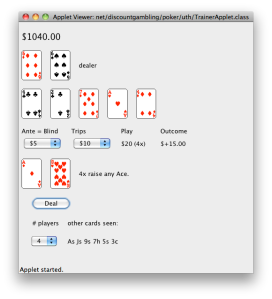
Ultimate Texas Hold'Em Practice Game (Screenshot)
- The Wizard Of Odds on Ultimate Texas Hold’em. I used his overall return numbers on the ante, blind, and play bets. These numbers take weeks of compute time to grind out.
- All my posts on Ultimate Texas Hold’em
- Practical Collusion for UTH. How to get an edge by sharing card information with the table.
- My 2009 UTH Win/Loss Statement
- A Week Of Ultimate Texas Hold’em, my initial obsession with the game.







 Discount Gambling
I was looking at the data provided by the Wizard, and if I am reading his matrix correctly,nonsuited 8/q shows a -.0694 return. 9/q turns positive with +.1325
Suited 6/q shows -.006 and turns positive at 7/q.
Similarly, nonsuited King, turns positive at K/7 not 5 or 6.
Suited King 2, is negative and turns positive at suited K-3.
Which is correct for the large raise ?
Thanks
Art S.
Do you think the house can control the cards which are dealt through the Shuffle Master? I have seen way too many cases where dealer pulls very low probability scenarios constantly – pocket low cards that hit an inside straight; players have trips and dealer gets full house; player pocket Kings and dealer gets pocket Aces – it is one improbable scenario after another. What do you think? Is this random or can the Shuffle Master program sequences to flop? At least control that players get low cards off suit and then when they fold, even if dealer has nothing, the house still wins.
Yes, I definitely think the shufflemaster machines do not deal a fair game. I have tracked over 600,000 hands comparing house hands to player hands disregarding whether the player plays or not and the house won over 58% of the time. This shouldn’t be. Both the house and player hands should be random giving each a 50-50 chance of winning if taken to the river with no betting.
On Tue, Jun 14, 2022 at 12:26 AM Discount Gambling < comment-reply@wordpress.com> wrote:
I just got back from the mirage playing pai gow and I recorded all my hands and out of 87 I won 5 lost 33 and pushed 49 ….I knew I was being taken advantage of
Just because the EV is negative for a 4x raise on K5o or Q8o doesn’t mean you should check. You should raise these hands over the long run, because you’ll lose less by doing so. Of course, you’re risking more in the short-term, so for borderline cases, it’s up to you to decide on the tradeoff. I’ll put these decision points into the table above, so you can see the value of the 4x raise vs checking for these hands.
Thanks for the quick response.
Two more questions :
1.After the flop, you are four to a flush, the board is suited.
You have a bet strategy for 2nd nut, 3rd nut, and 5th nut plus 3rd nut kicker.
What about 4th nut?
2. Betting combination draws.
Your third example shows a hand of 3h 6h, and you check because yuo are holding a 3. What is the rule here. What is the minimum to bet?
I have played this game 6 or 7 times… Have won once… Very suspicious of dealing machine… Seems to know how to set the cards against you.. Dealer has two full houses back to back.. Dealer has to straights back to back.. It seems like everytime i have a pair they always beat me.. Try going in with an A or K you get crushed every time.. They always seem to have a pair against you..Makes you wonder… What u say ?//
Dennis ( lvden7@msn.com)
I’m actually trying out ShuffleMaster’s Ultimate Draw Poker (not Ultimate Texas Holdem) machine (multi-player video console, not the cards & table version). I’ve worked out optimal discard strategy on that game. I’ve played it a few times, and am really suspicious myself. It should only be a .6% house edge, but plays disasterously. I’ll try it a few more times, and I’ll probably conclude it’s fixed :). I might contact the company if I get killed a few more times. Are you talking about a video machine version of UTH? I heard they exist …
I have played this game many many many times…and he is absolutely correct…they deal out really good hands..but dealer majority of the times seems to always get the best hand…can you actually call shuffle-master and have them look into it..? eg..you get pair of aces..dealer gets two pair../// you get two pair. dealer gets 3 of a kind../ I have been meaning to file a complaint.. but I was told since the casino is owned by the Oklahoma Indians..there is nothing you can do..!!! UTH not the video machine
What does bother me about these machines is that it is absolutely clear in games like Pai Gow that the machine KNOWS who has what cards. Those of you that have played a machine dealt version of Pai Gow probably are aware that due to the complexity of setting some “house” hands, the table has a feature in which at the touch of the screen on the table, the computer will tell the dealer what their “2-card” (low hand) hand should be. It can’t do that if it doesn’t know ALL SEVEN of the dealer’s cards and which numbered hand went where. The idea that therefore the machine could know the dealer’s card without knowing the player’s cards as well is far-fetched. So while it doesn’t automatically mean the machine knows the board and hole cards of everyone in Hold ‘Em, it certainly shows it CAN be done. That said, I still love the game.
I have hit quads back to back once. So if the game is “fixed”, I guess they were throwing me a bone that day. lol
On the second one, I was holding a J3, and the dealer flopped three J’s! Unfortunately, this pre-dates the progressive pot where I would have gotten an additional $300 for flopping quads. I had raised my trips bet though as I often do after hitting a big hand on the previous one. 🙂
To bet your 4th, 5th, and 6th nut flush draws, your kicker must be at least 3rd nut to bet. E.g., you bet 2x for JhQd on a 3h6h8h board; but you’d check Jh9d for the same board.
The lowest combo draw (outside straight & flush draw) you 2x bet is when you’re holding 64s or so. This rule might not be absolutely exact, but it’s close enough. You’re alllowed to approximate and gamble every now and then 🙂 All flop bets are 2x, else check.
Thank you, this is great work.
Allow me to ask a basic question.
For the river bet, with two pairs on the board, the strategy would play the board
when its kicker is 3rd nut. If the board was showing a pair of aces and a pair of kings,
would you bet the board with a queen 5th card or would you also play a jack or a ten
on the board?
Similar question would apply to your river bet strategy for trips or quads on the board.
If the board was AAKKQ, then the board kicker is 1st nut. For AAKKJ, the board kicker is 2nd nut. For AAKKT the board kicker is 3rd nut. You would call to play the board on all these cases. Interestingly, I just ran AAKK9, where the board kicker is 4th nut. You actually should call this case too, even though my basic strategy card says fold. This is probably because even if the dealer has a pocket pair of 9’s or lower, it can’t play.
The trips and quads on board are as I described on this page. To calculate “board kicker nut level”, you need to count the number of possible dealer kickers that will play, and add 1. So, for AAKKT, there are two dealer kickers that will beat the board (Q or J). Take these 2, add 1, and you get board kicker = 3rd nut.
“Interestingly, I just ran AAKK9, where the board kicker is 4th nut. You actually should call this case too, even though my basic strategy card says fold. This is probably because even if the dealer has a pocket pair of 9’s or lower, it can’t play.”
Wouldn’t a pocket pair of 9s make a full house? Nines full of Aces.
Good point. Made that “even if the dealer had a pocket pair of 8’s or lower, it can’t play.” Thanks!
I was curious about the side bet “trips” and whether or not you play it? I live in Vegas and spend alot of the time in the casinos. I just discovered this game.
I don’t usually play the Trips bet. Although the house edge is only 1.9%, it adds up over the long run, and I play a lot. Besides, the Blind bet gets paid 500:1 for a Royal Flush, and 50:1 for a straight flush (more than the Trips bet), so I don’t see a real need to bet it. Occasionally I’ll try a Trips bet, just for the fun of it. It’s pretty obvious that the dealers want you to bet it, because that’s where they make their tips. But over the long run, I’d rather make my 4x Play bets, since winning one of those pays almost as good as a straight on the Trips bet.
Do you have any insiights as to how this game is being rated for comps.
a) bets per hour, avg. bet, house edge
b) have the casinos started to downtick players who look like they are playing
a strong basic strategy? ala blackjack.
c) how do you think $25 ante and blind, following your strategy would compare to
$25 on the pass line with two $25 come bets at the craps table.
I have heard that the house take on this game is huge. With comps thrown in,
it could be very interesting.
A few of us have commented on receiving good cashback rates for this game. I’m pretty sure I’m +EV at casinopauma.com, since I play $5 Ante=Blind, and they give me between $5-$7/hr cashback. (At 40 hands/hr, I’m giving up $4/hr in house edge.) I have no idea what comps are like in Vegas. It’d be interesting to hear what others have experienced. If it’s anywhere near their BJ comp rate, I should be playing weekends over there.
I have no idea how prevalent UTH is in Las Vegas. It is plentiful and popular in the local casinos around where I live, but I know for a fact in Atlantic City it is only in three casinos (Bally’s, Caesars, and Trump Marina) out of 11 and only one table at each. Of course, there are much better plays in Vegas as I’m sure you know, for example they have 3x and 10x WPT hold-em with a <1.8% house edge at most of the MGM/Mirage properties and the Wynn.
You should ride up to Vegas, we would love to read a trip report!
I was in Las Vegas last month and played UTH at the Wynn, $10 min. Planet Hollywood
$5 min, and Treasure Island, $5 min. Wynn told me they would only rate my p;ay at the $25 ante bet level. Treasure Island wanted $25 min play for the ante,blind and trips combined before they would even take my players card. PH said they would rate my play, $10 ante.
I contacted Shufflemaster asking for more locations to play.
On the strip : Bellagio, Mirage, Luxor
Downtown: Golden Nugget
Others: Aliente Station, Gold Coast, Green Valley Ranch, LV Hilton, River Palms Stratosphere, Orleans.
I suggest calling ahead. The same email said that UTH was now in the Mohegan Sun in Conn. I told a friend who reported back that he could not find it there, and no one
at the casino ever heard of it.
I am headed bach to Las Vegas next week to really play this and would be glad to give a trip report.
BTW, how do you enter a trip report on this site.
Profbac- I can’t speak for the owner of this blog, but can probably send Stephen your report and he will post it for you. It would be interesting to see how you get rated.
Have you ever tried WPT 10x or 3x hold ’em table games? The house edge is 1.5% and .79% respectively, and the strategy is on the Wizard of Odd’s site. It’s very easy. I know for a fact Wynn has the 10x version and Mirage has the 3x.
Profbac–You will stand to lose $20/hour playing UTH. In craps, with two come bets out, you will stand to lose between $16-$50/hour assuming 48 point decisions per hour. With the more generous comp structure, I’d said UTH is the clear choice. Plus, it is more of a challenge as opposed to the pure luck game that is craps.
And yes, the hold percentage on this game is very high, usually between 24-27% cash dropped goes to the house which makes it very lucrative for them. This is a similar percentage to Spanish 21, 3-card poker, and Let It Ride.
Ted
Look me up on Lasvegasadvisor.com with a Private message, I will fill you in on
the comps situation.
I’m so glad I found this guide.
This will give me something to memorize and practice when I’m bored with Chinese.
I’m planning on trying to implement this strategy at Riverwind Casino to try and earn some extra spending money this semester.
Any general tips? I am by no means a gambler, and have only been through casinos a few times. I’ve been obsessed with Hold ’em for a couple of years, though, and have recently found profit in picky but aggressive play.
You don’t have to memorize the table, but you can practice. All casinos I’ve been to allow players to use basic strategy cards. If you love poker, you’ll probably find this table game a lot more interesting than blackjack. As the only one playing the game properly, you’ll find that basic strategy for this game makes pretty interesting table talk. If you keep to the minimum bet, with a sufficient bankroll, you’ll find the game extremely cheap entertainment. Have fun and teach others!
Steve,
I assume I have been talking to you at Harrahs Rincon. Tuesday the 12th?
Just checking your site for more info.
Tom Retired navy dude.
Yep, that’s me. Commit the 4x raising hands to memory, and the rest is easy! Play using basic strategy, and you’ll log more winning sessions. (Did you say you never log a win?) See you this weekend out at Harrah’s.
This is such a fun game that I love it so much. I have visisted casino so freguently in the past 6 months, just to play this game. With minimum bet $5, I found out it is fun and relaxed. However I lost almost $1,500 at Mandalay Bay during X-Mas 2009. Its dealrs just kept having impossible hands and killed me and everyone. I agree with Stephenhow’s strategy. I do not place more wager on trip than ante. I also use 3x bet on certain hole cards such as pair 4,5 6.
What’s more important about playing pocket 3’s, 4’s, and 5’s is to ask around how many of you outs are gone. I’ll post information about this shortly (probably my next post).
My wife is big into penny slot’s so she drag’s me to casino a lot (Oklahoma). I always found it difficult to gamble but I found this game two weeks ago and played it twice and really enjoyed it. Trying to follow your rules seemed to work, sat at table for 4 plus hours holding my own. A lot longer than I ever did playing Black Jack. Sat at table with $50 with $2 ante towards end of night was playing $5.
Did see a number of other players getting burned pretty bad. They seemed to be placing too much value on trips bet and I lead on the 4X betting.
What to you mean “ask around how many of your outs are gone?” House seems to be open about handling of cards, but I thought you had to keep your cards hidden from other players.
There’s a lot of ways to discretely collude. I find it manageable with 3-4 players, and if I sit on an end, its easy for me to flash my cards. If the other players are in-the-know, they’ll just chime in if they have your cards copied. Then I’ll know what to do. If you look at my Practical Collusion for UTH post, you’ll see how powerful sharing card info is.
Steve,
Went to Harrahs FRI and SAT.
Missed you at the table.
Kept the cheat sheet in my pocket for reference on preflop bets.
Spent a total of 24 hors at the table and won a few bucks. I was only behind once for about $75,
Hope to see you soon.
Tom (retired navy)
Cool! I finally got there yesterday (Sun afternoon), and the dealer (Suei) told me you played with the Basic Strategy card all day and night, and did fine. I ended up perfectly even after about 4 hours of play myself. Good job! Now, we’ll get better at colluding! 🙂
I booked rooms for thu and Fri.
Hope to see you there
I am becoming more and more suspicious of those “random” shuffle machines employed almost all casinos. Especially in games like let it ride where an inordinate number of low cards are dealt while the face cards are buried at the bottom, and what other posters have said about the hold em games setting you up. The starting deal for the cards in the hold em game should vary everytime by a roll of the dice, not with the player in 1st base every time. anyone who doesn’t think that with only a modest amount of computer help these shuffle can’t set the deck in favor of the house is awfully trusting of the casino industry…I’ve given up table games for poker and I am glad I did…
I tend to trust the games, but I wish every casino would simply cut the deck out of the shuffling machine, and deal out hands one card at a time. They do this at one of my local casinos (Harrah’s Rincon). If they simply did this, there’d be no argument over fairness, no suspicion. What’s worse, the new Dealer Bluff game uses hardware to read all the hands out of the shuffler, then uses software to make the dealer bet. Every time I play the game, this discussion comes up, and there’s usually a very irate player. They really need to cut the deck. Geez, even a magician will do it.
On the other hand, there’s a rational argument to why the game is fair using these shufflers, even without a dealer cut. The individual casino cannot “fix” the game, and tampering of the game would have to be implemented by ShuffleMaster, since they provide all the equipment. There’s almost certainly no hardware in the shufflers to arrange cards, since it’d be visible by inspection, and many people (gaming commission, techs, floormen, dealers, and even players) see the insides of the shufflers quite frequently (think jam). The hardware consists of a wheel-like device with many slots for holding cards as they’re randomly shuffled in. If there was any engineered-in ability to arrange the cards, it would be practically impossible to keep secret (somebody along the line would leak it, or blackmail over it, or exploit it). Since ShuffleMaster’s viability is dependent upon its reputation, it’s unlikely they’d risk everything on rigging a game with a house edge. I’m pretty sure it’s been demonstrated time and again that a fair casino is a license to print money (watch people check their monsters in UTH).
Still, I think the casino just needs to cut the deck out of the shuffler. I guess they think they can get a few more hands per hour if the dealer just places cards, instead of actually dealing them. Well, there’s a bright side to this — they can design the game for a lower per-hand house edge if they can increase the table hold with a higher hand rate.
Just got my win/loss statement from Harrahs.
According to them I lost $400 last year on the tables.
YOU HAVE TO BE KIDDING ME!!!!!!!!!
According to my records I lost $15000
I lose more than $400 in a session sometimes and I have NEVER left the casino winners.
Called my casino host and was told to ask before leaving the table what they have me down for.
I guess just because you are a $5 bettor (which is a joke as it usually is at least $10 even if you fold) you are not important.
I totled up our losses for the last 3 years according to THEIR records and we are out $75K.
Lost $10K already this year. Might have to change casinos.
same thing happen to me, ithink they do this for book purposes for irs.
I think it happens like this….You buy in initially for $100 and the floor will USUALLY put that into the computer. the next three times you buy in $100 they probably are not putting it in because they really don’t care. For rating you, they only care about your average bet. However, when you cash anything out they encourage you to color up and they MUST track all the 100+ chips. So they are forced to account for all that leave the table. My feeling is that sometimes when they don’t know who took the $100 they just put it on some player’s account. I know they look at me like a freak when I attempt to make sure they put it every one of my buy ins. I also try to hide as much as I can.
Bottom line though, the IRS is pretty clear that a win/loss statement from a casino is NOT sufficient evidence of gambling wins/losses. You are only supposed to keep your own detailed records with things like date, location, table # if possible, game, who you were with, etc. Also, you can’t really get away with gettig a W-2g from Casino A, then using a win/loss from Casino B that shows a loss as an offset. You would need to report ALL the wins and loss from all locations. So, even though it’s frustrating the win/loss statement doesn’t mean much to you or the casino.
I just played this game the other night and it kept me going for a very long time. After about 5 hours, I walked away with $360 (I sat down with $60)… I am very pleased with this game and can’t wait to go back! I am so glad that I found this table game! It’s awesome!
Steve,
Spent Sun and Mon at Harrahs. Looked for you but you must have taken time off.
Played for quite a while and did pretty good.
Did hit a boat at Mississipi with $50 bet.
Saw a LOT of ppl losing $$ not betting on the ace on UTH.
Hi,
my casino offers to bet 3x or 4x the BB before the flop. Is there any combination which would suggest to bet just 3x?
Thanks
There’s never any reason to bet 3x. If you should raise preflop, then raise 4x.
Stephen – Just to clarify, I’m referring pre-flop to only the minimal gain situations;
of course the big and modest gainers can always be justified as long as
one is playing with sufficient bankroll.
Juan (MathProf)
Steve, BS indicates raise 2X post-flop with pocket 5’s but you would have already
raised 4X (?) Also with pocket 4’s, 3’s, you would have checked only if one
or two fellow players held an out but would that now affect your decision
post-flop especially if players held both outs and you had dead pair?
I’m enjoying your site tremendously and I hope that you continue to investigate
this game – I’ll be 10 days in LV and 10 days in Reno starting 2/28 – would you
be interested in trip report regarding UTH?
Juan (MathProf)
I put in the 2x bet with 5’s in the strategy chart for completeness. Of course you’re supposed to 4x raise this hand preflop, but many won’t do it. So, I include all flop cases you should bet 2x on, *not* assuming that people have already 4x raised these situations. It’s their 2nd chance to bet. (A lot of times I see people miss their 4x bets, then miss their 2x bets, then finally 1x bet their monsters.)
For pocket 3’s, only raise if no 3 seen in other players hands. For pocket 4’s, only raise if at most one 4 is seen in other players hands.
Sure, post all trip reports! People find them useful. Good luck!
I discovered this game last Spring while in Vegas for a trade show. I left some friends about 11:00pm to go back to my room and get some sleep. Passed UTH on the way and threw $100 down. As you recommend above, I skipped the trips bet and instead went very aggressive at the open. It was a grind, and I knew I was in trouble when a new dealer came to the table and said “Good Morning Everyone”. It was 6:00am. I went up and grabbed a shower and went straight to the show for a grueling day, but I made $1,100 playing UTH. I gave $300 back on a subsequent trip three weeks later, but I agree: skip the trips (sucker) bet, and go big at the open.
Some thoughts on the 4X raise:
Since the ante and Blind are horrendous bets, we are all inclined to “go for the
throat” pre-flop. However, this bet must be treated like an insurance bet in
blackjack – totally unrelated to the original wager; your river bet is the one bet that is
original bet related because if you don’t bet one unit you lose Ante and Blind.
When raising 3X or 4X we introduce tremendous variance (big money swings) and
it seems to me that betting 4 units for a miniscule gain in profitability would be
“overbetting your bankroll” in Kelly terms.
Stephen and others – all thoughts appreciated
Juan (MathProf)
Some thoughts, though not math-ish:
Kelly does not apply here because it is a negative E.V. situation. There is no optimal Kelly number for the game unless you are playing with an advantage, which is nigh-impossible in this game.
Raising 4X does introduce tremendous variance but remember you are only betting it when you have the advantage. In that way it is similar to doubling down in blackjack. It’s not like betting the trips bet or the extra coin to play Super Times Play video poker. You don’t have the advantage on those bets and they just increase variance.
Anyway, I’m just talking out of my butt here so maybe Stephen could post some math to back me up.
Hi,
min. bet is $2. Are $200 at the beginning enough to raise 4X pre-flop or will the money swings kill all the money too soon?
Thanks
I address this issue in my latest post on session outcomes given bankroll, goals, and time.
Richy – looks like Stephen’s first scenario for 100 antes fits your
situation nicely – good luck!
Juan (MathProf)
just discovered the game in my local casino and love it. (even though i obviously had a wrong strategy for i always played the trips).
do you know if there is a place/site/service somewhere in the internet where i can play it online? I’d like to try out your strategy on a low level, before i enter the casino and play with 100 ante… maybe there’s some game with another name – as far as i found out the name is copyrighted by shufflemaster.
keep up the good work!
I’ll probably write a UTH applet sometime soon. I’ll keep you posted on it’s progress. Other than an iPhone app, I haven’t seen any places to practice the game yet.
Steve
thanks!
re: Abbreviated strategy for flop bet (2x)
A respected advantage play author has recommended the following flop bet strategy: (preflop strategy is the same as you recommend) also, this assumes that the preflop strategy is followed exactly.
1. Trips on the board ; bet if you hold a king or ace
2. You pair up, including pocket twos
3. The board is paired and you hold a Jack or better, and there is a flush draw
(4 to a flush) or four to an open ended straight.
4. No pairs; bet if you have four to a flush and a hole card that is a ten or higher.
What is the effect on the house edge using this for the flop bet as opposed to your more detailed flop strategy?
I’d have to code up his strategy and run simulations to see how suboptimal it is. It’s probably not much, since these cases are relatively infrequent in the scheme of things, and the differences between checking and betting here is small. But, people should be aware when they’re using approximations, and not propagate them as the gospel truth 🙂
Profbac, I agree. Not to impugn Stephen’s wonderful work in the slightest, but there must be a simpler strategy that distills the chart into a few simple rules of thumb, without giving back too much of the house advantage. Similar to the Wizard of Odds’ “simple blackjack strategy” chart.
I haven’t played UTH in a while (limits are too dang high here! people are really flocking to blow their money on this game), but it would seem to me just following the basic pre-flop strategy will put you in a better position that 90% of the players out there. Then, maybe there are 5-10 simple rules for post-flop/river betting that can whittle the house edge down to a manageable number.
IMHO Stephen has done outstanding work.
The difficulty has been in quickly implementing these rules at the table.
While the optimal strategy shows a low house edge, I suspect the cost of errors is quite high.
I had to rearrange the information in a format that fits my own decision process while in the heat of battle. I created four or five strategy cards, that suited me, and
my way of thinking about poker strategy. Simpler than it sounds. If this then do that…
BTW, I have been playing the $10 table at Balley’s in AC, maybe two hours per month.
The comps have been for $25 cash back, $25 food credit, and the usual free room.
I think this actually comes out to a positive expectation when counting comps.
PS. I played this at the Wynn, $25 ante for about four hours. Nothing in comps.
Not even a discounted rate on a room.
Look me up on Las Vegas advisor if you want to compare notes.
Stephen, what is the name of the iPhone app featuring UTHE? I searched the obvious names in iTunes and came up empty. Looking for some practice on the flight from Mpls to Vegas on March 25th.
Also, great site, thanks for sharing your knowledge!
Hey Russ,
The iPhone game is here: http://www.candywriter.com/ultimateholdem.html
BTW, I’m almost done writing my Java UTH trainer game for this site. It works fine, I’m just adding notations and more features. The last hand I played on my game, I bet $10 on the Trips bet, and flopped quad 6’s 🙂
Stay tuned, my app will be up in a few days.
Good luck in Vegas!
Hello, I have been following the basic stragit for UTH and been doing pretty good at it, I had one day I lost big, but I win about 75% of the time, my new stragety is to lose less smaler buy ins, and that seems to be workgin out well.
My question is, has anyone seen an different stragy for UTH , if u can see other cards that are in play, do oither readjust how they play or when they play if theri outs are alreay in play? I kow I foudn a website that talked about it, but I decidee to try out the system first see how it goes get good atit b4 I tried to accoutn for other cards in play, but now I cant seem to find the site that talks about that. Anyone that can help woudl be great…. thanks.
Read this post about adjusting your play based on seeing your neighbor’s cards:
Practical Collusion for UTH
Stephen,
I’m not writing on here to brag, but simply to give everyone hope. Last Friday, I was at WinStar Casino in OK playing UTH on a $5 min and $50 max table. I had studied your work all week long leading up to my trip of destiny. Three hours of cyclical ups and downs had passed by when I was finally up about $700 (I was betting $15 in trips, $25 ante and blind). With only about an hour left to play, I decided to bet the max on ante and blind and $25 on trips. The dealer was wiping me out. My stack had gone down about $300. On the next particular hand, I asked the dealer, James, if he’d ever dealt a Royal Flush on a max bet…only to look down and see QJ of diamonds. He said no, he’d dealt one to a $30 bet and I told him that we’re off to a good start….so I made the play bet of $150 and was waiting anxiously for the flop. Ad, 7c, 10d…No way!? I said…James, if there’s a Kd on the turn or river, I’m going to jump outta of my seat! The player in seat 4 had already made his play bet and said that he had a red king, but he couldn’t remember if it was a diamond. No worries. The Kd came on the river and I went absolutely banannas! After meeting up with a slew of Casino Big Shots and waiting for over an hour…I finally walked outta there with $27,100 and that included the $26,450 Royal Flush.
So to all of you guys who say the machines are rigged….not this time.
I discovered this game a little over a year ago and I love it despite the frequent frustrations I experience playing it. VERY suspicious of shuffling machine – how many times does the dealer pull inside straights [I can’t even pull them when I am open-ended] – suited hole cards for a flush [I rarely get a flush when 4 cards of the same suit are on the board] – pocket pairs that screw the players [I have seen players lose all too often with Pocket Aces – gee I never see them at Texas Hold Em Bonus table] – and dealer pairing with BOTH hole cards when I bet 4x [this often happens for a dealer full house].
I mean how many hands can that damn machine possibly rig? I have had ONE straight flush and never seen ANYONE [oops I saw the dealer get one] get a royal flush.
I have bet 4x on Aces very often and find it works approx 65% of the time. 2 face cards also do well but the rest of your guidelines seem to deplete my bankroll. After the flop if I double down [2x] on anything less than TOP PAIR I seem to lose but staying in after the river with a 10high and a pair showing on the board works more often than one might think. Hmmmm
Not knocking your strategy – actually I am glad to have found this site.
I do play the trips bet but NEVER for more than the ante – in 4 consecutive hands last night I hit Full House, Full House, Flush, Straight. Then I bet 15 on Trips, Ante and Blind – had AQ suited and bet 4x on the play and quickly lost the hand. From there it was downhill fast….
Next hand I bet $5 instead of 15 and won the hand – wow timing…..
I have played this game 300+ hours now all at Winstar (OK). Last year they had the normal Shufflemaster shufflers and although you could get some bad hands lasting 10-15 in a row, there tended to be a few people with winning trends at the table which played for 6+ hours at a time. In about the first 100 hours of play I had two straight flushes and many four a kinds. I have also one the Royal once last summer. Last year I saw lots of great pay-outs with straigh flushes and even Royals to others.
In Jan I played for about 18 hours straight and won 5 four of kinds and several boats (I agree that was just lucky.) I was playing mostly green after I had momentum and was cleaning up there that day. At the time they had a couple of machines with new ShuffleMaster hightech machines and many with the old fashioned Shufflemasters. I was on a table with the old shufflemaster. There was some scandal on the new type tester machine … I was told a few Royals were given out in one night on that machine so they shut it down or switched it out (obviously a malfunctioning machine.)
When I came back after the big win, all tables have the new hightech shufflemaster. I was told it can take a mixed deck and put it in order. It has some type of imaging system and I have read there may be a wireless text messageing feature to be malipulated by the house. I will tell you, I didn’t have just one bad night where I can longer get trips or better very often…I can count the trips or better on one hand after about 8+ hours of play …about 5 trips or better …that’s it. It is to the point, the odds cannot be right. I sat at first seat for about 8+ hours one day and had 1 flush and a few trips all day – that’s not just bad luck, that’s the machine. I have realized 1st seat on this new machine is usually dealt bad cards and when people come and go changing the number seated at the table it tends to be “more confused” and gives out bad cards to the dealer (as if expecting someone seated at last seat.) Just when you think you can “prove” there is an issue by “predicting its behavior like giving itself the Ace of Spades with 4 spades on the board… it will pay for a short period of time. Although I cannot prove it, I am convinced the new shuffle machines are rigged. If you play enough hands you should see some winning hands in a row since on the 2x or 4x bet (regardless of you doing a trips bet), but I can predict no traction at UTH for any length of time moving foward at Winstar. Yes a Royal is being given out here or there…I’m not saying it never pays just like in slots… you can have one jackpot winner but everyone for a week that put’s in the $100 loses it.
I have watched my poker friends which were regulars there all last year, stop going because they are all losing on a regular basis…including myself. It is one thing to have a bad night or even a few in a row but hours and hours everytime of no cards and the machines have to be rigged (and not just me – I the whole table loses.) I believe the casino is not regulated and they have somehow tweaked or tech modified these new machine to put the odds way into their favor.
I have decided to go to Vegas this weekend to pay UTH there to see if there is a difference in my expericence of late. I have an idea that even if I don’t win, things will be more “even” with some win…some lose over a period of time.
If anyone has played UTH at Winstar and Vegas, please tell me if you experienced a difference (besides the .50 a hand bs.)
At one local card room in Yakima Wa., they allow your UTH cards to be put face up by the player. Players choice. Only place I know of that does that.
Hypothetical question: I know they are called random shufflers, but this is what I am unsure about. Let’s say if the dealer puts the deck just how they come out of a new package. A-K in each suit. Will the shuffler shuffle them identically each time. What I am getting at is, if one saw the bottom card when the dealer loads the machine will it come out at the same place each time during the play?
Also, some dealers where I live do not slide the cards low to the table and if I am sitting back a bit in my chair I can sometimes see the bottom cards being put onto the felt. As long as I am not lowering my head to try to take advantage, is this considered cheating?
I guess I have to go by Tom Mc from now on. lol
Gl all.
Since using your strategy card, I have not lost in 4 sessions. Thanks for doing the grunt work. In my latest trip to the Green Valley Ranch, I ran into a dealer who said your strategy would spell my certain demise. She claimed she had been dealing UTH since the day they installed it and that I would certainly lose following the strategy card. She really tried to make me feel uncomfortable, but I just kept 4-betting the borderline plays and was winning them with uncommon regularity. She couldn’t believe I was 4-betting with Q7 suited on one hand until it beat her. The table was also lucky enough to share 4 queens on the board. The collusion thing definitely helps as well.
I think certain betting patterns during certain swings you are in..as I have played the game goes in some serious swings of ups and downs… So I think reducing your ante/blind/trips bet is very important or increasing your bet obviously if you’re running hot, to maximize profits.
Great breakdowns, ya’ll. I have a math question, because I am bad at math.
I plan on traveling to Winstar in Oklahoma ( 4 UTHE tables) and unfortunately due to an agreement the tribe signed with the state (or something) they have to drop .50 at the beginning of the hand. Every hand. Goes to the state or the tribe but not a dropped jackpot of any kind from what I have read. They said table min limits are almost always $5.They do the same thing with all the table games, and they don’t spread craps or roulette, I’m told.
Just how negatively does this affect my effective odds? I got spoiled playing THEB in vegas and I haven’t played UTHE yet anywhere and would like to try it. But not if I am getting robbed.
Thanks in advance…
That $.50 collection at the Winstar Casino is horrible. Unless they offer a better-than-standard Trips or Blind paytable, I’d say the game is unplayable. Normally, the house edge for $5 UTH is only $0.11 per hand, on average. If you decide to play the game, you should probably bet at least $20 Antes, to reduce the house edge (to only twice as bad as normal). The good thing about the $.50 collection is that it’ll probably help you to get up and leave once you’ve made a profit.
Steve,
I generally play UTH at Pechanga on Friday evenings, trying to get there before they raise the rent (from $5 to $10 or even $15). I read through the articles and comments and it appears that I’ve been playing this game wrong and I haven’t seen anyone playing it right. I came away from a table up $200 last Friday while the average loss for the remaining spots was probably in excess of $1000 (yes, 1 grand).
I looked at the Pauma website and they don’t list UTH as one of their games. Is it still there and is it sometimes a $2 ante (a couple of the comments read that way)? I’ve been testing your java applet and would like to see how I fare for real but a lower entry would make my wallet happier while I’m starting out.
Thanks.
The Pauma game is $5, although they let you bet just Trips, if you want. The best thing about Pauma is the $5/hr player rewards you get for game, since they rate you for $20/hand at UTH. BTW, the Pawn Stars cast will be at Pauma this Sunday (May 16th).
Hey guys – Love the posts!
I have been playing this game for over a year at Pala, Pechanga, and Harrah’s. Like the Harrah’s rewards the best. I am in Vista and open to going out with a group 🙂
Lets plan a getaway . . .
Also – where is this Applet you made – I wanna practice 🙂
Great work! Never had the nerve to play the 4x that aggressively, but it worked well this past weekend (Riverside, Iowa). A $200 bankroll was plenty as I had 5 of 7 winning sessions (2-3 hours each), and in one of the losers, I was up nearly double before bleeding too much back (last play before leaving; should have gotten up and walked away earlier than I did). The dealers were aghast at my play and shocked to see it work.
Pete, I am with you, I played using the basics and was up $400 after starting with a c-note. I never thought that playing that aggressively would actually payoff. I was wondering if anyone ever did any semi-martingale (bet 5, lose, bet 10, lose, bet 15)?
i would never use martingale on this game since the amount you risk is more than what you get paid, unless you make trips or higher. what i have done, with decent results, when i am running bad is only play the trips bet every 5th hand. i usually make an equal wager on the trips bet as my ante bet. when i do every 5th instead, i bet 25 on the trips. so, instead of betting 50 in 5 hands, i am betting 25 in five hands, but all the risk is in one single hand rather than spread across 5 hands. when i am running bad or not hitting the trips much, this seems to work better for me. the only time i increase my overall bets is when i notice the dealer is consistently not connecting with the board.
When I calculate the odds of winning with hands like 22 or k2 offsuit through the programs that run millions of simulations it comes up that I may win less than 50% of the time but still win more often than the dealer. Why wouldn’t I play max on any hand that I win more often than the dealer?
Just came back from Vegas. Discovered this game at the Aria (MGM property)Really loved this game. Gotta admit it has swings. Played min $10 bet with $10 blind. Occasional Trips bet. Sat down 10 times and walked out $100+ 9 times. Key is to walk with you triple your bank roll unless you like to watch the stack go up and down. Hit quads 2 times. Never fold. Always bet the min. Sucks to have a 5/6 and the dealer to be sitting with 3/4 or something. I repeat – have a goal and walk when you reach it.
If one doesn’t play the trips isn’t it heads up poker with the dealer for who has the best hand? So How does the dealer have an advantage?
The Play bet (4x preflop, 2x flop, 1x river) is heads up poker with the dealer. Of course, the player has the advantage here (+45.9%), since the dealer plays no-foldem, while the player looks at his hand, and bets accordingly. The house advantage comes from the Blind bet (-31.5%) which only pays for straights or better, and the Ante bet (-16.6%) which only pays if the dealer qualifies. In total, these three bets sum to a 2.2% house edge.
is there anywhee to play this game online??
Alan
Just look to the right side of the page and select practice game.
Stephan wrote a program for thi and Mississippi stud.
You can play UTH Poker Stars.com.
I have played this game about 10 times, and twice the dealer didn’t push back the ante if they didn’t have a pair. I was wondering how common this mistake is and also what is the expected value of the game with this extra payout? It would seem that this would make the game +EV since they probably had to include the qualifier to make it -EV. Just a thought.
“Never fold. Always bet the min.” Can this work?
“I have bet 4x on Aces very often and find it works approx 65% of the time. 2 face cards also do well but the rest of your guidelines seem to deplete my bankroll. After the flop if I double down [2x] on anything less than TOP PAIR I seem to lose but staying in after the river with a 10high and a pair showing on the board works more often than one might think.”
Does less than TOP PAIR mean a one Hole Card of 7 or more matching a card on the board? And 10high means a hole card? or 10high on board along with a pair on board?
2x
“1. Trips on the board ; bet if you hold a king or ace
2. You pair up, including pocket twos
3. The board is paired and you hold a Jack or better, and there is a flush draw
(4 to a flush) or four to an open ended straight.
4. No pairs; bet if you have four to a flush and a hole card that is a ten or higher.”
Above looks like good simple strategy for 2x
but what about for 1x river?
what I mean is say take blackjack for example there is a very simple strategy you find on websites:
always split aces and 8’s
DD on 10 or 11 unless D shows a 10 or Ace
hit till 12 when D shows 7 or less
hit till 17 when dealer shows 7 or more
also I found a site saying with UTH one should 4x 38percent of the time
so I assume 2x would be more than that, so maybe never fold 1x is ok because you will be 1x so few times and maybe dealer want qualify anyways?
Here’s my simple rules for playing UTH:
1. 4x raise by the book, except when minimum raising hands are copied by other players.
2. 2x bet any pair made on flop, except bottom pair on suited board w/o flush draw.
3. 2x bet nut kicker against a paired board, or nut kicker with a gutshot draw.
4. 2x bet open ended straight draws when both cards are higher than an 8.
5. 2x bet 4th nut flush draw.
6. Fold kickers against scare board. 1x call bottom pair and 4th nut kicker against scare board.
7. 1x call 2nd nut kicker on unpaired board, 3rd nut kicker on paired board, 5th nut kicker on double paired board.
Hi, love your site and it informative, just start to play UTH and use strategy on this site. I still do not know many jargon of the game like “4th nut” or “scare board” “idiot-end” “gutshot”. Please have glossary that let newbies know what you are talking about. Really appreciated your help.
Best regards
I think i found a hand in the UTH practice game that gives mistaken advice. I have 74o, and the board is KJ874, of which 4 are diamonds. This is a scare board, but I have two pair. I think I should bet 1x, but the advice is to fold to scare board.
Thanks for all your hard work, love the site.
A quick heads-up to readers regarding the “virtual” UTH machines that have been popping up. For those who have seen ShuffleMaster’s virtual Blackjack terminals, (the ones with attractive dealers on a big video screen) the UTH machines look very similar except, of course, for the game played.
I encountered two such machines on a recent trip to northern Nevada, at Grand Sierra (Reno) and Montbleu (Tahoe). At first glance, they appear to offer the same game as a live table would. However, after playing a few hands I noticed that the Blind bet does NOT pay out on a winning straight! It starts paying at 3:2 for a flush and up only.
I don’t have the wherewithal to calculate what this does to the house edge, but I can’t imagine it’s a positive effect, and could possibly make it much worse.
So be aware of this if you come across a virtual UTH machine. At the very least, play it only for very low stakes (minimums on both machines were $1), not the same as you would with a live dealer.
On a strange side note, Montbleu’s machine DID offer the best possible Trips bet payout (paying 9:1 for a full house). Dunno how that makes up for the Blind though.
On another side note, only three casinos in Reno have the game (on a real table) that I saw–Nugget, Peppermill, and Silver Legacy. Of the three, Peppermill is the only one with the “good” Trips paytable (paying 5:1 for a straight), so I’d recommend playing there.
Binions and Las Vegas Club in LV both have it, for $1. I also like to play it for low stakes, and for practice. Thanks for the heads up about the short-pay on the straight. I would estimate that adds another 2-3% to the house edge.
I’m puzzled by a couple of things here:
1) Wherever I’ve gone (primarily in Nevada) where this game is offered, there’s an option to bet either 3 or 4 times the Ante bet initially, yet here and Wizard of Odds always seem to just show to bet 4 times. Is there ever a time to bet only 3 times? And if so, why do these strategy tables not reflect this?
2) On a number of items regarding strategy after the flop, the strategy above (and Wizard of Odds too) recommends betting on hands that were previously recommended to bet on the pre-flop round. (For example, 3c 3d (in hand) 7h 7d Th -0.1361 -0.2446 CHECK pair < fives on paired board with no board undercards, or Ah Kd (in hand) 4h 5s 9s -0.6489 -0.6570 non-paired board, check nut kickers). This is really confusing….
Thanx, in advance, for any responses.
If you raise pre-flop, always raise 4x, never 3x. The Play bet heavily favors the player, since you’re playing against a blind dealer hand. If you have a good hand, bet as much as they’ll let you (which is 4x preflop, 2x on the flop, 1x on the river).
For completeness, I filled in the strategy for all cases on the flop, just in case you didn’t raise a preflop hand like pocket 3’s, or AKo. So, while you were supposed to raise pocket 3’s preflop, if you decided to check (e.g., someone else was holding a 3), then the strategy tells you to bet the flop only if there’s an undercard on board (i.e., a deuce). Similarly, if you checked A2 preflop (because you were scared, or your neighbor had a deuce), and the flop is KKQ, then you should bet your A2 because of the nut kicker. So none of the strategy is conflicting, but rather covers every case, just in case you didn’t bet preflop, or flop, etc.
I took the basics with me to Viejas with a 100 bankroll and walked away at 300. Pretty solid strategy, though the Aces didnt play out as well as I’d hoped, maybe a 50% rate for me. Other laughed at my 4x betting, and I will admit to 3x betting when others had similar cards. I also played trips each time, which payed out quite well. One lucky sould was playing the progressive and hit the Full house on the flop, trip queens for the rest of us. In anycase, thanks again for the help, and maybe we can plan an outing one time.
Just started playing this game two weeks ago and have used the info from this site and WoO from the start. I have played at Pechanga and Harrah’s Rincon and my preference is Harrah’s by a long shot! Harrah’s uses an automated card shuffler like the ones used in the poker rooms and they deal out the cards one at a time around the table. i believe they also burn a card before the flop and before the the turn/river cards are flipped. i find this much better than the shufflemaster shufflers Pechanga uses, which spits out 5 consecutive community cards first and then 2 consecutive cards for each player and dealer afterwards. overall, i am down at Pechanga and up at Harrah’s, but overall down. I have yet to complete a flush at Pechanga while holding two suited cards, but i understand i have not logged substantial time at the tables yet for it to be unusual. everyone thinks i am crazy raising so often preflop…sometimes making it uncomfortable at the tables when other players and dealers are telling me i am playing wrong. one session i felt like the enemy at the table because i was winning my play bets so often. i keep playing through all the negativity and try not to comment too much. This game is very fun and exciting, and like the real Texas Hold’em, there can be some attitude at the table.
one thing i need to work on is to stop making 3x bets and to start making 4x bets instead.
Just got back from playing 3 hours at Harrah’s Rincon and after an up and down (mostly down) session, i managed to walk away with $120 in winnings…this is making $5 bets for the most part and raising full 4x when supposed to. i didn’t hit any big trips bonuses, just a couple straights and flushes. on the way home i stopped by Pechanga and managed to lose $300 in 45 minutes and this is betting table minimum of $5! did not hit any trips bonuses at all…i am really beginning to hate the Shuffle Master machine at Pechanga. The way Harrah’s operates their UTH game definitely seems more fair and random. if someone joins or sits-out a hand at Harrah’s, the flop and hole cards are affected. at Pechanga, if someone sits out or joins the table, the community cards are completely unaffected and the players cards remain the same, except they just get shifted to another player, depending on how many players left or joined the table. I also noticed that at Harrah’s, the dealer does in fact cut the cards before the deal. you can even tell them where you want them to cut it…deep, shallow, or right in the middle.
I played at Harrahs Monday from 1130 Am until 0300 Tu.
Heard a lot of remarks about my 4 times bets and saw a lot of people lose a chance to cash in on them.
One person next to me actually called me crazy. Funny part is he would never even look at his cards until after the flop.
I did ok on holdem but went to Mississippi Stud and lost it.
Remember. If you can bet three you can bet four.
Steve
Thanks again for the Mississippi Stud practice game.
Tom Mc
Tom,
I’m usually one of those only bet 3x people at the beginning of the night on a marginal starting hand (K-5 off suit sort of thing). I won’t go to 4x until after I’ve got a handle on the flow of the cards and my bankroll can survive losing several consecutive hands. You can’t win if you don’t play and you can’t play if you have no money to bet because you gave it all away early. I don’t usually wait until after the flop to see if my hand will “improve” before betting though. I know I don’t bet everything I’m “supposed” to (I haven’t got the entire strategy card memorized yet) but I’ve got enough of it that I don’t have too many losing sessions.
I get a lot of comments about my pre-flop bets === “Geesh, that guy never gets two cards he doesn’t like.” “You bet on a Jack-Ten off-suit? What are you, nuts?” “A lousy pair of three’s and you bet already? Guess you don’t plan on staying around long.”
sean
Usually play at Pechanga (closer). Went to Rincon Friday night due to reading the differences in the game play here. Played from 5pm – 10pm and quadrupled my starting bank. What was especially nice was no raising of rent by the house. Usually see $5 minimums when I arrive with it raised to $10 by 7pm and $15 by 10pm regardless of how busy it is. Minimum was still $5 when I left
I liked the single card dealing vice the pre-packed hands from the shufflemasters. Three sets of quads on my table (Qs – me, Ks – 1st base, As – dealer). Three sets on table next to me (dealer gots 6s, the other two went to players). I don’t normally see that many in a session at Pechanga. No straight flushes on either table though.
Saw a lot of money left on the table by players around me. Pocket pairs (3 and above) that didn’t get bet until after the river, pairs (one on the board, one in the hand – from the flop) that were folded, starting hands with two face cards that weren’t bet pre-flop or post-flop. Seems a lot of the players were waiting until they had a “pat” hand before they bet. That’s a break-even proposition at best — in most of these cases, they had a higher bet in the trips box than they had in the ante. When dealer didn’t qualify, they may have “won” the hand and got paid off on their $5 play bet, but they lost $15 on trips so ended up with a net loss of $10 per hand.
All in all, a nice change of pace and if it wasn’t for the drive back up the hill on Pala-Pechanga road I’d go there more often.
sean
Sean,
I started out playing this game at Pechanga and like you, prefer to go there because it is just an easier casino to get to, but i have gotten to hate that ShuffleMaster shuffler so much, i try to avoid that game entirely over there…although, it stilled suckered me to play as i passed the casino on the way home from Harrah’s on friday…and of course i lost there again, after winning at Harrah’s. one of my first sessions at Pechanga was playing all night making $5 and $10 bets and using optimum strategy…lost $1800 before going to another table and being on tilt, i played $25 trips, blind, and ante on the first hand and got K-3 off…flopped trip kings and got the fourth on the river…even though i won $1000 in bonus on that hand, i still left a loser. ShuffleMaster dealt tables are my nemesis!
When were you at Rincon on friday? i was there from about 11am to about 2:30pm. i had a dealer named Lance who dealt quads on the board on my table and then dealt another big hand on the board at the adjacent table.
Doh! got caught up in my reply that i had already forgetten you had mentioned when you were at Rincon. Doh! Doh!
Is it possible to have an edge against the house with this game, following your strategy in this article?
Even using a collusion strategy with a full table, you can only reduce the house edge to about -1.6% of the Ante, on average ($0.08/hand @ $5 Ante). But the edge is pretty small relative to the average total bet, so you can look at the “element of risk” to be -1.6%/4.2 = -0.38%, which is pretty good. Also, by setting goals (outcome distributions with collusion), you can give yourself a 70% of winning a session, and a 68% chance of meeting your goal.
One thing i have noticed lately is that the dealers at Rincon seem to be used to our way of playing now. i have not gotten any comments from them the last couple of sessions. the dealers at Pechanga, however, are still making comments about the aggressive preflop betting. They are certain that this style betting will make one go broke quick. funny thing is, maybe they are trying to give me subtle hints…”Don’t play like that on our tables because these machines will break you!”
I have noticed that the dealers at Harrah’s have been mentioning Steve a lot more as have some of the players.
I love it when the 4 times bet works and people shake their heads.
Anyone going out tonight to Viejas? Would love to meet someone from the group
Hi there!
Here in Berlin, Germany, they introduced the game a week ago. I was wondering about the following: When the player has made his Play-Bet, loses to the Dealer at the showdown but the Dealer doesn’t qualify, the Ante still pushes! Is that the correct rule? Because I never noticed that in the Java-game above where I always lost the total ante-,Play- and blind-bets…
Regards,
Jules
great site,
anywhere I can get or buy memory cards (80 years old).
long time holdem player.
tried it once and came out a winner.
need cards of positive hands to play
joe,
Just scroll to the top and print out the cards there.
I find it hard to believe that the majority of the players (particularly at the 3 casinos that I played the last two days) do not follow the “basic strategy.” I walked up to the game with $120 buy-in, played for three hours, and walked away with $900. I consistently play the “trips” option, but I religiously play the 4x strategy. People are startled that I bet the A-4 unsuited, or the K-7 suited. When I fire these off, they tend to hit 75% of the time. Nice game and glad to find it.
-Tony L., from San Francisco
Most people who play this game are playing to win the trips bet and not really caring about maximizing the play bets. They are there to try to hit a big multiplier hand. the swings can be huge by playing by the “book”, or rather, by the “blog” in our case. however, when you hit a winning streak in this game, you can expect it to be pretty big…sadly, the same can be true for when the tables turn and you hit a losing streak.
Hey guys, went to Viejas last night and had a great session. There were 2 of us playing and we alternated straights and flushes throughout the night. We were also lucky enough to get several full houses and I even got quads!! Once the table filled though no one else shared information and we started getting some bad hands so we left. I went from 50 to 300 in about 3 hours of play. Also it should be noted that Viejas no longer offers progressive jackpots. There was a nice $20,000 jackpot last week for a royal flush on the flop, but the only payouts now are the ones on the table.
I’ll be going to Harrah’s and Pechanga on Sunday from about 10am to about 4pm…anyone want to join?
Anyone going to Viejas tonight or tomorrow?
I will be at Harrahs Rincon Sat the 25th of SEP
Always wear Retired SCPO Navy hat.
Get in around noon be there until late night.
Has anyone played at Viejas lately? Since they took away the progressive jackpot and changed the table, AND the shuffler, the table has become nearly unwinnable. I played numerous sessions with the old shuffler and had ups and downs throughout a session, but had success more often than not when using the proper betting techniques. Now, you can sit for an hour and not win a trips bet. No one the table is winning. In a game that is basically 50/50 against the dealer, the blind and ante pushes being the house advantage, every time I’ve played against this new shuffler I’ve literally lost 70-75% of my hands (including the ones I could have won if I had played and the dealer didn’t qualify.) I don’t plan on playing at Viejas again until they can start dealing like Harrah’s. I disagree with you Steve on that a casino would never rig a shuffler. If it’s possible they absolutely would take advantage of it.
not gonna lie the last few sessions at Viejas have been extremely harsh. I doubt they rigged it, but I’m going to wait a bit before I play again.
i have had 4 straight losing sessions at Harrah’s myself lately and ironically have been winning at Pechanga. Harrah’s hand deals while Pechanga has the automatic shuffler that pre-groups the community cards and all the players cards. Never been to Vieja’s, but it sounds like they went to an automatic shuffler system like Pechanga has. i always thought that Harrah’s was the fairest and the automatic shufflers seemed to always favor the dealer, but now i feel it’s just a streaky game. so far in my short experience the good and bad streaks on the automatic machines are magnified over the hand dealt games…maybe it’s because you play more hands per hour, but to me it seems one or two seats tend to get the goods hands longer than others.
This. There was one time where people at the table fought over one player’s seat after they hit many consecutive trips. IDK, maybe its just luck of the draw in the seats. The machine HAS to give the house an advantage, or else it wouldnt be widely used. I wish the machine would break so they could deal by hand.,…
Hi,
I went to Harrahs a few days ago. Played about 12 hours, Back and forth between UTH and Miss Stud.
Finally got my wife off the slots and she did quite well on UTH.
Hi to Allen if you come here.
I love playing the game. Went to Vegas a few weeks ago and won a gook 1K + in 3 days
Having trouble getting the applet to even begin to open? Unable to open website?
Any help thanks
Hi,
I recently starting playing this game in the Chicago Area after finding it on my last day on a Vegas trip. I realized that everyone was playing it wrong but couldn’t figure out what I was missing. Then I looked at wizardofodds.com and realized that people in general are being way too passive. My friends had to drag me away from the table at Mandalay Bay in order for us to make our flight. Fast forward 2 months. I found out that both Ameristar in Hammond, IN and Potawotomi Casino in Milwaukee both have the game.
I went to Ameristar and had terrible luck. I noticed that the payoffs on the trips bet were not as good as I remembered from when I was in Vegas, but didn’t think much of it. Ameristar played where the “trips” bet is a completed separate bet where it didn’t matter if you folded after the river, they just tucked your cards under the trips bet and if the board had trips or better (for instance board was 999TK and I folded 43), you would get paid. I thought this was the norm.
Then I went to Potawatomi and played, and the trips odds were better, but on one of my last hands, the board was 999TK and I had 2 rags, so I went to throw them in and the dealer and everyone else at the table said that I was crazy and that I needed to bet the play bet, even though I was going to lose, in order to win the trips bet.
What is the standard here?
Thanks.
Whytee (Matt)
if you have to pay to play the trips, i will only play it if the payoff of the trips bet will make me net positive on the hand or if my overall loss in the hand will be less than if i just folded.
I’ve made a point of asking to be sure they all know the rule that you can be paid on Trips if you fold. The dealers don’t always know, so ask the pit boss for a ruling. Everywhere has confirmed it to me.
I thought the Ameristar Trips payoffs were the standard I’ve seen everywhere.
The game is also at Riverside in Iowa. A nice place we’ve enjoyed.
Pete,
That’s exactly what I tried to do. The pit boss told me the exact same thing. She had no idea what I meant by “trips being a completely separate bet”. I feel like they are screwing everyone on this. They all acted like I was crazy (including all the players).
Whytee (Matt)
Pete / Matt,
I live in Southern California within a half hour drive of 4 different casinos I’ve played UTH at. There are slight variances in the play between them, but the payout tables are the same across the board. Two of the four let you ‘surrender’ after the river and still get paid on trips, the other two don’t. Three of them pull the 5 community cards from the shuffler, then distribute already paired cards to each player and the dealer. One takes the entire deck out, cuts it then deals one card at a time to each player and the dealer (twice for 2 cards each), burns a card, turns three, burns a card, turns two. One place gets downright ugly if you touch your cards before the unused deck is in the discard box while the rest will let you look before the deck is discarded. One place wants near silence at the table while another almost lets you place ‘go fish’ “Anyone got any 7’s? No, okay, I’ll bet 4x”. The other two are sort of in between. They don’t want you discussing the cards but won’t say anything about looking at them in such a manner that your neighbors can look also.
sean
If I’m playing the Trips bet, and the board is trips or better, and I have a folding hand, I would insist that they pay my Trips bet. ShuffleMaster intends that the Trip bet is independent of the Ante/Blind/Play wagers, and I’m sure they don’t want individual casinos messing around with their product. The licensing agreement probably says something to that effect. So, I think it’s a matter of educating the casino on how the Trips bet is supposed to be paid. Definitely try to straighten them out the next time it comes up.
Steve
Sean,
Let us know which casino is doing what.
Tom,
Rincon and Pala I know let you ‘surrender’ after the river and still get paid on trips. I know that Pechanga doesn’t. I’ve played twice at Pauma but haven’t seen trips or better on the board so don’t know about them.
Rincon is the one that has the cards hand dealt. Seems a bit more ‘honest’ game to me, but its the furthest of the four casinos so don’t get out there that often. I’ve had straight flushes (twice) and a royal flush taken away from me either by players coming into an empty seat or sitting a hand out and the cards (when dealt five in a lump then pairs to each hand) get shifted by one spot up or back. For that reason, I prefer first base if its open just so my cards never change.
Harrah’s has two tables and I’ve seen rent stay at $5 until late at night on Fridays and Saturdays. Pauma has only one table. I did see it get raised to $10 when the house was full. They were the place that shushed us for discussing our hands. Harrah’s will practically let you play ‘go fish’.
Pala has two tables — I don’t know how they decide when to raise the rent. Their stools are uncomfortable anyway (sort of forward leaning so you have to continually keep yourself braced into the seat). Pechanga has a total of seven tables but the last group of three doesn’t normally get opened until late on Fridays and Saturdays. They’ve also got the highest prices. Its not unusual to see $15 minimums with a half-empty house. They prefer you don’t touch the cards until after they’re in the discard box, but will tolerate a little bit of discussion and somewhat open looks at your hand (allowing you to share info with your neighbors).
The mechanics of play won’t vary but some of the table activities might depending on which dealers / pit bosses (table games supervisors) are working so talking / sharing of info might be different day to day or even shift to shift within a casino.
sean
Hey ,
Whenn is the last time anyone saw a “pit boss” now they just have “table game supervisors” Years ago they did have one person that was in charge of the whole “pit”.
I don’t see that anymore.
Steve,
Long time no see at Harrah’s. Talked to a player that played with you at Pauma a few days ago.
Tom
Tom, that wasn’t me … I’m generally only play at Viejas now, and I enjoy the card craps game the most. Viejas is a lot closer for me, plus, their player rewards are pretty generous (min $20/day). It sounds like a few of you up there are showing everyone how the game should be played 🙂
Hey Guys,
Does anyone know if Bally’s Las Vegas has UTH?
Thanks,
Whytee (Matt)
yes, they have one or two tables and they use the shuffler that spits out 5 community cards and then two cards for each player. if you want a hand dealt table, then try Aria.
Thanks Mike, do you know if Paris has it? We changed our reservation to there yesterday. Thanks agai.
Whytee (Matt)
i don’t think Paris has it…at least i didn’t see it there during my quick walk-through of the place while looking for my friend. Aria is pretty much right across the street in City Center, so you can go there if Paris ends up not having it.
Pete,
BTW, I went to Ameristar against yesterday and the payoff for trips is definitely less, only 7:1 for FH, 6:1 for Flush, and 5:1 for Straight.
Whytee (Matt)
you’ll be happy to hear that the payoffs in vegas are what you are used to…8:1 for FH and 7:1 for Flush…don’t remember what the Straight payoff was.
I just found this site; great information. I’m a $100+ BJ player and recently started playing UTH at the tables at WinStar in Oklahoma. I’ve played 6 or 7 times for 8+ hrs each time – once for 24 hrs straight – you might say I’m addicted. Here are some observations:
1. I play the max bet ($50) on the ante, blind and trips
2. I raise to 4x whenever it makes sense
3. I rarely fold because it’s worth $50 to insure $150 and during a good run, I’ll at least push more often than not where a fold guarantees a loss
4. Session management is key to leaving with more than you brought. It’s a game of streaks and timing is everything
5. The best hand I’ve had is quad 7’s
6. I’m up a cumulative $10 grand so far which is less than my usual ups for BJ for the same amount of time spent, but it’s much less stressful even though my average total bet is higher
7. Whatever your betting level is, make sure you have plenty of time and $$$ to stay in the game during down times. The cards will change
8. Last but not least, I’m sure that by employing the strategies on this site, will greatly improve anyone’s bottom line. I’m going to use them when I play tomorrow
Thanks for the great information!!!
hello, i am writting from switzerland….. and i play sometimes this game in our casinos….
your site was a great help for me, for learning the basic strategies……. thanks for that!
so now, i have question: whats better, when i play 2 rows ( with 5 dollar ante and blind) or only one row (with 10 dollar ante and blind) ??
thanks
Are you asking if it’s better to play 2 games @ $5 ante/blind vs. 1 game @ $10 ante/blind? There’s no difference in long-term averages (EV) between these two options. Personally, I prefer playing minimum bets, because I just enjoy playing the game as slowly as possible 🙂
Regarding this last question, I do have a question about this. A friend and I play together frequently, and split all of our winnings (or losses). Obviously we realize that the net gain will be the same playing $10 on a single spot, versus 2-$5 spots, however, the difference MUST cause some change to the overall variation from the mean. In other words, would you expect more of a variance or less when playing 2 spots.
Definitely, you’re better off playing two hands over one when you can collude using the other card info to improve your decisions. As I’ve posted before, this both improves your EV and reduces your variance.
Stephen,
I definitely agree with that collusion aspect. But what would you expect on the impact on the variance without colluding?
Thanks.
Right, playing twice the hands cuts the variance in half:
http://en.wikipedia.org/wiki/Variance#Population_variance_and_sample_variance
Not exactly. If both hands are playing the same dealer, there is a correlation between the results in the 2 hands.
Good point!
why isn’t your 4x preflop range wider….such a hand like 10 9s has 54% equity against a random dealer hand preflop. thanks for the help.
While a 4x Play bet for T9s may be +EV, the EV is higher by checking preflop, and betting 2x or 1x later. So while it may not be -EV to raise preflop with T9s, it’s worth more to check first. I.e., it’s better to check and catch up with a 2x bet on the flop (or 1x bet on the river), than it is to bet 4x preflop and miss the board.
thanks for the reply. very appreciative.
Just wanted to reiterate David’s comment from July 23. I love the practice game, but bottom two pair on a scare board shouldn’t be folded. It’s happened to me several times. Of course I always call the river and lose anyway. 🙂
Has anyone come up with a good progression strategy for the ante and play bet.
A positive or negatve progression could be interesting.
Profbac, that’s essentially what I am working on. Fortunately for me, the place where I play allows me to raise my wager in $1 increments, rather than $5. I start with $5 and progress to 6, 7, 8, 10, 15, based on winning wagers. I bump it up with either a trips bet win, or a 4x win.
I feel like proper money management puts this game in the black for me.
I’m sure there may be a better way to do it, and if anyone has an idea, please post it.
Thanks,
Matt
bump up in $5 or $10 increments if i am in a streak where i am beating the dealer consistently or if the dealer is consistently missing the board. if i hit the trips bet 2 times in a row, i will double the trips bet the next two rounds to cover both decks in case one particular deck is running hot. i am always keeping track of the decks…which one is running hot and which one is running cold. i will vary my bets according to the deck color until i notice a change in streaks. if i am having a really good streak, i will sock away a green chip every now and then and half of any trips bet of flush or better, in order to guarantee that i will walk away from the table with something. if i am running a really bad cold streak i will play minimum bets and tighten up my preflop raising considerably…raising only face cards or pairs of 10s or higher. that is probably the wrong way to play, but i have had bad streaks where had i not raised, but did 2x after flop instead, i would have lost less. basically, i bet aggressive when i am running hot and tighten down when running cold.
Went to Harrah’s Rincon Sunday.
Funny. The dealers all know Steves method of play.
(They miss you Steve).
I saw so many players with great cards waiting for the river. If I could only have played their cards.
Did ok at UTH but went to MI stud. I was down $975 out of my $1000 limit for the day.
Put $50 in my pocket to go to the bar and played the last $25. Walked away with $17 00.
Wife lost $1000 in slots. Got $100 from me played MI stud and hit quads 3rd hand.
Had fun. DON”T CHASE CARDS. lol
BTW Only played $5 ante.
Hi Steve–
What do you think of the Wizard of Odds’ new strategy for UTH? It seems significantly different (not to mention more complicated) than yours:
http://wizardofodds.com/games/ultimate-texas-hold-em/ult-tx-hold-em-adv-strategy.html
Went to Harerah’s the 5th Sunday and came home winning $3600.
Some on UTH Most on Mississippi.
Same thing people waiting with good cards until the flop.
Got the same remarks ” why do you bet those cards preflop?” After watching some learn some don’t.
One player playing $10 ante and $35 trip bet. He hit a full house. Same crap he says “see you have to bet big here on trips”. Bottom line is he went broke on trip bets and I walked a winner.
Steven,
Not so sure about the randomness of your UTH practice game. Within ten minutes of play, the dealer was dealt two straight flushes, a four of a kind and numerous full houses and straights.
i haven’t tried the practice game much, but i can say that i have seen some crazy dealer hands for real in certain sessions. last week, at Pechanga, one dealer dealt himself a straight flush and quads…back-to-back! every outcome is independent, so as unbelievable as some of the losing streaks may seem, they are possible.
It’s random. I use the java.util.Collections shuffle function. I’m on the road to Vegas! See you at the Aria!
Good luck at Aria…i love that casino…long but easy layout. i’ll be in vegas in a couple weeks for CES, so if anyone wants to hit some UTH together, post up.
Well done! Your employer (which casino is it?) will be glad to know I fell for your line of crap hook, line and sinker, and added to their profits. I had never played this game before, saw the Wizard of Odds site, which linked to this one, and saw the strategy. It was all very convincing about all the computer work etc. that went into developing this great strategy for this great low vig game. I assume you won’t allow this post, or you’ll delete it, but maybe one person will see it before it’s gone and save their money. I played at Harrah’s in St. Louis (live game). $5 min, and I only bet the minimum all night. I took the strategy card with me and played it and lost $400 in about 3 hours. It was a continuous downwared spiral spread out over two different tables. I MAYBE won 20% of the hands I raised with pre-flop. For the most part, no matter what I had, the dealer had a better hand. For instance, my best pre-flop hand was JJ. I flopped a J (yippee!). Four clubs came and the dealer had 82 offsuit with the 2 clubs. I lost a couple of other sets to straights. If I had a big A, I would hit nothing and the dealer would pair up with their junk hand. At least three times I had a small pair (either pre-flop or on the flop) that made two pair, and the turn and river was 55 or 77, etc. counterfitting my two pair. Dealer wins with J high or whatever. The few decent hands I had were when I tripped up with a T2, or made a straight because I had a 5 in my hand or something. This game is horrible, and the strategy is worthless. I saw where the casinos are making a killing on this game, and now I know why. Stay away people.
That does sound like a rough time. I’v played this game a lot, and there are bad spirals. I’ve also had good ones. Were you able to get info from the other players on their hands? That helps shift the odds.
All of us that have played this game regularly have had a -$400 session. We’ve also have had +$400 sessions. Ups and downs, it’s a roller-coaster. The math is right. If you look at my post on possible session outcomes, your probability of losing 80 antes in 100 hands (approx. 3 hrs) isn’t that small. (Integrate the area under the green curve from the left to the -80 ante point.) It’s a sizeable fraction.
Tom,
I’ve played a bit over 12,000 hands live at $10 increments (INCLUDING the trips bet), and I am up $450. At about $600,000 total wagered over that period, the hourly rate is terrible. But the sample size is, um, quite a bit more than your 3 hour jaunt through a bad run of cards.
That said, I’ve been up $4,000 and down $5,000 (a $9000 swing). So if you don’t have the stomach for it (which you clearly do not), it’s not the same for you. But it is very near break even, math-wise.
Maybe next time you start making accusations about people’s motivation, you should realize that anything can happen over 3 months, let alone 3 days.
Matt
Just like others have said, I’ve had great runs and have had horrible runs. At the end of the day it is still called gambling for a reason.
Just came back from Harrah’s Rincon. Had a $3000 down trend where dealer was hot. Hung in and got it all back plus a few.
I still see players losing money on bets I would have made preflop.
Most are betting heavy on TRIPS and losing fast. If you don’t get the preflop bets down your playing for a push in most cases. So if you get a lot of pushes and a few losses your not winning are you.
So, should I bet the Trips bet? And if yes, what % of the Ante/Blind bet should I place for the Trips bet????? In other words, if I bet $25 each on the Ante/Blind bets, what’s the optimum bet on the Trips? $10? $15? Or $0????
Thanx in advance for any responses. Heading to Vegas next week and look forward to partaking this game!
BadBill,
Can’t tell you what the “optimum” trips bet is but I see people losing their money quick overbetting the spot. I see them make table minimum ($5 or $10) ante and blind then put $25 or more on trips. If they hit a bonus hand, great but if they don’t then they get behind very quickly and never catch up. I’ve had sessions where I’ve played for two hours or more without getting more than two pair but still came out ahead by betting the before the flop using as much as I can remember of the strategy above. And if the cards are “cold”, change tables or casinos.
You should also check on “surrender” rules if you do play trips.
Example —
Community cards — ten, ten, ten, king, queen
My hand — four, five
One place I play will let me get paid trips without having to put chips in the “bet” spot another won’t. So for the hand above, if I’ve got $10 in each spot and have to “bet” another $10 its a push hand (take $30 – ante, blind, bet and get paid $30 on trips) if I don’t have to “bet” I net win $10.
seand summed it up pretty good Bill.
seand and Tom Mc:
Thanx for the comments, but I don’t see the answer to what I asked. Just a comment to not “overbet” this Trips bet.
Restating my query: Should I play Trips? And if yes, what % of the Ante/Blind bet should I bet on Trips? I agree to not bet more than the Ante/Blind bet, but a range of what is appropriate would be helpful.
BB
I would never bet more on trips than I do on the ante.
If you see Steve play he very seldom plays trips.
I wish I played the Trips on my last hand. I made a straight flush, and won $250 on the Blind. I guess I would have made another $200 on the Trips if I bet it 😦
Love this site as I play UTH very often at my casino. I use to play online poker, but fell in love with UTH and just play that non stop. I’ve had sick swings just like everyone else. I just have a few questions that need to be clarified. Also my new years resolution was to quit playing trips and I did that yesterday. I won 170 in about 1.5 hours betting 10/10 no trips. Shipping every all in I had.
Trips bet… it says -1.9% so does that mean every 100 you wager you lose 110 dollars?
4x bet it says it’s +45% ev so does that mean every 100 you will win 145? Not sure if I am doing the percentages right or not. Any help would be appreciated.
With the 6/flush, 5/straight Trips paytable, the cost is -1.9%, meaning that you’ll lose one bet for every 52 hands you play it. Or, for every $100 wagered on trips, you’ll lose $1.90.
No, +45% EV on the Play bet means that if you play it right (4x when you should, 2x when you should, 1x when you should), you’ll average a (0.45)(Ante) win. You should look at the Wizard Of Odds tables for EVs (returns) for a given hand. The returns are always stated in terms of an Ante, not the total amount of action bet.
Thanks so really for a sucker bet…. trips technically isn’t that bad of a bet? I use to play it but haven’t so far this year. I won 128.00 in about 1.5 hours of play. Had a ten dollar table heads up and had two different guys who had no clueabout the game come sit down, and play. When two tables over is a 5 dollar minimum yet they find me. Three out of the four hands I had all ins, and because they jumped in dealer had trips 3 out of 4 times. It was gross. I could of had a bigger winning session if they didnt jump in, or if I stayed but we all know if you stay long they win eventually.
Well, I actually think that between the Players Rewards, and the dealer mis-pays, the game is +EV. I get $20/day in Players Rewards, which will cover around 200 hands of house edge at $5/hand. A lot of times I’ll receive either a paid Ante when the dealer doesn’t qualify, or sometimes an outright blunder where they pay a 4x losing hand. The latter is like a +$55 differential, which will pay for 550 hands of house edge. I’m pretty sure the dealer mis-pays alone cover the house edge 🙂
I agree this site is awesome with wizard of ods by far this is the best game in the casino, especially with these resources. Just to add on to your house edge by dealer screw ups. On NYE’s they raised the tables to 15 minimum which in the two years of playing, its never been that high. Ten is the highest by far, anyways I had bet 15/15 no trips, got Ace/8 Suited and shipped in 60. Dealer put broadway on the board, then the dealer ask’s the floor person how to pay out. And they both agree to pay all three spots + trips instead of pushing and pay trips. So I won a quick 100 just off that hand alone!
I see mis-pays quite often. It depends on the dealer and the other players (if any) at the table if I correct the payout. Most of the time its due to the dealer either not reading their hand right (missing a second pair or a straight) or going down to six cards instead of stopping at five on a push.
I also see and hear people trying to confuse the dealers and that just slows down the game.
Yep, I see people “take shots” at dealers all the time. Some dealers really have a problem reading two pair hands when the kicker on the board plays. Tonite, the players convinced the dealer they pushed with an inferior two pair hand. The dealer called over the floor, who also couldn’t read the hand. Then they said “push”, and they *paid* the losing player hand. Unbelievable, and very awkward. All the players hold their breath until the dealer mucks the hand.
Stephen, one more follow up question, which way do you go about attacking the game? Do you play 5/5/5? 5/5 no trips? 10/10 5 trips? Or do you just randomly play trips here and there? Seems to me if I were to play trips that 15/15 5 trip bet would be ok. I witnessed a guy betting 10/10 25-40 trips bet the other day and he was running amazing. Hitting trips like 3 out of every 10 hands. Of course he told me that is where the money is at.
I only play $5 Ante, and I’ll occasionally make a $5 Trips bet. I mostly play Trips so I can toke a $1 Trips bet for the dealer. I am all about discount gambling.
Played at Harrah’s yesterday.
I still can’t believe the way people play for a $5 win or a push.
Guy at the table was betting average of $30 on trips. He finnally hit a big hand but was way down still.
Saw a royal at seat six yesterday. The guy tapped out and started to get up then got out another $100.
Played Pala for an hour and a half on Sunday. Full table playing $10 / $10 / $10. Got paid one straight flush and missed quads by one hand (was sitting third base and the player in spot 5 sat out a hand and the dealer got quad nine’s instead of me). All in all a lucrative holiday season — quad’s at Pauma once, Pechanga twice, and the straight flush at Pala.
Hi Tom! That’ll be your Royal soon. I saw a sick hand today @ Viejas. The guy next to me makes a crazy $100/$100/$30 bet, and the board flops KKK. He pairs his 8 on the turn to make KKK88. The river is a low blank. So he’s celebrating, thinking he just made $240 + $500. The dealer turns up an 8 as well, so he pushes, making only $240 + $0. He’s pissed, because the dealer was making everything, and this was the last straw. He used some expletives for a while.
Steve,
how do you get all these comps? I was in Vegas recently, playing Harrah’s properties, around 20 hours at Bally’s 5/5/5, 4 hours at Paris, 10/10/10, 4 hours at Rio, 5/5/5 and an hour at Caesars 10/10/10.
My total rewards went up about $18 for the trip.
Thanks,
Matt
The local casinos are definitely better than the Strip casinos for comps and player rewards. Here in the greater San Diego region, we have a dozen or so casinos. A few are really good with the cash back (Pauma offers $5/hr for 5/5/0 UTH). Maybe you can look into some off-the-strip casinos like the Silverton. Well, hopefully you got your room comp’ed.
Harrah’s Rincon has started giving food comps at the table .
They are pretty liberal . They started out asking us but now I ask them after I have played a few hours.
By the way. You really have to watch the dealers close. I saw too many pushes being raked the other day. Almost as if it was a new house strategy.
Went last night and played, went with 10/10/10 I bought in for 430. I honestly played less then 20 hands. I won 3 hands. Lost about every all in, and really I only won 2 hands but dealer paid out a a hand she had me beat. It was as bad as I ever ran in that game in a long time
For those of you studying real Texas Holdem, look at Dan Harrington “Expert
Strategy for No Limit Tournaments”, Volume II, pages 365 and 366, titled
Hand Rankings in Heads Up Play. If you look at the hands with a 52% or better positive
expectation you will get a list that looks almost identical to the pre flop strategy for UTH.
If you are getting annoyed with other players ridiculing your play at UTH,
ask them if they have ever played heads up poker, or made it to the final table.
Do it with your best game face, and watch how they react.
I’m on a small trip across the country, and found a tiny little racino in NM that is slots only (it’s near El Paso, TX) but has a virtual UTH machine for $3. It’s little bit steeper than I’d hoped–was looking for a $1 machine–but I decided to give it a shot anyway.
I was pleasantly surprised that, unlike the machines I described in my earlier post, the Blind bet was full-pay (even money on a winning straight), making the game identical to a real table. Unfortunately, the Trips paytable was also the worst possible one (7:1 for a full house).
None of it mattered, of course, since I blew through $300 in about 2 hours, even just making the minimum bet. 😦
Some very suspicious bad beats throughout the night. The worst one actually happened twice…I bet 4x on K6 suited. Another player has pocket sixes (the cards are all face up on the machine). The dealer…just happens to have the last remaining six with an Ace kicker. I could understand this happening once, but TWICE within 10 hands of each other? What are the odds? (OK, the details were a little different each time, but I do specifically remember three out of the four 6’s in players’ hands, and the dealer having the remaining one both times…to the detriment of all the players.)
I’m not going to accuse anyone of rigging the machine right out…I have also had some pretty nasty fake money-losing sessions using the game on this site as well (which I trust to be honest, since there’s no financial gain from it). But it was still very disheartening.
I’m leaving for Vegas in a few hours, hope I have better luck there.
Was that Sunland Park?
Well, I made it to Vegas, and have one piece of advice to all UTH fans out there: if you’re visiting, play at Bally’s.
Why, you may ask? The following reasons:
1. The best possible Trips paytable (9:1 on a full house, 0.9% house edge)
2. For those who are paranoid about auto-shufflers…there isn’t one! Dealer shuffles by hand after each round.
3. Just a good atmosphere in general: friendly dealers, speedy drink service. (Definitely try to play in the evening when “Jerrod” is there.)
I’ve done very well at the game so far. Have won about $500 playing at various places. (Lost more playing other games, but that’s another story.). So again, if you’re in Vegas and need a UTH fix, I can’t recommend Bally’s highly enough.
Agree 100% about Bally’s. Additionally, they will let you share information entirely, and don’t care whatsoever. Worst part is you can’t play until noon, which completely sucks.
Good to hear the UTH at Bally’s is good. I will be playing there March 17-20th for March Madness. I have always had good experiences with the staff at this property and I’m not surprised to hear good things.
Hey guys, a heads up for those in San Diego. I just got an mailer from Barona and inside it me said due to popular demand, Ultimate Texas Hold-em will be added to the chipless roster. Not sure when it will be, but I will for sure keep an eye out. Now there really in a reason for me to go to Viejas, other than the buster Blackjack bet.
Hi vg, I heard about UTH heading to the Barona iTables too. I was definitely interested at first, but after I thought about it, I’m not sure if I like it. The iTable takes away any possibility of dealer mistakes and mis-pays in the player’s favor. I *do not* take shots at dealers, but they’ll occasionally not see their straight, and pay the player bets instead of taking them. That’s a huge differential, and frankly, it’s the difference for me between a losing game, and a +EV game (that pays for my tokes). I think I average a +$50 mis-pay every few sessions …
I went to Pala for the first time this week. I have never seen such conservative players and it was all encouraged by this smarmy little twit dealer. I had players sit down next to me and ask me to give guidance on what hands to be betting. The entire table would roll their eyes at me and basically call me crazy for playing hands pre-flop like K-J os, A-J, and even A-K. The stupid dealer was telling everyone “you shouldn’t be betting pre-flop with anything less than a pair of tens, and even that is only worth a 3X bet.” He kept saying that checking was free, and only an idiot wouldn’t take advantage of something free. I kept telling him he was wrong, but unfortunately every damned time I would bet with a nice pre-flop betting hand I would get cracked. Even then, I came out $1,350 ahead.
Seriously, some of these dealers need to shut their mouths sometimes. I didn’t bet for him much because of his attitude, but one of the times I did I hit quads, giving him $155. He then had the gall later in the evening to keep making comments to a new player on the table that I was winning and wasn’t tipping. There are several traits I hate in a dealer, but the worst is fishing for tips. Here’s a list of other undesirable traits:
-The guy who wants to make small talk and tells stories that nobody is listening to, AKA The Bore
-The clueless dealer, you know, the one who you kind of wonder how he/she makes it through the day without getting hit by a truck. The one who looks at you with a straight face and says, “Do you have a flush??” immediately after you’ve groaned when he/she has pulled two pair.
-The tut-tutter or tsk tsk tsker. They click their tongues and take fifteen seconds to point to each card they have to show you they’ve beat you. Otherwise known as slow-rolling which would get you a punch in the mouth at some cash games.
The OMG you can’t say that at my table dealer. It’s a casino…not a convent.
And an example of a trait that is excellent for a dealer. At Pala, there was one dealer who was very sloppy pulling the board cards, players cards and her own cards out. Several times I could see the first card of the board as well as at least one of her cards which is kind of important since at Pala all cards are out before you even look at your hand and make a decision.
i run into dealers and players like this everywhere i go and every time i go. i quit arguing or debating with them and just play my own game. whenever someone criticizes my play now, i just look at them, smile, and say something like…”i’m just crazy like that.”
Dealers also drive me crazy when they put up a scare board (4-flush, or no gap 4-straight) and while everyone is shaking their head and cursing, the dealer cluelessly asks, “Does anyone have a club?” or “Does anyone have a 7 or a Queen?”. What do they think? That people reads hands as poorly as they do? “Oh, I misread my hand. I thought I flopped a set, but actually, I runner-runner’ed a straight.” Geez. I try to explain to them that it’s bad etiquette to even mention the scare card (like saying 7 at a craps game), but I often don’t get through to them.
I don’t always play by the suggestions above (particularly if the cards are running against me). Four to a straight / four to a flush on the board and I got off-suit ace and a low card. I fold. Dealer looks at my cards “You’re not going to bet the board with your ace?” “No. I don’t have a pair. I don’t have a club. I don’t have a seven. You’ve beat me three of the last four hands and I had two pairs on the last hand. I believe I’ll toss my cards in and hope for a better hand next time.” If I folded, I folded. Its my decision to expose my cards to the table, not the dealers.
seand, you’re correct to fold to an unpaired scare board with only nut kicker. The tables above say you can call a paired scare board with nut kicker, but on an unpaired scare board, you need at least bottom pair with 4th nut kicker.
I just finished training as a dealer, and will do my best to not do any of these oddities. As a player, it bugs me as well so if I ever deal to you and do this, feel free to smack me on the head 🙂
Some of the dealers are starting to recognize that I last a lot longer on a buy in than most even if I do lose it. Lately some have even told newbies to ask me to help them.
Of course you still get that “WOW ! that was a real gamble” crap or “your sure lucky”
I like it how once in a blue moon some of these players will 4x raise AK, make a small show of it, proudly declare “gamble”, and look like they’re flying solo across the Atlantic. Ok, I admit when I raise K5o, I first check around to see that I’m not copied, then make an unenthusiastic 4x raise. I shrug my shoulders whether I win or lose. If I were to say anything about the hand, it would be “grind”.
Just wondering if anyone knows the odds for these three hands with all 5 cards being shown plus your two cards…. The odds to make these not be put on the board.
Royal Flush
Straight Flush
Quads
Also is UTH better then bonus hold em? Or is the edge for each game real close?
Hey Stephen. Great website. I met you at Aria during Christmas weekend playing UTH. You were 2nd seat and I was playing 1st seat (two asian guys). We were talking about playing x4 preflop strategy from this blog and you told us you were Stephen and is the blogger. That was awesome.
Love this game, but usually lose until last September after reading up on the strategy. Since then, it’s been great! Also, got my first royal last weekend with Ah playing $15. The dealer had straight flush with 9h. LOL so sweet!!!
Woohoo, $7800 Royal! Those RFs are like magic — it’s like 10 SFs all at once (or at least 5 of them, if you play Trips). Of course I remember you guys! I remember anyone who plays correctly 🙂 And of course, I always like positive feedback about the site! Keep teaching them how to play up there in Seattle!
Are we taking nominations for the most annoying UTH dealer? If so, mine is an Asian male at Encore who opens the hands of every player once they play or fold, and offers commentary–usually wrong, by the way–about their decisions. So irritating. I played about 10 minutes before giving up and walking over to Wynn. Good dealer there. They dummy up and hand out the cards.
My vote would go to a dealer at the Showboat in AC who openly scolded me for following the strategy. “What the heck are you doing? I want you to win, my friend! You can’t bet Q8s before the flop, this is crazy!” It didn’t help that I had hit a particularly bad run of cards (despite winning more over at Caesars and Bally’s).
I was pleasantly surprised to find that the dealers at most places I played in Vegas “dummy up and deal,” as you said…only exception I encountered was at the Cosmopolitan, and that was only because I wasn’t playing the Trips bet.
Dummy up and deal needs to be the standard for all dealers. Chatty dealers may get new idiots to play the game, but they drive away the players who would play for much longer. Casinos need to tell their dealers to shut the hell up unless the player is actively speaking to them.
As you mentioned above, many of the dealers feel they know they game better than the players because they deal it, when in fact they only know how to pay it and scoop it. They don’t know a damned thing about actual strategy. And when you tell them they’re wrong…they sure should as hell shut the fuck up.
Curious was the dealer Indian?
Played a few sessions this weekend at Riverside Casino, outside Iowa City, Iowa, making $350-$400 on $5 ante in about 6 hours of table time. The dealers were all surprised at how “aggressive” I played–no one else was 4x betting aces or anything but pocket KK or AA. But you could see their interest was piqued as I ground out more wins than loses with those. People were slow to catch on to sharing info, but I found a few and, as usual, it helped avoid disasters (like avoiding 4x pocket QQ because the players to either side of me each had a Q–that got a double-take from the dealer!).
Pete,
Perhaps someone more knowledgeable can provide better insight, but I’m pretty sure you should still bet QQ in that situation.
You are correct in hindsight. It is a strong enough hand that it would be worth the bet without the chance to improve. (the “book” says only consider checking pocket pairs 33 to 55, I think.) But I was in one of those slow patches and feeling a little over conservative.
Went back to Pala today and had a pretty nice session, coming out over $2K ahead. As always used the optimal betting method nearly all of the time and was rocking it when I did. I lost count, but at one point, I had won 18 of 23 hands where I bet max pre-flop. That adds up.
Did run into one annoying situation there though. The floor manager started taking notice of my success and became almost harassing. He decided he was going to stand directly over my shoulder since I was in the first spot and never take his eyes off of me. When he took breaks, he would whisper to the other floor managers and point at me…and sure enough they did the same thing. It was obnoxious, harassing and unwarranted. Some of these floor managers are not terribly subtle that they see players as the enemy and “how dare they” actually win once or twice.
Just to piss them off I try to grab my entire stack and head to the cashier without coloring up. Heh heh.
You should really go ten miles down the road to Harrahs.
Almost all the dealers and table game supervisors are very friendly. They WANT you to win. If your not winning they are not getting tokes.
Or, you should go to my all-time favourite, Pauma, which is half the way down the road to Harrah’s. At RK’s level of action, he’d become an instant VIP, and I’m guessing he’d earn about $10/hr in free-play. Seriously, you definitely need to check out Pauma. I like the snack-bar in the back, it’s classic. They actually have reasonable salads back there. The 2-for-1 prime rib is a great deal, and the mini-pizzas are really good. Plus, I think they have a $30-for-$20 promotion in the mornings. With the added weekly VIP rewards (it’s not hard to get $50-$100/week) and the occasional miss-pays, I maintain that UTH is +EV @ Pauma. And Tom, you can drink there too.
Hard to brak my wife away from Harrahs.
I might leave home a little earlier and stop there. What time does UTH table open?
Probably 10am, but if you’re ready earlier, I’m certain they’ll open it for you. Usually, they have a few dealers standing dead in the mornings. They’re very flexible, and $5 UTH is a high-roller game over there.
Having a fantastic last week and a half. Up over $7K and still chugging along. And I haven’t even hit any straight flushes or quads. I have never seen such pissed off floor managers in my life.
Eat it you two-faced dregs. 🙂 They love you when you’re losing like crazy, but the carefree friendly attitude goes out the window when you’re sitting there with silos of green chips.
I found your website through the Wizard of Odds. I was playing your updated Ultimate Texas Hold’em trainer app today and got a Straight Flush (9 spades – King spades)! It paid off as a Royal. I have a screen shot I could send you.
I hit a Royal too playing 100/100/100. Since purple is my largest chip, the payoff went off the screen. I don’t need the screenshot, but maybe I’ll log royals or high scores in the sidebar later.
Stephen, I may be wrong, but I think he was pointing out a mistake in your game, not bragging about his score. He said he got a K-9 straight flush and it paid like a Royal.
Thanks, easy to check out. I’ll look at it later … playing Casino Hold’Em now …
I ran a test for KsQsJsTs9s, and it eval()’s as a straight flush, not a Royal flush. The Blind paytable also pays out 50 correctly. If you still have the screenshot, please send it to me. Thanks.
I played UTH for the first time last week at a casino and I must say I fell in love with this game very quickly. I stumbled upon your site and I’m learning a lot from all of your strategies so I would just like to thank you for all your hard work! I practiced with your trainer app couple of times (excellent app by the way!) but I have one question. Did you program your app to be an one on one game (me vs dealer) or did you consider there are other players in the game as well?
The older Java app displayed other players hands so you could apply the collusion strategies I’ve posted about. I’ll add this feature to the Flash game soon. Thanks for the feedback.
but does it change my probability of winning if a play an one-on-one game rather than a full table game?
Oh, you’re asking, “Are my odds different if I’m playing heads up vs. the dealer compared to a full table?” I hear that question a lot, because some people feel that other players at the table end up holding their “outs”. Of course that only happens some of the time, and its up to you to find out (if you want an edge). For example, my post on practical collusion for UTH shows if you have a marginal 4x raising hand like K5o, you should definitely check at least your left and right neighbors if they have either a King or a 5. If they don’t copy you, then you can be much more confident in your 4x raise (it’s EV is almost 10% better than not knowing anything). On the other hand, if they have either a King or a 5, you should check, since a 4x raise is at a -3.5% disadvantage to just checking (less risk, more reward). So, you should learn about using table information, and embrace the additional players at the table. (Of course, there’s always some idiots who think their hole cards are some secret, and don’t want to help out. Or, there’s some over-zealous dealers who think it’s their duty to stop even the most discreet sharing of info.) But if you have no information about the other players cards, then it doesn’t matter at all to your overall EV. The effect is the same as if the dealer had cut the deck differently. It doesn’t make any difference probability-wise.
Watch out for the dealers and the floor managers that think when a dealer’s hand is not qualified, the House does not have to pay any of your Blind bet (when your hand is straight or better)! They said “Ante = Blind”, thus if Ante pushes, then Blind pushes. This was NOT documented in Shuffle Master’s instructional manual, so they think no payment should be made to Blind when dealer is not qulified. These people are at Eldorado Casino, Reno.
Yes, UTH has to be the table game with the highest percentage of dealer mistakes. Of course, many of these mistakes are in the player’s favour, and it could easily make the game +EV for you.
Well, the particular error I mentioned (not paying player’s Blind bet) is not one of these mistakes.
Think I found another bug…was dealt 2s2d and checked. The flop was 10c Qd 2h giving me trip 2’s, but wasn’t prompted to bet 2x. Can’t see why I wouldn’t bet trips there.
Same thing just happened with pocket 3’s ending up with trip 3’s on the flop (forgot to bet them pre-flop) with As Jd.
On a humorous note, I’m in the midst of proving the volatility of any casino game. I’ve been playing your game for a little over an hour, following the prompts every time, and I’m about $1500 in the hole. 🙂
Thanks, found the bug. I fixed it, and another one that bothered me (needed to play the board on something like AKQ22).
Don’t tell me you got stuck $1500 playing 5/5/5? … 🙂
Believe it or not, yes – was only playing 5/5/5 at the time. 🙂
Was on the NCL Epic where I was pleasantly surprised to see that they had UTH and had the 98% return trips bet paytable. I taught my wife the basic strategy to the game as well as the simple pre-flop betting strategy and we played a total of 5 sessions each.
Session 1 betting 5/5/5
Wife $420 Stu $270
Session 2 betting 10/10/10 ($5 table was full)
Wife -$200 Stu -$200
Session 3 betting 5/5/5
Wife $170 Stu -$100
Session 4 betting 5/5/5
Wife $200 Stu -$100
Session 5 betting 5/5/5
Wife $3100 Stu $260 (gave up on UTH and made a little scratch playing short-pay .02 cent Ultimate X deuces wild video poker and progressed my bet up to .25 cent triple play.
Yup, my wife hit the heart royal on the turn after playing less than 5 hours. Needless
to say, we were very happy.
On the way out of the casino, a straight flush was drawn on the board.
Saw only one quad the whole time, but a fair amount of flushes, full houses and straights. Surprisingly, the dealers were very on top of their game and never paid out when they shouldn’t have. Occasionally, they needed to be reminded of the occasional player’s straight or full house. 4 out of 5 dealers didn’t care much about collusion and we used this to our advantage. I would also say that there was not a single player on the boat besides my wife and I who won nor played proper strategy. Most players would only play suited face cards or pocket pairs around 8 or higher. No one played Ace-anything besides us.
Thanks Stephen, for your lessons. Made $3,560 (well really my wife did) on UTH on the cruise. Didn’t play anything else. There’s nothing like the feeling of walking of the cruise ship in Miami and going directly to the bank to make a sizable cash deposit. Thanks again.
So, after losing my shirt playing this game over the last few months, i decided to take a little break and go back to regular old poker (Hold’em and Omaha hi/lo). I didn’t have too much time, so i went down to Lake Elsinore instead of my usual poker choice, Pechanga. As is usually the case at the Lake, there was a list for the Omaha table, so i looked around and to my surprise, there was an Ultimate Texas Hold’em table there. I was shocked and excited, but at the same time nervous because I knew that it was very likely that i would play it while waiting for my seat and it would be very likely that i could lose a good chunk of my bankroll for the day. the table is a $5 minimum bet to $100 max. there is also a “Bad Beat Bonus” option that can be played for $1 up to $100. unlike a lot of the other casinos in southern california, the trips bet can also be anything from a buck to $100, regardless of the table minimum. i also believe you can surrender at the end and still get the trips payout. the bad beat bonus has what appears to be pretty good odds, but i did not hit it enough to come ahead playing it. the lowest payout is 6 to 1 if trips is beat and the highest payout is 10,000 to 1 if a straight flush is beat. what makes playing the bad beat bonus tempting is that the bad beat can be your hand or the dealer’s hand…as long as a trips or better is beat, it qualifies for the bonus payout. another player hit the bad beat bonus enough during the session to come out positive playing the bet…he hit a couple 20 to 1 hands and a few lower ones. i ended up playing table minimum only and $1 on the bad beat bonus and was in for $200 at my lowest. near the end of my session, i hit quads and when i cashed out, i was at $400…so i guess you could say the quads made me a winner. this was about a 2.5 to 3 hour session. i can definitely see myself going to the Lake more often as it is closer to my home.
oh, one thing though…you can forget about the dealer making a mistake and paying you when you shouldn’t…they have a floor person sitting at every “casino-style” game there and they watch the dealer like a hawk.
I noticed another difference between the game at the Lake compared to the other casinos I have been to…they let you play 2 hands at the Lake. The second hand has to be played blind, so you have to go all-in 3x or 4x and you do not get to see the hole cards for the second hand. the first hand you can play however you like.
i don’t know how many people would actually play 2 hands, but i did witness one player doing it and although he was running strong at first, the downward streak was twice as fast. i have played 2 hands in pai gow and black jack and rarely came out ahead or more ahead than playing a single hand only.
Just got back from Vegas and after 4 days was up over 15K. I was truly amazed that almost no one played near as aggressive as I did. Even the floor person came over to me and said “you have this game figured out” and she did not know anything about strategy.
So I finally dealt the game at Pala. It’s a little different procedure from other places, but the same game. I dealt a full house to a player betting quarters all around, so it wasn’t too bad.
You’re probably the first dealer at Pala to understand the game. I think there’s one dealer at Rincon that understands basic strategy. Oddly enough, all of the dealers at Pauma understand the 4x preflop raising strategy. At Viejas, about half of the dealers understand 4x raising, and the rest are ambivalent. But geez, from what I remember at Pala, the dealers go out of their way to tell you raising K8o is “crazy” and “wrong”. Who knows, now that you’re there at Pala, you might be able to educate your fellow dealers. But then again, from what I remember, some of those dealers seem extremely set in their views. Well, anyways, you’re going to be everyone’s favorite dealer for UTH over there …
i used your system this past weekend at cache creek casino near sacramento. i won 1000 in about an hour and a half but i was against the dealer heads up the whole time. im just wondering if your system will work at a full table?
I am heading to the MGM in Vegas for three days on Monday. I have lost the last three times playing this game so I’ll try the method. My suggestion is to get a casino card M Life, I have been getting free rooms at MGM and even Aria during the week, NY,NY and excalibur on the week end. See you at the MGM, I” give you a report.
Didn’t do well, I never got on a roll. maybe next time. losing in Vegas doesn’t feel as bad as losing at a local Indian casino. Probably because its vegas, I did get free rooms and they gave me another night free. I love the MGM…just wish my luck was better.
Played at Harrah’s Rincon yesterday.
First session I bought in for $200.
As I was not playing trips bet I started putting one $5 chip in a separate pile each hand.
When a hand came up where I had trips I would take away what I would have won from that stack. Players questioned me on what I was doing and I explained. At the end of the session I was ahead $75 but I had $125 in the (trip bet) stack whitch would have made me a $50 loser had I bet them. Went to Mississippi stud for a sesision and came back. Several players had stopped betting trips.
Second session was short. Dealer dealt himself two straights in a row a boat and trips.
After that I caught rags four hands in a row. Bailed out. Back to Mississippi Stud.
I lost on what appears (to me) to be a push on your game!
The dealer won, Queen plays.
Ugh. Yesterday was a long day. Thank God I never gamble with money.
Thank you for creating your practice simulator this is exactly what I have been looking for! I have been playing basic strategy for this game for about 3 years now. I did notice that your flash app does not have the extra player option to use collusion play in your simulation. Would you be able to add this feature to the flash app or keep your java app available? Also I wloud love to be able to download the java app for this to be able to practice when I am off line. Thanks again for providing this simulation it is a great help!
I encountered this situation on the practice game, and honestly couldn’t understand why it told me to bet it. It’s a double-gutshot straight draw, sure, but the strategy doesn’t cover it. Is this correct, or just a bug?
FWIW, when I bet 2x, I did hit a 10 on a river for a straight. Perhaps it’s psychic? 🙂
Yeah, double gutshot is the same as open-ended (8 outs), and both your hole cards are greater than 8. 2x bet it! Sometimes, you’ll end up missing, but still win on your kicker 🙂 Had you waited until the river, you would have folded your winner, because you would not have called with the low kicker. It’s all worked into the strategy.
I have been playing the basic strategy for this game since I started playing 3 years ago and I just realized this might not be 100% optimal strategy for the game. Please tell me if I’m crazy for thinking this but I believe basic strategy should include 20 additional x4 hands.
Here is my theory,
When playing the player must bet the ante and the blind bet. This is an automatic disadvantage bet the player must make in order to play the game. Therefore and strategy for this game is used to determine when to bet the play bet and only the play bet. This pays 1:1 on a winning hand regardless of the dealer qualiying. Therefore in theory you should win this bet about 50% of the time minus tie situations.
With this said 100% optimal strategy for this game should include a x4 play bet for the the top 50% of Occuring hands. I stress occurring hands because not each hand has the same odds of being dealt.
To determine the top 50% of occurring hands which should be played in Optimal Strategy I took a spread sheet including all possible occuring hands and their win loss and tie percentage vs any random hand in a heads up setting. Basically this is an average percentage for all possible situations and hand outcomes. (I did not create this chart I found a few on various websites and compared them to validate.)
Using these stats I took the win % – the loss % to give me the advantagious % (EV) for each hand. I doing so this successully negated the tie % where you would push with the dealer.
Here are the results for the hands I would include in Optimal Strategy,
Win % Tie % Loss % Rank Name W – L %
51.93 3.33 44.74 68 Q8o 7.19
51.25 4.12 44.63 69 K5o 6.62
51.63 3.22 45.15 70 J9o 6.48
51.23 3.94 44.83 71 K2s 6.4
50.71 4.11 45.18 72 Q5s 5.53
50.5 3.65 45.85 73 T8s 4.65
50.22 4.2 45.58 74 K4o 4.64
50.45 3.74 45.81 75 J7s 4.64
49.76 4.18 46.06 76 Q4s 3.7
49.9 3.72 46.38 77 Q7o 3.52
49.81 3.43 46.76 78 T9o 3.05
49.71 3.55 46.74 79 J8o 2.97
49.33 4.18 46.49 80 K3o 2.84
48.99 4.05 46.96 81 Q6o 2.03
48.93 4.16 46.91 82 Q3s 2.02
48.85 3.88 47.27 83 98s 1.58
48.65 3.97 47.38 84 T7s 1.27
48.57 4.06 47.37 85 J6s 1.2
48.42 4.17 47.41 86 K2o 1.01
49.38 1.89 48.73 87 22o 0.65
48.1 4.13 47.77 88 Q2s 0.33 Cummulative Occurrance
47.95 4.32 47.73 89 Q5o 0.22 49.32
47.82 4.33 47.85 90 J5s -0.03 49.62
47.81 3.8 48.39 91 T8o -0.58 50.52
As we get closer to a negative percentage the Cumulative Occurance of Optimal x4 bet hands reaches 49.32% of all occuring hands which should be bet x4 prefolp.
And so I propose optimal stragegy would include,
Any Pocket Pair
Any Ace
Any King
QXs Q5o
J6s J8o
T7s T9o
89s
Andrew,
All the game rules are taken into account in the analysis using a customized program. All the effects of the Blind and Ante bet are taken into account in the 4x Play bet decision. So while you’re on the right track, you should have come up with the same 4x raising points as me and the Wizard of Odds. However, the hands you point out are very strong, and you should 4x raise them at a full table when not copied.
Steve
Hi, I just started playing this at a nearby casino for 2 times, my friend suggested me to play $5 on trips and 10 on ante and blinds , would this be a good strategy or should I play equal beta on trips, ante and blinds ?
@Sieghartx2; Since the Trips bet pays more rarely than the ante and/blind does added to the fact that the House edge on Trips ranges from .9% on a 3-4-7-9 pay structure (paying Trips, Straight, Flush, Full House, respectively) to 6.2% on a more common 3-5-6-7 pay structure, I’m always amazed at the fact that the majority of players pay either an equal, or even larger, amount on the Trip bet. Personally, since most tables in Vegas pay the last or a 3-4-7-8 pay structure (3.5% house edge) and the above strategy is about a 2.2% house edge, I try to pay 40% of my Ante bet on the Trips, i.e. $10 on a $25 Ante bet. Of course, if you’re playing $10, most places might not allow a $4 bet.
I’m curious what others think of this, but I’ve had good luck with this level of play. Seems that playing the Equal amount creates issues when the dealer doesn’t qualify and you win the hand, but only break-even at the one level.
As Badbucks says, check the return on the Trips paytable. In San Diego, we mostly have the 8-6-5-3 (1.9%) version, so most players bet equal amounts on the Ante and Blind. In Las Vegas, the most common paytable is 8-7-4-3 (3.5%), and many players don’t bet Trips, or bet an amount less than the Ante. At my local Barona Casino, they offer the best 9-7-4-3 (0.9%) paytable, and they allow you to play $1 bets, or you can bet it alone, without the Ante and Blind bets, for a $5 minimum. There, you often see people playing $10 or more on the Trips, and $5 on the Ante. I still keep it cheap, and play it for $1-3.
How do 3.5% house edge and 2.2% house edge induce to 40% of Ante on the Trips? Is there a math here?
@ Julio, if the house advantage is roughly 63% better (2.2 divided by 3.5), for rounding purposes, I bet 40% of my Ante bet on the Trips. Stated another way if you have $35 to bet, I choose to bet $25 and $10 on the Ante and Trips, respectively versus $20 and $15. I find that the slightly higher frequency of the Ante payout (and hence, netting $15 on that betting pattern) is better than only netting $5 on the $20/$15 pattern. If someone else can dispute this, please feel free to do so. Again, Vegas usually only allows Trips bet in $5 increments, hence I can’t do $22 and $13 (true rounding).
Thanks for the math. You’re saying that EV of $25 x (1-3.5%) = $24.125 (a loss of $0.875) and EV of $10 x (1-2.2%) = $9.78 ( a loss of $0.22) sounds like a good betting strategy.
My bad. You meant Ante $25 x (1-2.2%) = $24.45 ( a loss of $0.55) and $10 x (1-3.5%) = $9.65 ( a loss of $0.35) sounds more balacned than other betting strategies.
Has anyone played at the Cosmopolitan? What’s the best betting strategy for a low roller? (Trips or no trips, etc.)
THx
I’ve played there once back in January of this year. I think they have 2 tables there. For strategy, just use what’s provided by Stephen. U can expect huge swings in your bankroll by playing by the book. I normally buy in for 50 times my normal ante bet amount, but lately, I am beginning to feel that is not enough to whether the swings. If u play the trips bet, just be aware that if u r running bad, u will easily bleed through your whole buy in from losing the trips bets. If u r running good then just run with it. As far as the cosmos goes, the dealers r pleasant and the atmosphere is like a huge martini bar…lots of young people and lots of energy in the casino.
Thanks, Mike. I’m thinking I’ll skip the trips bets just so I can conserve cash. Just wanted to make sure I wasn’t giving away an edge by doing that.
re: Cosmopolitan
If you are looking for comps, don’t waste your playing time at the Cosmopolitan. They are really stingy.
By comparison, I was playing at the Wynn, $10 ante, and getting 20% off the std. room rate. I started playing $25 ante, and I am getting comped for a mid week room. I do not play trips.
If you play trips, go to Ballys. $10 ante will get you some decent offers from CET.
Totally agree regarding CET comps. I rarely play at harrah’s or its sister properties in vegas, but i do occassionaly play locally at Harrah’s Rincon, which has gotten me regular offers for free rooms in vegas. I was able to stay for free during CES earlier this year and i have already booked a room for free during CES for 2012. No blackouts, weekends ok, and no resort fees. I think CET and treasure island comps are a couple of the easiest to get from the strip, although mLife seems to be doling out frequent room comps too.
Mike.
I play at Harrah’s Rincon exclusively. They tend to comp better than most in the area as far as I can tell.
Just wish they would put inanother Mississippi Stud table.
Tom, I totally agree. I play mostly at pechanga (closest to me), followed by pala, and then Harrah’s. Harrah’s rincon gives free buffets like they are handing out business cards. Pechanga has treated me fairly well too when I ask for comps. Pala is the absolute worst of the three. I have asked for a buffet twice after playing for 3 to 4 hours, making 10 and 15 dollar ante bets, and both times I was rejected. I quit asking for food comps at pala…I just go in, play my game and leave.
Unbelievable and maddening day at Pala yesterday. I had been playing for a long time in the first spot and had been going through a rough stretch. Table was full except for seat two. I thought about moving several times, but I stayed put. A woman comes up and takes seat two. First hand….Royal Flush. Table pauses for a half an hour while they get her paid. I go back in seat three and play for an hour. Table is full except for seat one. Dealer decides to rearrange the chips, alowing a woman to come up and take spot one. Very next hand, the player in seat two hits a ROYAL F’ING FLUSH! Which would have been mine if dealer hadn’t fussed with the chips or if the woman hadn’t jumped in. I was playing 25 with 15 on the trips, so it cost me about $13,500.
RK, I defenitely feel your pain from that session, except for missing out on the royal flush twice. I have yet to see a royal flush except for when the dealer dealt one to herself. Lately, I have been sitting in the wrong seat at the wrong time consistently. One of my recent sessions, at a full table, I was the only player to not have a flush or full house when there is 4 to a flush, 2 pair, or trips on the board. This happened about 5 times during the session. I was running so bad, I reduced my betting from 25 ante to 5 ante and moved seats…no change in luck. Sometimes, the best thing for us is to just pick up our chips and take a break.
Aiyah! The Pala dealers (except for vgMega) drive me nuts, and so do the players. They leave after a few bad beats, then they come back if they see or hear someone winning. Then they don’t bet their hands, and they don’t communicate card info. It’s pretty much my least favorite place to play. In the Pauma Valley, I really like Casino Pauma, because of their cash-back comps (about $5/hr for $5 Ante play; that’s essentially positive EV). The only downside is no one plays there, so you’re likely to be heads up against the dealer, except on weekends. On the other hand, it has some charm as a small, local casino.
Anyway, that’s insane about the Royals, especially the second one. You’re right; with the Pala dealing procedure, that was precisely your hand, until the dealer dilly-dallied. Argh.
The dealers at Pala are not great. I’m not sure if you know them by name, but it was Charlie who never shuts up and tells outlandish stories that can’t be true and John who smiles wayyyy too much and tells everybody to play the game the wrong way.
There was also a player there who started telling everyone that the best hand in this game is one high card and one low card because “that gives you better straight opportunities.” I just shook my head and laughed. He had his mind made up that k-3 was better than a-k. Seriously?? Surprisingly he was losing and losing.
Oh boy, Your right about Charlie and John. They mean well, but they can come off in a bad way. I wish I could deal that game myself a lot more, but they are set in their ways on who deals what, especially in the Carnival pit. And your right about comps….they are really tight about it. BTW, if you guys have any questions about procedure, ask away!
Harrah’s WAS giving out meal comps just for the asking. It was a promotion they were running.
I asked for a comp a while back and they said they stopped it because players were taking advantage of it.
It seems some supervisors were comping for Fiores too much.
I complained in a on line survey and said it was the SUPERVISORS that were abusing it not the players.
Actually got a call from the casino director and had a nice chat. They may brinhg it back with some restrictions.
Stephen,If you knew one of the flop cards,would this change basic strategy in Ultimate texas holdem?
Obviously if you knew you would pair up you probably would bet,but say you have k5 or q8 and now since you only have four unknown cards to match yours would you still bet 4x on these hands or other close plays like jt.
Thanks
Went to Pala today…i know…why would i do that? well, i should have listened to myself because they opened the progressive pit tables at $15! hardly anyone was playing and everyone, including the dealers and suits were complaining about it. apparently the justification for it was that since it is drawing day for the jackpot, there will be lots of players. supposedly, they had waiting lists more than 20 people deep last month during a drawing and the tables were $10. guess they figured if so many people were waiting for $10 tables, they would be able to sustain $15 tables. if i had a porsche, i would enjoy the drive to pala, but since i don’t, i see no reason to risk my life in my car in those mountains to get to that casino.
You really should drive past Pala, and go to Casino Pauma. As I’ve said many times here, their cash-back comps make UTH +EV over there. They always have $500 drawings over there, and since it’s a tiny casino, your chances of winning are a lot higher than competing against the hoards at Pala. My friends have won the Hot Seat bonuses there (once $100, another $250) when they randomly draw a seat at a table game, or slot machine.
There are self-proclaimed BJ and Craps professional gamblers. Could one turn pro playing UTH? (with all strategies reported here.) I am looking for a career after retirement. This may be it.
Well, it’s certainly a fun and cheap hobby for your retirement. The only way you’re going to get +EV is on dealer mistakes, and on comps. If you play right, and minimize your tokes, I think you’ll find it very cheap entertainment. You certainly won’t have to cook or pay for groceries 🙂
Went to harrah’s the 28th.
I got $200 in chips. Every time I did NOT bet trips I put $5 in a seperate stack. If trips came up I removed that amount from the stack and so on.
At the end of the session I had $130 on the trips I would have been in the hole.Making my net for the game $145
Back again the 4th for more.
PS Lost my butt on Mississippi Stud after a 8 hour session.
went to The Spa Resort and Casino in Palm Springs yesterday and finally broke my losing streak. they have one UTH table and it is progressive just like Pala’s. The dealers, players, and suits all did not understand the statistics behind playing the way we do, but they didn’t care either. The dealers were pleasant and were excitingly happy when i would win with what they thought was risky and would say “oh, shoot” if i lost a 4x bet…even if it was with Ace-little. The suits hung around the table a lot…i mean a lot! at first i thought they were just trying to see if something fishy was going on, but i quickly felt relaxed when they also showed excitement with the hands. I will definitely go back there again! excellent alternative to Pala! Does anyone know of any other Palm Springs casinos that have UTH? i know Morongo, outside of palm springs, has it, but wondering about some of the others in and around palm springs.
Hi I am confused by the statement and example on the flop. The statement says… “The only time you’d check your pair is if the board is suited, and you have a pair, no flush draw, and your kicker is smaller than the board (it’s pretty rare).”
But then you give this example…6c 9c hole cards to a flop of Ad Jd 6d -0.5031 -0.4768 bet bottom pair on a suited board w/ 6th nut kicker
Isnt my kicker lower then board?
As an example, let’s say you have 2c3h. The flop is 3d9dKd. You have bottom pair (3’s) and 12th nut kicker. You have no flush or straight draw, so you check. On the other hand, if you had Jh2c, you’d have bottom pair and 3rd nut kicker. (Think of the dealer having 2s7h; you’d beat his kicker if it went to showdown like this.)
your kicker is not lower than the board because the 9 is higher than the 6.
Went back to Spa Resort yesterday and was stuck for 2 buy-ins for most of the session. I was playing with another player at the table at first and then mostly one on one. the dealer started to get really hot when it was one on one and then she suggested i play two hands. at first i was against it because i am used to having to double the bet when playing two hands in other games like blackjack. to my surprise, the dealer said i didn’t have to double the bet and that i could do minimum bets, even on the play bet! by that time, the floor came around again and she confirmed the loose betting requirement for the second hand too. The only stipulation with playing two hands is that you have to play one of them blind. i had been playing $25 ante bets and $15 trips, so $5 bets on a second hand seemed like cheap insurance to me. one of my first hands ended up being quads, but it was on my $5 hand. during the rest of my session, i would play two hands as long as the streaks would go in my favor and as long as i was the only player at the table…except for a couple times when total newbies sat down. being able to play two hands is great when you are the only one at the table, but i can see it being devastating if there are more than one person at the table, allowing other players to steal your thunder when you have a hot streak going, depending on their seat position. By the end of the ~4 hour session, i ended up breaking even, thanks to several hits on the trips bet in a row, some good preflop all-ins, and lots of non-qualifying dealer hands. i am liking this casino more and more. if any of you are near Palm Springs, i recommend trying out this casino for UTH.
what’s everyone’s thought on per session bankroll for this game? In my one year of playing this game, i feel that having 100 times your ante gives enough cushion to handle the swings, using the aggressive optimal strategy, and allowing a good 5+ hour session. of course there will be times when you will blow through 100 antes in no time and sessions when you never have to dip past your first 10.
Just got back from Harrah’s Rincon.
Netted $245 on UTH for two short sessions.
Usual raised eyebrows and smirks at my playing style. A few possible converts. lol
Second session was funny. A player was in seat 5 and as I started to sit in seat 4 he moved over.
I place my $5 bet and no trip bet. He was playing $25 play and $200 trips. First hand I hit a flush.
He got ticked and said I was stupid for not playing trips. He lost about 2K and kept dropping his trip bet.
I made 3 trip bets for the session dealer change card change etc and won 2 of 3.
When I was coloring up to leave the dealer asked “how did your trip count go Tom”
I told him I saved $130. I heard him telling the other players how I count as I left See my post above for explanation.
PS Got $400 back on MS from last visit.
GL all
Tom
Holy California card craps! He was playing $200 trips and he only lost 2k! he must have been hitting them pretty frequent to only lose 2k. sometime late last year or early this year, i lost 30x the trips bet in a session without hitting a single trips bonus. My trips bet varied between $10 and $15 during that session, so you can figure i lost somewhere between $300-$450 in trips bets during that session. actually, i lost an additional $30 because i didn’t hit any flop bonuses either. can anyone guess which casino this was at? I have done the exact same chip tracking you do, but stopped after a few sessions because as i got deeper into my session, the chips migrated into the tracking stack and i had to keep using those chips and it got confusing real fast. now i just play a smaller trips bet compared to my ante, or not at all if it is a clear cold streak, knowing that i am giving up a few hundred dollars if i don’t hit big or frequently. I will probably head to Rincon next friday to play some, although i have not had much luck there recently. I will probably check out Pauma too, on my way home.
He left shortly after I sat down. I don’t know how much he lost before I got to the table but he was broke when he left.
Went to Vegas for the weekend. Very difficult to find UTH tables. There were a lot of WSOP Hold-Em tables, watched for a few minutes and it appeared to be even money payouts on everything (saw a full house and a flush while I was watching).
Played one short UTH session at Paris. Not enough light above the tables. Payout was 8-6-4-3. One dealer held the cards near his chin (hand dealt game) and flipped the cards across the table. Twice players had to pick them up off the floor. Had three hands in a 20 minute period he started to rake my chips and I had put my hand down on top of his to get his attention to point out that my flush beat his two pair. Very disappointed and I won’t play any table games here in the future.
Walked thru the shops and restaurants from Paris into Bally’s. Also only had one UTH table but it was 9-7-4-3 (I alternated playing UTH with 3-card poker at $5 a hand at midnight). Very bright table games area, lots of loud music for the go-go dancer in the pit. My wife (who usually plays blackjack) sat in for half an hour and caught quads.
Saw a couple of young women putting $125 on ante and blind, then going 4x on any pair or any face card (yes, I saw a $500 play bet on J4o). They were doing okay to start with but the cards turned ugly and one looked to be near tears after a very long losing streak (from where I was at 3-card looked like one lost 8 hands in a row, won 2, then lost 6 more).
sean
Paris has UTH now? last time i went, couple months ago, i saw UTH at PH and Bally’s, but none at Paris. I had played a lot of UTH at Bellagio, Wynn, Mirage, TI, Bally’s, PH, Aria, and Cosmopolitan. PH, Cosmo, Mirage, and Wynn were my favorites as far as atmosphere and energy at the tables and casino.
Paris had one UTH table and one WSOP table. Ballys had one UTH table. There were a couple of places we were in that I didn’t see UTH and asked about it. Was told they’d pulled those tables and replaced them with the WSOP game.
Flamingo best for mispaying people…though in my last session they narrowed down the amount of dealers running hte game so it was better.
Was in Vegas this past week. Played UTH off-strip at Orleans, Silverton and South Point. Ann low key and pleasant to play at. Dealers were fun, particularly at Silverton and South Point (where UTH is apparently very new). Saw it at Harrah’s but didn’t play there. Tried to play at Bally’s. but when i went by there at 11:30 am, the table was not open.
People generally don’t play very aggressively. Freaking people out with 4x bets on any ace or small pairs, let alone the K, Q and J bets. Only the occasional player who knew how to play “right”.
Had more losing sessions than winning, unfortunately. A couple of starts with 6, 7, 8 losing hands in a row. But ended the trip on an up note, playing my last hands before I had to leave for the airport, I hit back to back full houses (playing trips) to double my money on the last session.
Pete
Paris definitely has UTH. Played it there on 7/23/11….
stephen, you seem to be a regular visitor at barona… when do u usually play at UTH tables… would be nice to play on same table with you..
Just got back from Lake Tahoe and Harrahs has it for 5 min. Pays 8-7-5-3. Had 3 sessions, all winning. Its amazing how people get killed playing the bonus. Of probably 20 or so people I played with, I was the only one using this strategy. One lady hit quads playing the 10 on the bonus every hand and was broke in an hour.
Thanks for the site as I practiced for a week and it paid off in Tahoe.
Same at harrah’s Rincon. People going broke because of trip bets.
Dealers don’t even remark about mynot playing trips now. Hard habit to break but it’s worth it.
Sat down for a session just before it was time to meet my wife. Doubled my $$ in twenty min and left.
Bankroll and moving up
Does anyone have a time limit or goal to win in each session? I started playing 3 months ago and developed a hit and run strategy. It seems like when I played for hours in a row I would only get up about 12x-15x avg bet (of course not playing trips and using basic strategy. Now I just try to hit and run being hapy with winning 8-12x avg bet and moving on to play it at the next casino or just taking a short break and coming back. Also, buy in amounts, based on avg bet? I usually am buying in for 20x avg bet, might be a little light since i have gone through it a few times. Whats your worst losing streak? AVg bet 25$ i lost about 1600$ once and walked away, another time i lost 1300 but managed to get it all back plus $200 with a few lucky $100 bets when i picked up an ace. I book wins constantly and would like to move up. Basically started at 5-10$ bets and won about 2k in two months time. Since then Ive moved up to avg 25-30 per bet and a few risky $50-100 bets when stuck or leaving after a big winning weekend. WHat is your bankroll amount per bet?
THanks
Mike
By bets I assume you are referring to the size of your ante bet. In terms of session wins/losses and bankroll, I use my normal hold’em cash game bankroll discipline. Whether or not it is correct, I can’t say, but it works for me. I allot 100 ante bets per session. Right now I play 25 ante and 15 on the trips, so for a session, I cap my losses at 2500…believe me, the swings will take you to the cap if you run into a cold streak. I do not buy in for 2500 because I just don’t like having so many chips on the table, so I buy in for 1000 at a time. I do not buy in for less because I don’t want to keep buying in repetitively either. This is a casino game, so walking out even or slightly down is a good thing. Like real hold’em I am happy with booking a win of one ante bet per hour. This does not happen often though, it is usually up or down a sizeable amount. Leaving up one ante per hour usually means you had a rough session and just happened to get some back plus a little. So, shoot for one ante per hour and your bothers wins will be even more exciting and your losing sessions will be expected, since it is a casino game. One thing I never do, no matter how much I am winning…I never leave when I am hot. Why do gamblers leave on a hot streak but keep playing and keep playing bigger when they are on a cold streak? TILT! Don’t do it!
Bankroll management like I use will not make u a winner…it will only let you play the game longer. I am net down since playing this game. I like many others started playing this game and was winning almost effortlessly and thought this game was a money tree…WRONG! This game can bite you in the ass hard and to play perfect strategy, I believe you need a deep bankroll for the limit you play. Adjust your bet size to your bankroll. I have lost 1000 within the first 10 minutes of playing on several occassions. The swings in this game can be brutal and that is part of what makes the game exciting. Play this game for fun, not for expectations of making money. If you want to make money consistently, play real poker. I used to only play real poker, but now I play this all the time because it is more fun, plus the interaction with the players is more exciting…for the most part.
I typed this on my phone, so if there are spelling errors, I blame it on my phone’s auto-correct/auto-suggest setting. If there are gramatical errors, well, so I suck at grammer…lol. good luck and see you at the tables.
One ante bet per hour? That can not be correct? I dont play trips but even with that I Can not imagine to try and grind out a session to only win approx $75 for 3 hours…That shows how bad trips really is if im reading this correctly. Dont get me wrong I have losing sessions (and by sessions I mean buying in and playing til I get up) and when they are bad they are bad (one at -1700, one -800, but 80% of the time I walk away a winner of atleast 8-12 antes and its usually in a span of time under an hour. If its 4 hands then I walk…
Under Promise Over Deliver. my goal of one ante per hour is not a calculated average of expected win. it is just a personal amount that i set that is carried over from my limit hold’em days. If i make one ante per hour great, i walk away a winner. If i make beyond it, then I feel i had a good session. I think everyones goals and expectations of win rates will vary greatly. Given that it is a casino game, excluding any comps, you are expected to lose money on this game, so breaking even is good. we would all love to hit it big, but i think for most, it is about having fun playing and learning to squeeze out as much edge as we can in the process. to give you an idea of streaks, i have had days when i have won 12 hands in a row and i have had days when i have lost 15+ in a row. i have on one occasion hit quads twice within 5 hands of each other and have played with someone who had hit quads 3 times during his session. my advice is to just keep playing at a level that will allow you to play without exhausting your bankroll and have fun. over time, you will get a feel for what kind of bankroll management will work for you. This is an addictive game. i cannot remember the last time i played a hold’em cash game.
Hi, guys. Do you think that it might be possible to even beat the casino and gain a small edge if you are allowed to look at the other players cards all the time? This way you have a lot of info about your outs, especially on the river…
Batkata,
I do not believe seeing the other players cards all the time is enough to beat the house. The problem is that you are always wagering more than you win, excluding bonus hands. not to mention, the dealer has to qualify in order to win your ante bet. I believe this game will always be a house-edge game, excluding player comps, unless you can see the dealer cards. Some casinos, like Barona, deal the game with all players cards face up, so it must still be house-edge for them to do that. the edge in seeing other players cards is it allows you to make a more informed preflop decision and on a given street. essentially, seeing other cards can save you some bets.
I have been wondering if team play may add some value to this game though. even though the cards are all random, I have been wondering if a team would be able to take up the whole table and work together to take advantage of hot streaks at certain seats and to have players sit out to shift a potential cold streak to the dealer. i don’t know, the cards may be too random for it to have any positive effect, but i do think about it. the spa casino lets you play a second hand with only minimum bets on the ante, blind, and play spots. this is the only casino around that i know of that will let you play a second hand (blind) without having to bet 3x minimum on the play. during heads up play with the dealer, i will use this second hand to change up dealer’s hot streak. I have only done this for 3 sessions there, and so far it seems to work ok, except one time i got quads on my second hand (which happened to be my first spot hand), which would have been my bigger bet hand if i did not play two hands. The Spa lets you play the second hand on either side of your actual hand, whereas most other casinos make you play the actual second hand blind.
I have played two hands several times at Barona without having to play either one blind. Ask them.
KNowing 8-10 other cards is very valuable. It may not always be useful per each hand but at times it will help you save a bet or gain a bet. IF you are playing with 5 other people and nobody has a duece and you have two of them, even though the book says not to bet 4x, you now should since you know 10 cards so the odds of hitting your set are much higher…
Anyone know of website that has a list that has UTH? I am curious if any casinos in WV have it? As far as I know on the east coast….Harrington (DE), Ballys (AC), and Caesars (AC) are the only ones I know. I think Parx (PA) has it but I cant play in PA (employee). ANyone know anywhere else that has it?
I just might have to make a trip to barona tomorrow!
“I have been wondering if team play may add some value to this game though. even though the cards are all random, I have been wondering if a team would be able to take up the whole table and work together to take advantage of hot streaks at certain seats and to have players sit out to shift a potential cold streak to the dealer.”
The other stuff you said was reasonable…. but this? Ridiculous.
Sometimes, i do dream ridiculous ideas:).
Guys, I think you can benefit from seeing other players cards. Especially on the river. You can count the outs that the dealer has. And if you play the optimal strategy without knowing other cards, the casion edge is 2,2%. It’s not that much and if you look at other players cards, you might even get a positive EV. For example, I figured out that preflop if someone holds one of your cards, your EV drops by 3%. At the same time, if the other players hold an overcards to your cards, each of them adds +0,4% to your EV, and if they hold overcard to just one of your cards, it adds 0,2%. It’s not that much, but that’s only preflop. I think there is a way to beat those 2,2%. We just have to make more calculations…
Does anyone use an Anti-Martingale betting system?
Start with 5-5-5, if you win, then 10-10-10, if you win then 15-15-15. Then back to 5-5-5 regardless of the result of the hand (to protect profits). This way you’re taking advantage of the winning streaks.
What do you guys think?
Works great if you start with about a 10K bankroll or get REAL lucky.
Yes, the drawdown can get nasty.
I play cash games ($1-$2) when I visit Vegas. Well, last July I played and got destroyed twice (one in Planet Hollywood, the other at Harrah’s) holding KK.
Anyway, we were hanging out at Gold Coast and I decided to play 3 card poker, not knowing the strategy and Iost $100. I moved to UTH, and again not knowing the proper strategy, I won $220.
When I found this site and the correct strategy, I realized I could have won $600 easy.
There was a point where my wife almost punched me when I didn’t bet the Trips $5, and the progressive $1.
I was betting it but seldom because I was trying to save chips and was already dejected by my cash game result.
The board was a full house with three 8s. I was holding the last 8. 😦
Thank you guys for the discussion. Since we’re not playing against each other, let’s really hone in on making money so we can take back what we lost from these casinos.
what does everyone usually tip when hitting something decent…quads and above? percentage of winnings? flat amount? i’ve seen people tip nothing. i’ve seen others tip $25 on $10 bets and i’ve seen people tip $100 on $10 bets. these observations are only with quads. i have not seen anyone tip on a straight flush…then again, i have only seen it twice. i have never seen a royal flush.
I try to tip at the end of a session. The dealer knows if your ahead or behind. Percentage is up to you.
Even if I leave losing I toke at least $5. If you are a regular you will see that a toke when you leave even if your losing reflects in the dealers attitude toward you next visit.
Has anyone played at the Palazzo/Venetian in Las Vegas?
I am trying to find out what it takes to get a free room playing UTH.
Is anyone getting comped rooms at the Wynn, or Caesars.?
Feels like M Life has turned very stingy.
I have never played at Venetian. I looked for it last January but could not find it there. Vegas still might be feeling the crunch, so comps may still be relatively easy to come by. I actually find M-life to be comp friendly. I have been getting offers year round from M-life and have only had time to take advantage of it once this year at the Mirage. I had a comp room booked for Bellagio earlier this month, but had to cancel. Wynn seems to be pretty comp-friendly lately as well. I only played there for maybe an hour tops, while waiting for the Le Reve show, during my last trip. I was playing $15 ante/bet and $15 trips. Since then, they have sent me two comped room offers…the latest one I went ahead and reserved a room in January for the SHOT Show. All my play in vegas this year has been $15 ante/bet/trips, so my guess is either they base the comps on the old $25 minimum or it may be lower now. the best advice I can give is to call the casino and ask to speak to a host.
Venetian has UTH at the Palazzo, not the Ven.
I talked to my host on 1/7/2012,who told me they only look at your ante, blind and trips bet.
They don’t count or even estimate your player bet anymore.
They used to, but too many players are actually playing that bet at a positive EV.
To get a room comp they want to see $100 per hand , excluing the player bet.
I went next door to the Wynn and got the same story. By comparison, they want $150 at blackjack and $200 at baccarat. (assumes 4 hour of play each day)
Has anyone been getting comped at CET properties?
What does it take to get a free room?
Is UTH still really the best game to play for comps?
I have been playing at Harrah’s Rincon at least once a week. I alternate between UTH and Misissippi Stud.
Average 10 hours a day at the tables at a (so far) loss of about $1200 a visit. Having a real bad run of luck. Comps suck.
Wife does the same plus slots. Never hear a jackpot on slots announced any more. They have the machines so tight they are embarrassed to announce the few winners.
This is the closest casino to me that has my games so I am stuck.
Marketing should be giving MORE comps to keep people coming.
Instead they depend on CHEAP kitchen appliances.
At least the staff there are friendly.
Haven’t been to Rincon in a while. Still mostly at Pechanga. Saturday I got trips (jacks) on 3 card then community quads (kings) then a solo set of quads (deuces) on UTH. Wife wanted to hit Pala so was there for a bit on Sunday. Woman at the table got quads and we heard loud voices (screams of joy) from the quarter slot carousel — someone hit for $19 grand. Pala has converted most of their ‘carnival’ tables to ones with the progressives. Really slows down the play as the dealers try to hit the sweet spot with the dollar chips to light up the red dots. During the couple of hours I was there on Sunday saw one full house payout ($50) and three trips payouts ($9 each). Meanwhile they were pulling in $5 or so per hand because everyone else at the table was playing it.
$1200 loss after 10 hours of play!! Here is something to think about..
I played 15,000 hands of UTH on the practice game on this site. I never hit a royal flush.
Played $25 ante and no trips bet. I grouped the results by 300 hands to approximate 9 to 10 hours of play.
The average loss session was -$1200. The averagwe winning session was $1000 (round numbers here).
Assuming an average bet of $100 per hand, the loss rate is -1.3%. If There was a winning royal flush, the loss rate would have been -.44%. There were almost two losing sessions to every win session.
So, I am not sure your results are just bad luck. We all may be over estimating this game.
I do not know how many hours I played this past trip, but it must have been somewhere around 25-30 hours in 4days, spread over a dozen or so sessions at several different casinos. I mostly played quarter ante, sometimes 50, if the cards were running good and the dealer was hitting air. Overall, I ended up only $300-$400. My first day, I lost $1000 in 10-15 minutes at Palazzo…14 losing hands in a row! Lost a second $1000 on that table over the next 2 hours. Moved to Mirage and dropped 1k in about 2 hours and then the same at Harrah’s. I recovered all the losses on the second day without any huge hands, just good run of cards. Last 2 days were mixed sessions, with some big swings and 3 quads, 2 at Harrah’s and 1 at Mirage. Since playing quarter ante, I think my average win/loss per session is +/- 500-1000, so your practice calculation seems to be close to my real play estimate. Although, I do play 15 on the trips most of the time, unless I am just running really cold.
I’ll be there again tomorrow. lol
Been dealing the game a bit more now at Pala. Gave out some decent hands and tried giving advice on the preflop bets. Got a few converts on betting preflop with ace and mid pairs. We’ll see if they learn…
Anyone going to be in vegas in January? I’ll be there from the 10th – 14th and again from the 17th – 21st. I’ll be at Harrah’s for the first trip and then Wynn for the second trip.
Profbac,
It seems Venetian is rating the game like MGM…2x ante, plus trips. I played at Cosmopolitan this week and the pit told me they rate UTH as 3x ante, plus trips bet, which seems like a much favorable rating. I do not know what is needed to get comp rooms, but I stayed free through a casino marketing offer. I started playing quarter ante last year and get casino marketing free room offers for many LV casinos (MLife props, Venetian, CET props, Trop, Wynn, and Cosmo). Vegas is hurting, so I feel the casino marketing comps have been getting better for little players like me. On a side note, I was at Cosmo this past week for CES and at night, just about all their tables were bumped up to $25 minimum ante. I will be staying at Wynn and Harrahs next week for SHOT show and will ask the pit what kind of play is needed for room comps. However, like I said earlier, the room comps through casino marketing are really good and may be more favorable than the “standard” calculation of what is expected play for comp rooms. I can confidently say, I played very little in some of these casinos, prior to getting these free room offers.
Now that I think about it, maybe I get all these Vegas room offers because I don’t go to Vegas very often. Most of my play goes to Pechanga and I notice the more I play there, the monthly Easy Play offers I get are lower. However, if I don’t frequent it for awhile, I get a higher Easy Play offer. Maybe Vegas does the same thing with free room offers.
Mike, have you ever played blackjack. I also play 4-6 hour sessions and go through 3K to 6K session swings,
and I am starting to think that BJ may offer a better return and comps. Curious what you and others think.
Profbac,
I only play BJ occasionally, usually when I am with friends and we all want to play something together. Oddly, I get scared playing BJ with quarters, but have no problem playing quarters and black chips on the play bet in UTH. Personally, I think the comps should be better for UTH, and I think for players who play by the strategy get short-changed with the rating system because we raise so often pre-flop, yet that 4 times bet is almost meaningless in the rating system. Cosmo will at least rate at 3x the ante, plus the trips, so you will always at least get rated as if you called the river on every hand, but other casinos as you have found out only count the initial chips wagered to see the hole cards. I enjoy UTH much more than BJ, which is why I play that and so far casino marketing comps have been pretty good…even when i was playing $15 ante. I definitely would not be able to stomach $100+ per hand BJ, so UTH is one game that gets me close to a $100 per hand rating…at least at Cosmo. On a side note, at what level should a player consider asking for a host? compared to many players i played with in vegas this past trip, I looked like a small fish that a host would probably laugh at if I made any requests. I ended up playing enough and earned enough player’s club comps to cover most all the room charges and my rooms were already comped prior to getting there, so i did not even bother to try to see what a host could give me beyond what I had already earned. BTW, by playing at MGM Grand at $25 ante for about 1 to 1.5 hours, I accumulated about $22 in express comps on my MLife card. I had cleaned it out prior to playing by eating at Noodles, in Bellagio, prior to that session, so I assume I was at zero express comp dollars at the time I started at MGM. It is possible i had some previous play that didn’t get added until after my dinner, but I have no clue.
Was anyone here playing at MGM Grand last night? I was at a table with some serious players…strategy and wagering.
I played at Bellagio last month and also tracked my express points. $25 ante, no trips bet, played 8 hours over two days and earned exactly $80 in express comps. $10 per hour is the answer .
I didn’t know that MGM Grand had UTH. Where exactly is it.
I used to like having a host, but got real annoyed when they start giving me a “repert card”
I had a three day comp at Cosmo with a host. I Played 8 hours and stopped after losing $6,0000.
She added $100 to my bill at check out because I “didn’t play enough hours”
Lately I have been getting offers from MGM casino marketing and the M Life web site. That has been working fine.
I normally don’t like going down to where MGM Grand is and really have no clue where I was within the casino, but it was in a pit with Hold’em Bonus, in front of the cashier cage. It was the end table…very hard to see because it does not have the tall signage.
If it was a comped room you should have told them to shove it.
Been going to Harrah’s Rincon on a regular basis.
Comps are still pretty good IF they know you.
Playing mostly Mississipi and UTH.
UTH is a slow winning process but I do pretty good by betting the 4 times when i should. I have been playing the trip bet lately and it seems like it might be a wash. Lost out on some good pays when the cards were coming. Got down $10 the other day and went to Mississippi and hit a boat first hand. Go figure.
Good luck all.
MIKE,
I quit BJ as I never know when to up my bet. I figure as a straight bettor $10 or whatever. I have to win two out of three hands to make $$$.
Is anyone aware of any other 9-7-4-3 (.9%) UTH tables in Vegas (or Laughlin) besides Bally’s? Does Bally’s ever have $5 minimums on UTH? Heading to Vegas for some REAL playing.
If you are ever in the Detroit area (I know-WHY! lol) the 3 casinos all have different Trips payouts, table minimums are usually until around 4PM: MGM Grand .9% $10min; Motor City 1.9% $5min; Greektown 3.5% $5min (sometimes).
Never seen it anywhere besides Bally’s. Bally’s is $5 all the time. They have two tables now; in the far end of the pit closest to the Strip entrance. (Not the party pit).
Got back from my second 5 days trip to Vegas. Played a lot of UTH at encore, TI, Harrah’s, mirage, bally’s, and Cosmo. Like my firs trip, a couple weeks ago, I was quickly down 4k on the first day…what’s up with that. Floated the second day and then went on a winning streak thurs and fri. Hit 3 quads and 2 straight flushes this time, yet only ended the trip +1k…better than -4k. All my bets were quarter ante, except for a handful at 50…one of which being the second straight flush hand. Trips bets varied from 15 to 25, and sometimes none at all…luckily all my big trips hits had a bet on it. Of all the places I played, I definitely like Cosmo and mirage the best…friendliness of dealers and pit, as well as atmosphere. Cosmo also has the best rating system for the game…3x ante plus trips. Tropicana has the worst rating…ante plus trips. Everyone else rates it at 2x ante plus trips. Harrah’s was my least favorite because the ventilation sucks there and every single dealer and pit wanted to constantly check my ID. I know it is to cover their ass, but it was getting kind of ridiculous. One thing worth mentioning, Bally’s is no longer using the 9-7-4-3 system…they have a progressive now, so now they use the 8-7, like everyone else. They do still keep one table at $5, all day, while the other changes to $10. Cosmo bumps all their tables to $25 at night, with maybe one at $15…crazy, but somehow they still fill up their tables more than anyone else. I wanted to play at bellagio, but they only have one table now and it was constantly full, so I never got the chance. Bellagio has my favorite dealer of all time…a guy named Pierre…funniest dealer I have ever had…unfortunately, he only works graveyard shift now.
Forgot to mention…I also played at PH, which has the worst UTH dealers. They were constantly making errors…favoring the house, nonetheless! If you play there, you need to pay attention! So many hands, the dealer raked in players chips thinking they had losing hands, when they really had winning hands. The dealers were mucking the community cards too before paying trips bets. Super incompetent and rude dealers there. Why can’t they use the pole dancing dealers for this game? They can’t be any worse than the ones they already use. Play at your own risk at PH!
Profbac,
You mentioned you play BJ, so thought I might share this with you..Although, you may already know. While plying at Encore, a lady at my table was telling me I should play the black chip BJ tables there. Apparently, the dealer has to hit soft 17s on those tables. I forgot if they were single deck or not. Black chip BJ is way outside my comfort zone for BJ, so I never checked it out. You probably already know who has the better BJ games, but I figured I would throw Encore out there since that lady was raving about it.
Mike, thanks for the report. I stopped in at Ballys late Dec. and they still had the old trips pay table,
so this is very recent. BTW, my observations were identical to what you wrote. I was so annoyed at
PH that I cancelled my credit line and asked to be taken off the mailing list. So I am now an M life guy.
BTW, Pierre at the Bellagio is funny. I have been telling one of his jokes. It goes like this.
On Sunday I go to church and hear the people praying. On Monday I come to work (as a dealer in the Bellagio) and I hear people praying. Do you know what the difference is?
The people who pray in the casino really mean it.
Dealer hitting on soft 17 is against the player.
I’m not a big BJ player, so I am clueless to what is favorable. She was hyping it like it was a gold mine though…maybe she was just extremely lucky at that table.
A slight correction: Caesar’s (Harrah’s) properties use 5x Ante & trips for their rating system.
I wonder if that is specific to Ceasar’s because the pit at Harrah’s on the strip told me they only factor 2x ante plus trips…maybe they were trying to get me to play more on the trips by saying that.
At 5x Ante and trips, I would give them the majority of my play…for sure! That would be the best rating i have seen for this game!
Actually, it’s really SIX times Ante & tips (both the Ante and Blind, plus maximum on the Play). And it should be ALL Caesar’s/Harrahs’ properties, not just Caesar’s. While it sounds great, compared to some of their other table games, their program isn’t that generous to UTH players (their conversion rate to comps and tier score isn’t that beneficial). If they don’t give you that six times rating, you should ask them how they calculate the rating that they give you and argue for a higher rating based on six times. That has worked 99% of the time and they’re usually quite accommodating….
Now you know why I have given up on CET properties. You don’t get straight answers,
On my last trip I was playing UTH $25 ante, no trips. I mplayed for 4 hours ay Caesars.
I spoke to a casino host who told me I was rated as a $150 average bet.
OK, I will be back in a few weeks, what type of room can I get on a comp.
Answer, none, your avaerage bet is too low.
I went over to Harrahs and spoke to an “executive host” and asked the same question. She looked up my play ar Caesars and told me the same thing. I asked what do you need for a room in this place. Answer $200.
Really. I am being comped at the Bellagio for less. She said MLiFE takes better care of table players.
Guys, I think that is the answer.
Last week I played at Bally’s for about 3 hours. Later that day, I had a lady at the player’s club look up how I was rated. I only played $5 ante-blind, no Trips. I got rated as average bet $32. Go figure!?!
Back from Vegas with a trip report and some Trips Bet info, as well as UTH machine play info.
First, for those who play trips, I checked a majority of the casinos all over Vegas for Trips payouts (had a lot of time to kill). As someone reported earlier, Bally’s has succumbed to the 3-4-7-8 (3.5%) payouts like most of Vegas. The pit manager told me they changed the tables about 2 months ago. I saw at least one of their two UTH tables open at 10:30AM one day. I did find some 3-5-6-8 (1.9%) payouts at the following casinos: Planet Hollywood, Stratosphere, Orleans, Plaza. BTW, Orleans has a second table in another pit area towards the back that is only open weekends (“Party” or “Festival” Pit or something like that). Gold coast used to have the 1.9% payout, but it is now 3.5%.
The Plaza is the only live dealt UTH (1 table) downtown. There are two machine dealt games downtown, and the one at Las Vegas Club DOES pay on a straight on the blind bet. Min bet $1, max $100. Even though the machine says $3 min, the $3 means if you are playing that hand (and not folding) it will cost a TOTAL of $3 min). Binion’s has the other machine, it does NOT pay the straight on the blind bet. Min bet $1, Max $25. Both machines have the 3.5% Trips. I did not check the Tropicana to see if they had a machine, which someone earlier thought they might. All the above live tables were always $5 minimum, no matter what time I played or saw them.
All the other casinos that I checked, and it was almost all of them on the strip, all of downtown, and all of the Boulder Strip, had the 3.5% trips. I did not check the far outlying casinos.
So here’s how the week went. I am a strictly $5 player. I play the pre-flop strategy religiously, and the flop and river abbreviated strategy. I used to play Trips in Detroit (1.9% at Motor City Casino), much to my bankroll’s disappointment. I always keep accurate track of what the Trips bet would have done if I played it. I was all geeked up to play the Trips again in Vegas at Bally’s (was .9%), until I discovered it had changed to the 3.5% payout. I played the ante-blind a little over 3 hours. I was Mr. Discipline as I watched myself get straights, flushes, 3 full houses, etc. Yes, I know about trying to “go with the trend”, I’m also sure you know what has happened as soon as I have started plunking down the trips bets in these situations. I ended the session +118, Trips would have been +170. I figured it was a fluke.
Next day was the Plaza. It was Tuesday night around 8:30. The most people at the table including me was 3. I ended up alone after about 20 minutes and took a break (I usually don’t like turning my money over so quickly doing one on one). Went back when I saw another player and played 70 minutes between the 2 sessions and ended with -80, Trips would have been +110. Yes, was hitting nice hands again (and trying to keep that now enlarged vein on my bald head from bursting).
So, I decided that maybe this was just a good all-around week for getting good Trips hands and that I should start playing the Trips Bet, go with the trend. After all, I brought enough bankroll to allow that. I’m sure you know exactly where this story is going…
The next evening I went to Orleans since I knew they had the 1.9% Trips. Played for 3 hours (including Trips) and ended the session -349 regular bets and -250 trips for a total -599! GDMFSOB I was pissed. I cannot tell you how many times this has happened. Remember, I’m only a $5 player. After cooling off and having some dinner, I went to the Gold Coast thinking they still had the 1.9% Trips. It wasn’t until I was paid on my first flush (which contrariwise flushes pay more on the bad pay table) that I realized they had changed to the 3.5%pay table. I seemed to be hitting some decent Trips Bets so I kept playing it…for almost 4 hours. Result: -43, Trips -250= -293. Sheesh.
The next day I played the UTH machine at LV Club for the fun of it (Plaza’s table was closed) while I was downtown (no Trips) for 1 1/2 hours. +14, Trips would have been -65. What can I say, downtown’s the only place I can get deep fried Oreos, and yes, I will make a special trip to get them. Besides, I tire of the strip quickly.
Decided to play at Stratosphere that evening. I decided I would be playing Trips for the rest of this week (today and tomorrow) just to keep consistent and not drive myself crazy. I was winning a lot of the 4X bets, most likely more than probability would dictate, the dealer and the other player couldn’t believe it. It seemed like a giving table, the other player and I were getting a good share of straights, trips, and a full house each. Flushes were nowhere to be seen. A lady sat down who never played UTH before and hit a straight right out the gate, then a few hands later a quad. The guy to my right wasn’t too happy (she was to his right, I was to his left at the end of the table). She moved on after a couple more hands. The table started to get cold for awhile but I was still sensing (probably more like hoping) that it was a giving table, maybe it was taking a little break. Even after all these nice hands my Trips Bets were now down around -100. Finally, he and I started to get some Trips Bet winners again, and finally he got the first flush I had seen at the table since I sat down 2 1/2 hours earlier. All of the sudden, our table filled up. My trips bets got back up to -70 when out of nowhere…I hit the first straight flush of my UTH playing history! Thank you for sitting down, people! And no, unlike my home casino, the pit managers did not take out all the cards and make sure it was a legit deck etc, etc. The dealer paid me and had the pit managers double check the payout, and that was it. I played one more hand, which lost, and got the hell out of Dodge! Result: +320, Trips +130= +450. I decided this was it for this trip, I like to go out with a bang. I would find something else to do for the rest of tonight and tomorrow, which isn’t hard to do in Vegas
Here are my week’s results. I know they won’t exactly equal the previous figures I gave you, but those didn’t include tips and other minor exceptions: Regular bets +78, Trips bets -115= -37 net for trip. Definitely ahead of the game. Yet even winning a straight flush, and many other Trips bets, I still ended up in the red on the Trips Bets. A good lesson. For me, it’s not worth the drama and increased bankroll fluctuations to be messing around with the Trips Bet, only to be in the negative even after hitting many Trips Bet winners, more than my share of full houses, and even a straight flush.
So sorry, was not reading my scribbled notes too well. The eighth paragraph showing my results at Orleans were incorrect. They should read: Regular bets -59, Trips bets -230= -289. Abbreviated expletives to remain!
The last paragraph showing my rough total for the week was including the hypothetical Trips Bets that I didn’t actually make. So the week’s total after the Orleans correction including the hypothetical bets is: Regular bets +270, Trips bets -135= +135
The week’s total of my actual play (roughly) after the Orleans correction is: Regular bets +270, Trips bets -350, to bring my net to around -$80.
tmdeee: I am going to The Orleans and Gold Coast this week. I played there whenever I was in Vegas, have not seen anyone not playing Trips. U have have been a sore thumb. On the other hand, there is always a group of 2-3 players at Gold Coast (part of Boyd Gaming) that bet $50-$100 on Ante and not betting Trips. They must be the people from here.
I like playing at Gold Coast because every time I’ve played, the Asian players let me take half of the action on their 4x and 2x bets. If you know the basic strategy, you know when this is advantageous to you.
I’ve gotten the reverse. When I don’t play Trips people have asked if they can put action on MY Trips. Meanwhile, they mostly only do the 1x bet.
The white and black players let me do the same too.
Me too, I always rely on others to make money. Knowledge is power.
Does anyone know which table Red Rock, Vegas, has (3-4-7-8) or (3-5-6-8)?
great site….plan to read and post….
has a super Super Bowl sunday at palazzo…hit the royal with the progressive,,,,payed 17k plus 7.5k with $15doller ante….hope to stay forever positive with UTH
Just played my last round of UTH at Viejas and will never go back again. The place has gone so downhill over the past few years. The UTH dealers here have got to be the most incompetent I’ve ever seen, constantly misreading hands and scooping chips from winning hands. Ever since they laid off nearly half their dealers last year, the remaining dealers seem very jaded and rude. Since they now deal the board first, I noticed that half the dealers were pulling the five cards in one direction and half were pulling them in the other direction creating inconsistent flops from dealer to dealer. I asked a floor person who said that they should be spread from right to left. The next time I played, a surly dealer was spreading them from left to right and I said, “You know, I asked a floor person the day about this and she said it was right to left.”. He immediately got an attitude with me and basically treated me like I was a fucking idiot. I called a floor person to ask him and he jumped all over me for doubting his dealer and insisted that it was definitely left to right. There also was an incident where I lost my last chips and said “fuck” as I left the table. The next time I went in I was cornered by the casino manager who told me that the female dealer reported that I had said “fuck you” to her. I didn’t actually say that but it’s not a surprise since that particular dealer is a complete pain in the ass…can’t think of her name, but she is Caucasian with long dark hair usually worn up. Ever since the floor people have harassed me every time I play. Today was the last straw. I was playing blackjack waiting for UTH to open and the dealer got blackjack three times in a row. I flipped my cards to the dealer which she grabbed before they went into the rack. I didn’t throw them…I said nothing. Tom, the floor person, came over immediately and accosted me for throwing the cards. I said I didn’t throw them and felt like I was being singled out for harassment. A few minutes later another floor person came over and said she heard I was throwing cards. I said I wasn’t, but if they wanted to they could just tell me to leave rather than constantly harassing me. She left me alone. Half an hour later she came back, pulled me off of the UTH table and said that surveillance showed I did throw my cards and they needed me to leave for the day. All the while THREE security guards were surrounding us. I told them that was fine and that I wouldn’t be coming back. I like to swear when I’m getting beat, but I have never even come close to being violent. It ‘s no surprise that they are really hurting for business when the place is run by such inconsistent, unintelligent, untrained fools.
(1) Spreading com cards from left to right seems to make more sense. This way, even if the bottom card is exposed, it’s the flop; not as bad as exposing the turn or river.
(2) I said “fuck” to myself often when I got a bad beat. Got into trouble with neighboring players several time..
(3) At Red Rock, Vegas, the dealer does not pick his own two cards from the tray in the shuffler until every one has played / folded.
I was playing this weekend at Bally’s and got dealt the King of hearts. As luck has it the flop was Ace, Queen, and 10 of hearts. The jack of hearts of came out on the river and i got my Royal Flush. Only thing that sucks is the government took 28%. I love this game.
Congrats! I need one of those soon. Were you playing a $5 Ante?
Congrats on the Royal. Not sure why they pulled 28% for taxes though. IRS doesn’t seem to require it (backup withholding http://www.irs.gov/pub/irs-pdf/iw2g.pdf). I remember looking this up a couple of years back when I hit a Royal and my local casino didn’t withhold anything.
Regular gambling withhold — 25% if winnings less wager is greater than $5000 (and a few other rules) but at least 300 times the wager are the major items.
Backup withholding — 28% if winner doesn’t supply tax id (ssn), 25% wasn’t withheld, and winning are at least $600 AND at least 300 times the wager (or winnings of $1200 from bingo or slots or $1500 from keno or $5000 from a poker tournament).
Figuring standard payout on a royal (50 times on trips, 500 times on blind), with $15 on all four spots, your total wager was $60 and total winnings was $8280 which was only 138 times your bet, not 300. If you had gone “all-in” and put $60 on bet pre-flop, your total wager was $105 and total winnings was $8325 and would have been between 79 and 80 times your bet.
Either way, you’d need to report it as income when you file next year but you can offset it with any losses.
i was in Atlantic City and they never have a $5 ante, table min was 15 and that’s what i had on.
Awesome! I saw Bally’s and immediately thought Vegas and was going to ask if you were playing the progressive bet.
I hit my one and only Royal back in October at my local casino. I had the Ace-Little, non-suited and went 4X in the number 4 seat. Flop was all royal spades. The turn or river, forgot which, completed the 4-card royal/straight flush possibility. I knew one of my cards was black and was pretty sure it was the Ace…only question was, was it the Ace of spades. Everyone wanted me to look, but I said no way, in case the eyes above wanted to dispute my win, if I did indeed have it. I also did not want to make a scene because I like to remain as low key as possible when I gamble…don’t want bad people following me home. It turned out I did have the Ace of spades for the royal, but not only that, the guy in 6-seat had the 9 of spades for the straight flush! Table was shut down for 30-45 minutes while they made sure everything was GTG with my Royal. 15 on trips, 25 ante/blind, and 100 on play…it was a good payday and unlikely to ever happen again. My casino did not withhold any money for taxes, but I did have to sign a W2 or something like that. In all likelihood, I will not be owing any taxes related to gambling…lol…I wish we could get tax refunds for gambling losses…lol. Now when I play, I make sure the floor knows exactly how much I buy in for and I always stuff green chips in my pocket before I color up when I leave and make sure the floor makes note of my “loss” or “minimal” win. They keep track of the black chips, so green chips are better to hide…cargo pants are your friend.
Good habit to hide chips. One time at The Orleans, I won at UTH table after playing for 5-6 hours. The floor looked at my stack of chips and told me I did not have enough play. One local guy told me, “only certain % of the losses could be comped. Winners are on their own.”
They shut my table down for like 15 minutes and checked the deck. I’m sure they checked the surveillance as well. I’m sure it will never happen again, but it was great. Only regret…. i wish i bet more on that blind bet, but who knew.
I was on another forum that I can not find now but on that forum they said they were getting duplicate starting cards on the Video version of UTH at Binions. They noted it did not seem to ever happen with the dealer. The people on the forum said they asked a floor person which I assume was a slot person about it. The floor person knew nothing about the game which is not surprising.
I went and played that machine a few weeks later and it happen to me. 5 players and all 5 players got a 10 of diamonds. Dealer was the only hand that did not have a 10 of Diamonds. I took a pic of it if anyone cares to see but I do not know how to post it here. I also saw other duplicate cards on other hands.
I won 3 of 4 sessions I played unfortunately I barely broke even because the 1 loss was big.
The only thing I can come up with is the house deals its cards and common cards without revealing them. Than each player is playing a separate deck vs dealer with those cards pulled from each deck. Anyone have any thoughts or explanations?
I am going to Vegas next week for first week of March Madness. I am not staying downtown so not sure I will even be around downtown at all but if I am should I stay away?
I haven’t followed the thread, but what might be going on is the use of cloned decks for each player. This is a way such that each person plays with a single 52-card deck, and the other player’s down cards don’t affect your draw. I wrote about this for a similar Shuffle Master game called Ultimate Draw Poker.
I don’t know anything about the game, but if you are able to see other people’s cards on the screens, they probably do this to avoid collusion, so it doesn’t matter if you see other players cards. It still shouldn’t change the odds of winning, it would be like playing head-up.
They might as well just use a single deck (i.e., forget the cloned decks), because the collusion benefit is too small to matter. (For 6 players colluding, you only pick up like 0.5% against the 2.3% house edge.)
Sure, but .5% is .5%. It all adds up. I can’t think of another reason. The game is designed for people to not share information, but the video version allows that to occur. JMHO.
Try to post on http://wizardofvegas.com/. It has a lot of discussion on games including UTH.
Why play a video version of the game? Play the real thing.
Yes, I prefer the real thing too, but the video version can be played with $1 “chips”. Good for practice or if you have a smaller bankroll.
BTW, as I reported earlier, there are two video UTH games downtown. Binions ($1-$25) DOES NOT pay on a straight on the blind bet.The other is at the Las Vegas Club ($1-$100), it DOES pay on a straight on the blind bet. The machines say $3 on them, the $3 means if you are playing that hand (and not folding or playing trips), it will cost a TOTAL of $3 min. Both machines have the 3-4-7-8 (3.5%) Trips.
Why not is about as helpful. But to answer your question dealers are often clueless, not all but a lot of them are and I do not have to tip the hot ladies on the screen.
“But to answer your question dealers are often clueless” This is the reason to play the live game over video. Dealer errors actually happen quite often and benefit the player. A misread hand can become a winner. This is the reason why Barona went with an iTable as opposed to a regular, to eliminate any dealer errors possibilities.
I do not keep wrong pays and is actually illegal to knowingly do it. I do not look down on you for doing it however I feel is it not the right thing for me to do. I prefer Video to dealers, Another reason it plays faster.
Machines replace real people to save money, even if the dealers are perfect. People are sinners – asking for overtime pay, time off, sick leave, better schedules, etc.
WTF sinners? LOL There are no sinners in Vegas everyone knows that. I am not sure Native Americans believe in original sin either but you would have to look that one up.
Okay here is my first post… I have been playing this game now for about 3 to 4 weeks off and on and the first few times it was fun so I started learning more about the odds and how to play better and so on. Well I went last night and got my ass handed to me! The best hand I had the whole night was two pair! While the dealer had hand after hand of three of a kind and straights and so on… What the hell!!! I have practiced and practiced on this site and others and have a pretty good idea whats going on. I am not saying that I play a great game but I played the way this site suggests for best odds and in the end I started to pull back and not bet the pre-flop at all, I waited until I could see for sure what at least the flop had. Hell it got so bad last night that I was thinking a pair of twos was a good hand! lol
Last night was so bad that for the first time I really felt that the shuffle machine was fixed!
regarding the stats on “EV” of fold vs call or check vs raise, can someone explain what the numbers represent?
For example, If for a given hand, If the EV for checking is -.08 vs -.07 for raising, how dose this translate to the money bet. Do I loose on the average about 1% less money for that hand if I consistently raise instead of calling?
What sort of a difference in the house edge is created when the dealer always pays the ante bet on a win, whether or not the dealer actually qualifies?
I’ve run into this twice now in the past couple weeks (once in Vegas, once in Missouri): the dealer doesn’t qualify, the ante bet gets paid. I try to take advantage of such situations.
Yeah, I’d rather play the live game – human dealers can make mistakes.
ANyone done the calculations for the odds on the Bad Beat Bonus version?
Do you have the paytable and rules for the bad beat bonus?
This is from a Shufflemaster page. I think the game I saw had the Straight Flush paying a 10,000 to 1. You could bet a minimum of $1 on the Bad Beat Bonus.
BAD BEAT BONUS – RULES OF PLAY:
1. This is an optional bad-beat bet for Ultimate Texas Hold’em.
2. Players win if they and the player/dealer are involved in a bad beat. There are two ways to win:
The player has three of a kind or better and loses to the player/dealer.
The player beats the player/dealer’s hand of three of a kind or better.
3. Payouts below:
Hand Beaten
Pays
Straight Flush
7,500 to 1
Quads
500 to 1
Full House
50 to 1
Flush
30 to 1
Straight
20 to 1
Trips
9 to 1
4. To participate in the bad beat, players must make bets on the Ante, Blind and Trips. Players place their bad-beat wagers in the marked circle.
5. If the player’s hand qualifies for payouts, the player/dealer pays him according to the posted paytable. If the player’s hand does not qualify, the player/dealer takes his wager and moves on to the next player.
6. If the dealer and the player have a five card tie; then the Bad Beat Bonus bet loses because neither the dealer nor the player suffered a Bad Beat.
I have played the Bad Beat Jackpot at Lake Elsinore in CA. It’s been awhile since I’ve been there, but that is the only place I have seen it. Hit the flush jackpot a few times. Everytime it was 4 card flush on the board and both the dealer and I had flush cards.
Thanks for the rules. The house edge is pretty bad @ 14.8%. I posted the details on the bet here.
Here is the Paytable for Lake Elsinore’s Bad Beat Bonus:
Straight flush: 10,000 to 1
Quads: 500 to 1
Full House: 40 to 1
Flush: 25 to 1
Straight: 20 to 1
Trips: 9 to 1
Sames rules as posted by Pete. To qualify, the winning hand must have at least one hole card that plays. Doesn’t matter if you got beat or the dealer, if it qualifies, you win the bet.
Anyone here a regular of NorCal casinos? I am heading up to Oakdale next week and will be playing at some casinos that spread UTH in my spare time. All the casinos seem to be about 1.5 hours from Oakdale. For you norcal folks, which casino should I go to?
To Knoclan.
Join the site
I am interested in how EV is calculated here. Does it take into account payout on ante and blind or strictly on the play bet.
It would seem that your only decision point is whether to make the play bet 4x pre-flop, 2x post-flop, 1x river.
Are the calculations based on heads up odds vs random dealer hand for the 4x bet only? I have seen some odds calculators show Q5 offsuit with a better than 50% chance to win heads up against random cards.
The ante and blind bets are already invested and should have their own separate odds with the condition that a minimum 1x river bet is a requirement for a win.
There are 3 5 card boards that you do not mention in your river bet chart. they are all boards that use all 5 cards to make the hand- a full house, a straight, and a 5 card flush. these boards should all be called since the house just does not have enough outs to beat the board- a straight would be beaten by only 1 of 4 cards that would make a higher straight, a flush 2 low could be beaten only by 1 of 9 cards higher of the suit, and a full house low over hi cards (ex- 66688) would need a 6, 8, or higher pocket pair. the other type full house- hi over low cards (ex 88866) would need an 8 or pockets 6’s up to beat the board. just not enough outs for the dealer not to call these boards. Also , instead of memorizing the river bet chart, i just count the outs that the house could beat me with- if they have 20 or more cards possible to have- no river bet. real sure about calling with 19 outs- not sure about 20, 21, 22, or 23 outs though. also have betting preflop similar to your charts before i saw your site or the wizards- if you have over 50% chance of winning against a random hand preflop, bet preflop. even AA loses almost 15% of the time. i also believe in my local casino, the ideal shuffler is not on the straight up. these shufflers are capable of reading the cards. i know this because several of the pit bosses when changing decks, will put the cards in the shuffler. when they get into a subprogram, the shuffler takes this completely shuffled deck and organizes them then spits them out resulting in an absolutely perfectly organized deck in perfect order in under 35 seconds. one way the shuffler could cheat is after the dealer distributes the cards around, he presses the green button. the shuffler then knows the last 2 cards are the dealers and can arrange the board to work for the dealer. if the dealer deals himself 1st, the shuffler knows his cards automatically and could arrange the last 5 cards out to work for the house. I believe that my hand should beat a house random 50% of the time when a push doesn’t happen. to be fair in this, the folded hands needed to be counted too as if they were called. our casino doesn’t require a river bet for the trips bet to be alive. this allows you to see other peoples cards in the end. over 4879 hands for myself and trips bettors that i saw their cards for sure in 108 sessions, the house won 57.9% of the time. only 2 sessions did the players win 50% or more. (51 win -50 losses and 113 wins to 111 losses) the other sessions all house won over 50%. (if the dealer took the trips bets if the player folded i counted my hands only when he was dealing to be fair to the shuffler) if you do this tracking, let me know your results, and is this indicating statistically with reasonable surity that something is amiss? PS i do play real poker, too.
Just to add my 2 cents on Pala, etc. I have played at pretty much all the SoCal casinos. I used to live in Oceanside but now live in LA. I have friends who work (floor and pit) at Pala so I feel bad for them that other dealers are driving away players. My friends there are nice and don’t do the things mentioned. I do agree the comp rate sucks although I’ve never had a problem getting a dinner comp when I asked. It’s usually just $40 though. Pala has decent video poker so that is a factor in my going there. I also enjoy Crazy 4 poker and Pala is one of only places in this area that has it.
I also like Pauma Stephen but something you should mention when you’re suggesting it is that is a VERY smokey! It’s a small tent-type structure with poor circulation. There is also not a lot of other selection there. I play a lot of video poker though and they do have a pretty good selection of that. I find it strange that you say they understood the 4x betting since the last time I played the game there I still saw a few dealers who didn’t know how to deal the game or read the hands. I personally, don’t believe in taking advantage of house mistakes which sometimes pisses other players off. I won’t say anything if I’m not in the hand but if a dealer tries to pay me I’ll say “Actually, you have a straight.” and then everyone hates me. lol I don’t really like this type of dealer though because you have to watch them like a hawk. I have a “friend” in Vegas who actually looks for games like this specifically so he can take advantage. In the poker rooms, this rarely happens of course since they have the banker watching. Oh, and Pauma has some really good pizzas at that snack bar!! Overall, I probably like Pauma the best but sometimes don’t go due to the extra drive and the super smokey environment.
I haven’t played table games at Harrah’s too much as I’ve usually gone to play in poker tournaments. I do remember that I didn’t care for the place too much though. I think it was probably mostly due to their poor selection in video poker. They didn’t have a lot of variations, had crap pay tables, and broken buttons. Perhaps I would have liked it more if I stuck to the table games. I used to get the free room offers there a lot before I moved away.
My brother works at Pechanga but I sort of hate the place. The table games are normally higher than $5 minimum and for the most part the staff are cold at the least. Many of the floor are downright mean. Their video poker selection kind of sucks too. On the weekends they are over-crowded. Also, if you play poker, I think it’s one of the worst run poker rooms in CA. They can’t keep tables filled efficiently. They will have 10 tables playing 5 handed and players are still waiting to play. I’d rather be on a 3 person wait list than have them open yet another table. I’m not sure how Pechanga’s comp rate compares to Pala but I’ve never gotten anything at Pechanga. Very rarely, I’ve gotten free rooms but that was like 3 years ago.
would you recommend playing this at a full table or one on one?
I like a few players at the table that will share their card info with me. That makes it easier to know when to 4x raise or check marginal hands like K5o, K2s, Q6s, etc. Take a look at my simple collusion strategy modifications to learn how to use neighbor card info.
This is an odd board / hand while practicing…
Board is Qc Qh Js 10s Ks
Me 7s 4c
I chose to call for the tie as 9 or better is a winner 8 or less is a board push
Is this the correct decision?
I checked the 4x raises compared with a heads-up game of TH. Rather interesting in that K2suited is the worst 4x raise, but in TH 10-9suited and J9offsuit rank better. These two are the only exceptions to a 4x raise. In TH K2suited has an EV of +0.064.
I had a board today while practicing at the Wizard of Odds I thought was “weird”
Qc Qd Js 10s Ks
Me 7c 4s
I decided to raise, looking for the push… Villain holding 9 or better, 2 spades, or pocket pair wins: holding 8-high or less (no flush no pocket pair) is a push.
Was this a bad choice?
no, the 7 is 3 nut kicker that is not on the board
Separately, in response to others that have noted variance, practicing at $2+$2 no Trips (3.4% HE), I have noticed +/- $200 swings (50 bets or 100 antes). I’d recommend a $5+$5 player to have $500 ready.
Hi Stephen, I too started enjoying UTH. I find that the electronic version is only available where I live and as a result, all the other player’s cards are heads up, leading to collusion conditions. Also, since this game is popular, there’s always about 5 other players playing.
Would it be possible to modify or create a practice game to include other players too and their hands? Obviously, it doesn’t matter what they do, but it would be cool to see the effect of having 2-10 cards taken out of circulation.
I find that playing 6 vs the dealer leads to a different playing experience than the practice games (also that real money is on the line).
What do you think?
ah. the option is available in the older java game. very cool. self-rtfm.
Is your UTH “cheat” card updated for any new information you have gleaned from the game? If not will you do so in the future? Thanks.
It’s a pretty complete basic strategy. Any refinements I’ve added are related to using info from other players at the table (collusion). Check out all my posts on UTH.
Stepehen is your practice game running correctly?. I have tracked my results for 15,000 hands and I am winning at a 2.8% rate. I am assuming an average bet of $102 per hand, ($25 ante). and I have hit one straight flush, no royal flush. I seem to be getting a lot of pairs, acees and kings.
If I group the results for 300 hands (simulating a three day visit to the casino) , I am showing a 3:2 win to loss ratio. My results in live play are as to be expected.
The game should be fair. I use the Action Script 3 shuffle function they provide for their containers. I certainly don’t juice the game! If there’s no mis-pays, everything should be running fine. BTW, I just seem to lose all the time IRL and online.
This is my favorite game at the casino, but I’m so sick of running into “Trips guy” every time I play.
1. Trips guy sits down at the table, notices I’m the only one not playing trips, and asks “why don’t you play the trips?”
2. Trips guy starts talking about how trips is where the money is at.
3. I hit a straight or a flush and Trips guy yells “play the trips man!”
4. Trips guy makes his last bet, not winning a single trips bet the entire session, and says “hey, you do pretty good for not playing the trips.”
Seriously, I don’t care if someone plays trips or not, but stop telling me what to do with my money.
People need to realise that the 4x Play bet is “where the money’s at”. Still, they check their Ace, and end up “breaking even” when they win a 1x bet against an unqualified dealer and lose their Trips. During the same hand, another player 4x bets their Ace, has no Trips bet, and ends up netting +4 Antes. That’s a big difference starting them in the face. Especially when the 4x raiser has a weaker Ace.
Get the same thing. The “SEEYOU SHOULD HAVE PLAYED IT”.
Got into the habit of buying an extra hundred in $5 chips. I place one chip for each hand in a pile to my right for each hand I did NOT play trips. If a trip bet comes up I remove the amount I would have one from the stack.
At the end of the session I pick up my stack of “TRIPS (NOT) BETTED) and color up.
I see so many players that play JUST for the trips. Sure,they get lucky sometimes.
Good Luck at the tables
I do the same thing mentally – I sometimes lose count so my results are not totally accurate – but they show clearly that trips is a big loser and it exacerbates bad sessions which is the worst.
I play the trips, but at an amount only 40% of my regular ante/blind bet. This way if I hit it, I get the benefit, but if it loses (as usual) and I win the other bet(s), I’m still making money. Hard to believe folks play the trips at either equal or larger bets than their ante bets.
Sorry to say, I found a bug in your simulator. How can I get a screenshot to you???
Say what? In your scenario, the board plays. Are you talking about regular hold em?
Heading to Vegas in a couple weeks, really looking forward to giving UTH some solid play after practicing proper strategy online over the past few weeks. I’ll be staying at PH, does anyone know what the trips paytable is there? Thanks…
Last time I checked, which was 8 months ago, it was 3-5-6-8 (1.9%). A few other places also had it- Orleans, Stratosphere, Plaza, and a couple others. They’re best you’ll find in Vegas now since Bally’s gave up their 3-4-7-9 (.9%).
Thanks for the info, I’ll report back if it has changed. I was hoping it would be the 1.9 and not the 3.5…
While at PH, try High Card Flush. I heard it’s doing well.
Yeah I plan on giving that game a shot. Seems like a fun diversion for when you’ve had too much to drink and aren’t looking for a “thinking” game!
Las Vegas Comps revisited.
UTH and TH bonus are the only casino games I have been playing. $35 ante on UTH and $50 ante on THB.
I play the strategies from this site and no bonus bets. I give a solid 4 to 5 hours per day. A few months ago CET in LV stopped all comps. Now M life only offers special rates. I spoke to a few hosts to find out what happened and they each told me that they are not comping these games like they used to. Wynn and Venetian told me they ignore the play bet and want $100 combined on the trips, ante and blind bets (they have UTH, not THB)
The Borgata in Atlantic City has THB and comps nicely at the $25 level. Funny thing is Harrahs in AC, which is pretty nice, has been giving free rooms mid week and free comps for just $10 ante at UTH.
Anyone else getting comps in LV, and for what level of play?
The Golden Nugget in LV has THB, I am curious if anyone gets comped there.
That’s really weird. I’ll be playing at Planet Hollywood this week, I’ll report back. Why would they stop comping UTH, yet continue to comp games like BJ and Bacc, which have a lower house edge?
Wow! I guess they must be getting so much action, they don’t need us Carnival Game players anymore. I really hope this is not the case, as I was getting used to staying for free during CES and other conventions. UTH is practically all I play when I am in LV.
I will also note that I was in Vegas for 2 weeks in January and then for a couple days in May. During this time, I played at Cosmo, MGM properties and CET properties. I don’t keep track of my Cosmo player point status, but I do watch my Total Rewards and MLife tier points. Between the total time spent at MLife and CET, I probably played 70% MLife and 30% CET. My MLife tier point balance is just shy of 180,000 (almost Platinum), while my CET is at just under 1,600 (not even halfway to Platinum). Perhaps, CET is discounting the rating for UTH. My minimum play is 25 ante and 15 trips. At one point at Planet Hollywood, I was playing 100 ante and 25 trips for about an hour.
Just got back from Vegas…stayed at Bellagio. i asked about the rating for UTH and the first person told me they only look at the Blind + Ante Bet. I was shocked to hear that and decided not to play much there. Went over to Aria and multiple floor people told me they rate at 3x Blind, plus Trips. They all told me that all the MGM properties should be rating it the same. One of the floor persons also told me that the person from Bellagio that said they rate 1x Blind + Ante was probably getting the game confused with the rating for Crazy 4. After going back to Bellagio and getting confirmation from a couple different floor people that Bellagio does in fact rate 3x Blind plus the Ante, I felt more relieved and decided to give them most of my action since I was staying there. I did make a short trip across the street to Bally’s and so far they have the best rating for UTH, 6x Blind plus the Ante! I have no idea how this rating translates into comps, so they could have definitely changed the comps as Profbac mentioned.
BTW, I made Platinum on this trip and while trying to look up the perks for Platinum on the mLife site, i could not find anything other than the standard tier information. Does anyone know the “unadvertised” perks of being Platinum with M Life?
I don’t know how long UTH has been here, but I just noticed the game at the local SoCal casino, San Manuel. I stopped going there last year because they didn’t have the game…it is all I play. The only difference I notice about the game here is they do not allow you to bet more than your Ante on the Trips, which I do not do often anyways.
Mike, thanks for the trip update:
You might want to check out the Anthony Curtis site “Las Vegas Advisor” you get some serious discussion about comps and players clubs. As to Mlife, here is my understanding:
– Your level, ie. Platinum, gets you discounted room rates, etc,
– Free rooms etc depends on your play. Tier credits are awarded for gaming and money you spend on rooms food etc. I know a business owner who has gold status and doesn’t play. He does hold meetings etc at Bellagio and get the tier credits to be a gold member based on his expenditures. He has never been offered a free room.
– The three times ante is what I was told. The Blind plus Ante, plus trips method is used at the Wynn and Venetian. A host at the Wynn told me that they know the player bet is negative EV for the house if played correctly.
– I have been told by hosts and players that Mlife rates you on your total play at any Mlife property during your stay. Monte Carlo has THB not UTH. MGM has both. If I am playing for comps I like THB better so this was good to know. Monte Carlo rates THB at 3x ante plus bonus, MGM 2x ante plus bonus. I played in all ot these properties and checked on how my play was rated.
Atlantic City: Revel
I stopped in yesterday and was happy to see that the Revel has finally added a THB table. No UTH.
Revel is the newest and nicest casino in AC, It is also in bankruptcy and advertising a new comps policy.
If your in AC check it out.
Thanks for the great resource! I was linked over here from 2+2 and while I play small, this has definitely aided my enjoyment of the game. Regarding “trips guy”, I do play the bonus, but I did get a conciliatory, “Uh, I would check that…” as I was counting out 4 chips to make a play bet with: pocket 10s. Psychologically, it is tough for me to put the big raise in with the bottom of the offsuit ranges while stuck, but we all have our crosses to bear. 🙂
hi, I’ve been playing in the real world and in the simulated world and I wonder if anyone notices:
1. a difference in outcomes playing headsup versus at a full table. It seems heads up, I should expect to win about 50% of hands. In the real world, at a table with 4-6 players, that number seems to drop to 30%.
2. of course, casinos don’t cheat but I find it odd that my real world experience seems to follow a pattern. Sit down, win first 3/5 hands, with trips win. Then table cools off for 10+ hands.
3. How odd is it to get, in the real world, same hands 3 times in a session. Last time I played, I got pocket 9’s 3 times, each time the hand lost.
1. I don’t think there is much difference in expected win rate whether you play alone, or with other players at the table. It is still only you against the dealer. The variance is pretty wild in this game, so expect the house to win most hands on occasion and expect for you to win most hands on occasion. Sometimes, it will be about even.
2. I have lost the first 15 hands before and I have hit the Trips bet the first 5 hands before. These are random and to be expected.
3. I have had the same hole cards more than I can count in a given session…it happens…nothing fishy about it. I have seen a player hit quads back-to-back. I have seen the dealer get a Royal Flush one hand and then quads the very next hand. I have seen players get straight flushes twice within 5 hands. I have sat at a table where six quads were dealt within 2 hours. Stuff like this does not happen often, but they do.
I have been at San manuel playing. Saw so many players who should have won .
I did not play trips at first and missed three flushes back to back. Played trips later and it put me in the hole. Took several hours to recoup my 1 K . Lesson learned AGAIN.
San Man does not allow your trip bet to be higher than your ante. Usually a $5 table except weekends.
Only one table but I have never had a long wait for a seat.
Players were friendly and i played over 10 hours.
Not sure about comps as i don’t play for comps .If I get them they will let me know.
Going to Harrah’s the 27th (still my favorite) No mississippi Stud at San man.
Play nice and win.
Tom
Lol…I skipped sanman last week and played at Harrah’s. I wonder what the casinos are thinking by restricting the trips bet…their loss. Ceasar’s in Vegas now caps the trips bet at 50. Sometimes when I’m on a heatet, I like to press the Trips.
People are crazy. Last week, player next to me put $50 on trips while only $15 on play/ante for 4 hands and busted out (you make the big bucks on the trips, he sayz). I wasn’t using my trips, I wonder if there’s a way to offer player ability to use unused trip bet.
Ha…when I was learning proper strategy on WOO, I would not play the bonus and keep a stack of physical chips next to the computer, paying into the stack when the bonus would have hit and removing from it otherwise. Watched it whittled down to negative most of the time.
Of course I still play the bonus…
Stephen,
Do you know if the strategy for this game would change drastically if the computations were based off of a few hundred thousand hands versus however many millions of hands? I am very curious and would be willing to try out a “short-term” strategy.
Thanks!
Mike
Well, if you mean “Is it worth 4x raising K5o if I only play the short term?”, then yes, this is a valid question. I should probably post a table of EV(4x) vs. EV(check pre-flop) for each starting hand. This will give you an idea if the difference in the mean (EV(4x) – EV(check)) is worth the extra variance. Also, if you’re playing on a fixed buy-in, then I could probably calculate the session outcome distributions for optimal strategy vs. a lower-EV-lower-variance strategy. I may get around to this … I’ll put it on the list.
Here is what happened to me not long ago in Pauma casino playing UTH. I lost a lot so I stopped playing bonus. One hand, my hand was two small cards and dealer put a four-of-a-kind on the board. Dealer’s hand beat me on the fifth card, so I didn’t even get paid on the Blind. It was a full table and everyone played bonus. My wife commanded me to write “I will never play UTH without bonus” on the white board 100 times 🙂
How many hands would you have lost the trips bet? Sometimes the one big hand MIGHT get you even.
JMHO
played several sessions at Showboat AC, First session played a few hours, won $30. Went back, played about 5 hours, lost 500 within 20 minutes. Down about 700 at the low and came all the way back before walking away down 125. Went back again and played 3 hours and lost 650, no comeback this time. could not stay any longer.Kept getting premium hands and missing board and losing to dealers pair. Since I don’t get to play often and I figure you only see about 30 hands per hour at the table, a short term strategy makes sense. I modified the 4x bets to only raise when it makes a significant difference, so only raising K9o, Q9o, JTo. Not raising A2o or A3o. Suited, need J9, Q7, K4. Anything EV neg should not be raised because you lose less in the long term, since for guys like me there is no long term. Using Wizard calculator to try to figure out which mods to make. Any thoughts?
Looks like raising bottom pair on the flop should be avoided unless holding kicker higher than board cards…..for a short-term strategy that is. Going to try these mods with real money tomorrow. So far, ran simulator a couple times with good results, seems to keep you from getting crushed early. Also, seems like trips bet helps in the short term, because like any gambling game, you get good cards you win, get bad cards you lose. Trips pays nicely when you get a premium hand, again, in the short term……
CORRECTION: Raise bottom pair on flop unless kicker in hand is smaller than all board cards. EV gets really good if bottom pair and even 3 cards to any straight- prob helps that to have straight draw your kicker is usually in between board cards…..
Hello Stephen,
Your analysis is extremely interesting. Where I live in Europe,the only UTH I found is not worth betting trips (it pays only 50 for the royal flush, and overall an average of 82,8% of the bet), but surprisingly, most players are betting on it because they like the gambling aspect of it.
I have been working a few days on the subject and I have a some questions and remarks on the work you did.
1) I am impressed by your statement on calculating all the pre-flop starting points and wizzard of odds who took 2 months to compute all heads up situations (354 billions pre-flop, which most likely can be divided by 3 or even more by eliminating some redundancies but still, it seems huge). Wizzard is the calculating the EV. I myself used a model to approximate the EV and I found a bit more conservative preflop results than Wizzard of odds. But what do you mean by “It takes me about 16 hours to calculate each of these preflop points”. If not the EV, what did you calculate?
2) I have been betting over 2000 hands at the casino and I won over 1800 euros with an ante of 1 euro (99% of the time). Are you sure the house edge is 2.2% ? When I am using your simulator (the java one), which allows to quickly get results, over 1000 bet series, I made 800 USD (with 5USD ante) and, on the second series of 1000 I did, I got in 10mn time twice a Royal Flush which exploded my profit !!!
a) How sure are you about the edge of the house? When I see the way players are betting, even with a negative edge, the casino would make loads of cash just with the way the players are betting.
b) If the house edge is 2.2%, I should be 180 euro down not 1800 euro up. Am I being very lucky? What are the odds of such an outcome, or this is just normal given that in fact 2000 bets is not that much?
3) If I understand well, betting quickers on flop (when you have not made the mistake not to bet preflop when you should have), makes sense only in situations where the flop is :
– AAX and you have a K or Q or AAQ and you have a K or J.
– KKX and you have a Q with a low quicker
Am I correct?
I will have more questions and remarks as I progress. Anyway thanks again.
Ed
UTH,
At SANMAN I let players who want to play on my trip hand place a stack of chips near mine and I. place the bet for them.
I went on a bus trip to Laughlin with a veterans group last Sunday for a few nights. I had to take a cab to Harrahs at $10 a trip but it was worth it. As usual ten hands or so in I hit a boat and got the “SEE you should play trips). In the last two years I have played a LOT of hands and seen very few win real big on trips. KEEP THE 4X PRELOP BETS GOING.
WRT big wagers going in on the Trips bet, Lucky Chances in Colma, CA has a strange rule where the sum of the two-way bad beat and the Trips cannot exceed the Ante, so if you’re a $5 player, you cannot bet $5 on Trips and still play the TWBB. I’ve never played there because you have to pay $1 for every $50 wagered to take a hand, but it’s pretty incredible the way people play their hands.
Walked in to LC to play poker yesterday, just in time to see a big crowd around the UTH table…a guy had just hit a royal in spades with a $20 bet. Corp guy hands over a rack of white, not a bad day’s work, I guess.
Anyone going to Las Vegas over Thanksgiving? Where do they have UTH and where do you like to play?
They had UTH at Planet Hollywood, $5 in the daytime, $10 at night. 3.5% Trips paytable, Venetian had it with a $15 table min 😮 didn’t play
Stayed at Rio a couple of months back during the week. They had both UTH and WSOP for $5 during the day and at night. We shuttled between Rio and Harrah’s / Planet Hollywood. Saw the UTH tables at Paris but didn’t play there — it’s always so dark at the Paris card tables makes it hard for me to distinguish between clubs and spades on the community cards. Harrah’s had UTH but tables are crowded, pit bosses are slow — I dropped over $200 at $5 ante before the pit boss bothered to come over and swipe my card to show I had sat down at the table.)
Checked out the game at M8trix in San Jose. Pretty Draconian…I guess if you bet the bonuses, it’s an extra dollar? Anyway, they drop $2/hand, and the flush pays 6-5 on the Blind bet.
seems to me you should be able to count how many “outs” the dealer has available to him that would be able to beat your hand. this could be adjusted 4 how many people folded and how many played the river. strategy says with board paired- call with 3d kicker. but if 2-3 fold aft river would that be wise?
Wouldn’t each fold count as two “loser” cards that the dealer can’t receive and therefore instead
of 45 unknowns, the total is reduced by each card folded; therefore the magic number of 19 should
perhaps be reduced by 19/45 for each folded card.
Went to play poker the other day and saw a player sitting at UTH with ~$25K in front of him. I thought someone had hit another royal, but it turned out he was taking his shots at banking in turn. I’m not 100% clear on how the player-banked rules work in CA, but it looked like he got to bank two consecutive hands and then had to play a certain number of hands as a player. As badly as some (most?) play this game, is this the best player-bank opportunity in a CA casino (as opposed to the 21 variants, double-hand, 3cp, etc?)
Hi there, great site. I am relatively new to Poker, so appreciate if you or someone can help me out. I want to try out the strategy but I am not sure some of the terms mean? I tried to google but came up empty handed.
1) board undercard
2) 4th/5th nut flush draw
3) no gap draw
4) 1 under / 2 under
5) bot pair
6) open-ended
7) gutshot, gutshot straigt draw, gutshot board
8) kicker is overcard to board
9) idiot end
Thanks!
Steve,
I’ll be at Harrah’s Rincon the 19th and 20th. Hope to see you at the tables.
Lunch/dinner on me.
Been doing well at Harrah’s. Still see so many players checking GOOD cards. Sometimes It’s hard watch.
Stephen! Thanks for all the work you’ve done. I have a few ideas, a couple of which I think could possibly turn this game into a +EV endeavor! Let me know your thoughts.
1. Betting 4x instead of 3x (if the correct play is to make this bet) makes a lot of sense intuitively. However, for those several occasions where both betting 4x pre is -EV along with checking, but it loses less, would it not be more profitable to bet 3x in these cases, so that you lose even less? This could make a very significant difference overall.
Or is my thinking faulty, and betting 4x play is profitable, but still not enough to make up for the ante+blind disadvantage, thus make it a net -EV? If so, never mind. it’s still the better play to play 4x, obviously. Just figured that I may have stumbled upon something big. (fingers crossed)
It MAY be worth it to look at the values of different plays again. if there are ANY hands at all where the play bet itself is -EV (but still less -EV than checking) then these indeed should be situations where betting 3x will lose even less!
2. On all of the colluding info, it doesn’t say (or I may have missed it, sorry) how much the house edge is lowered. In fact, I am pretty sure it wasn’t listed, because there should be several figures, since the house edge will be lowered more based on how many other players’ cards you’re able to see.
3. I was just in Vegas for Memorial Day Weekend and played about 12 hours total of UTH and THB. The dealers made probably over a dozen mistakes in that time. About half would have hurt myself or another player (but I spoke up) and the other half helped me, or another player, and I shut my damn mouth. Now, ethics of this aside, it would seem to me that this is a HUGE advantage that absolutely swings the game into +EV territory. Let’s say my experience with the dealer errors is average, so there is a mistake that favors us every couple hours. (Obviously very very small sample size, and it varies dealer by dealer) That means that if we’re betting $5 min each hand with 11 cents -EV, at 30 hands/hr we’re down $3.30/hr, or $6.60 every 2 hours.
It should be possible for you to calculate how much is made in the average dealer error. Sometimes it’s the ante incorrectly getting paid, and sometimes it’s the whole bet. So if we can find out how much is bet on average and the ratio of that getting paid to just the ante (or maybe even sometimes the blind bet, too) then we can quantify just how much a dealer error is worth per hand.
More simply, if the dealer mistake every 2 hours averages more than $6.60 (which I would be shocked it it doesn’t) then this game is officially +EV. That is, if you can be on your A game and make sure that you are aware of EVERY dealer error. Also I just realized that what would also have to be quantified is the average number of players, since that would divide even more just how often it is US that benefits from the dealer error, and not another player at the table.
I know this might be a lot to quantify, but if we’re talking about making this a winning game (and with dealer error + comps it definitely SEEMS like it is, to say nothing of colluding) then it might be worth the work!
I am going to Vegas tomorrow and will be there for the entirety of the WSOP, and I would really love to play a winning pit game (other than counting at BJ which I already do) when I need to take a break from the cash games and tourneys.
So did I just type up anything worthwhile????
Another thought I had about looking at copied cards when colluding. I think there’s a more accurate strategy (although it may be too complicated to play) that takes into consideration other cards that effect your hand, that aren’t necessarily your cards. For example, if you have a marginal hand like Q6 off (normally a check) but at your full table you see that a few aces and kings are gone, I would bet that Q6 off is now more profitable as a 4x bet because a queen high is almost certainly better than the dealer’s holdings, since the odds of him having ace high or king high are super low, with only 1 of each remaining.
More extreme, if ALL the aces and kings were gone, then Q6 is WAAAY profitable since literally only pocket pairs and Q7-QJ will be better, so you now dominate most hands.
Another example, if you have 55, you say to still bet even with your other two fives gone, but what about 2s, 3s, and 4s? If your compatriots have these cards, that takes away a LOT of combos of hands that you dominate, and 55 may prove to be better played with a check instead of a 4x bet. And for the opposite reason, the more overcards to your fives you see, the better. Even more specifically, it’s better for queens thru aces to be gone, since those cards will counterfit your low pair more often when a higher 2 pair is on the board, since the Q-A will play more often than, say, an 8 high with 2 pair on board which will result in not play often enough that there is much greater value in pushing.
What do you think? Intuitively, would it make sense to make up a strategy for some marginal hands?? I think there’s a lot of chopping down of the HE if we do this, and who knows, turning it +EV. Let me know your thoughts.
I dont like to read all comments, but did someone already ask why T9s isnt in the 4 bet minimum raising Hand Chart? It has more then 54% EV against any random Hand, more then Q6s or K5o for example.
Greez from Germany
Because Of the UTH a Blind and qualified Ante bets, you can’t use a direct % win vs. a blind set of hole cards. The 4x raise decision calculates the combined return on all bets .
So u say: in a Hand like T9s the return rate of ante( avarage is around 71% on win) is much lower then from cards like K5o? Whats the reason? mostly the qualified is paid cos board pair, so without math provement, it “feels” like nearly no difference. is there a way u can show me a comparision between this 2 hands with 4bet/check scenarios?
Pechanga has a UTH tournament coming up. What’s the best strategy with regards to the Trips bet. Anyone know the structure for UTH tournaments?
Just started playing this game and this site is a great tool to understanding the various games. I live in N.Cali and usually play at Graton Resort Casino (Has a Casino no resort lol) Trips bet is 3-4-7-8 with Bad Beat at 9-20-25-40-500-10K. I like to practice on your simulator but the odds are set different than what I have to play. Any way to program your software to give different odds choices?
Thank you for the info and happy gaming
On a different note – Graton floor guy said it wouldn’t pay off the trips bet if I folded. Board had trips and small kickers while I had small kickers too. Odds were that the Dealer would out kick me and I would lose. Same Floor Guy said that I shouldn’t bet the river 1x cause I would lose but I knew (and told him) that if I bet I would lose less. $10 ante / Blind and $5 trip = fold is a $25 loss. Or bet $10 and get trips payoff = $35 getting $20 back is $15 loss.
Is the Trips bet supposed to be a separate bet that isn’t tied to other bets? Does folding lose your trips bet? Hard to find any definative answers.
If trips bet is a separate bet then I would have only lost $5 total after folding.
Anyone know?
Casinos set there own rules on this one. Most casinos view it as an independent bet and will pay it off if you fold. Pechanga, in SoCal, is like Graton, where you have to play the river to get paid on the trips bet.
Stephen, question about placing side bets on another players 4x or 2x Play bet. In our local casino, all players show their cards to each other pre-flop. After that, as usual, most players don’t play 4x pre-flop Play bet per basic strategy, and some don’t play the 2x pre-river Play bet per basic strategy. But an unusual aspect emerges at that point… players will openly discuss who wants action on their 4x pre-flop Play bet or 2x pre-river Play bet even if they don’t want to bet it themselves, and dealers often ask if anyone wants to place a bet on someone else’s Play bet.. of course if post-flop or post-river the player wants to play 2x or 1x, the difference is settled between the two players.
Example: Player X is dealt Ac-10s unsuited, and doesn’t want to bet 4x. Player Y openly asks if he can bet 4x on Player X’s Play bet, and Player X says OK. Dealer flops 2h-3d-10h. Player X wants the 2x Play bet action, and gives Player Y 2x (so at this point they’ve split the Play bet). Player win, split winnings… Dealer win, split losses.
A few questions… would you use the same basic strategy when deciding to place 4x or 2x side bets on other players Play bets?… do you have a table of the EVs for only the Play bets, since I would not be winning/losing the Ante or Blind bet for the side bets?
I know this sounds questionable, but at our casino the dealers actually get in on the banter at the table, often encouraging players to place side bets on other players 4x or 2x hands. Most people don’t play these bets because their too scared to play 4x… seems almost too good to be true at this point.
Stephen,
Not sure if my last post made it through or not… to summarize, our local casino allows all players to show cards pre-flop and also encourages placing 4x and 2x side bets on other players Play bets who don’t want to play pre-flop or pre-river. Example, Player X has A-10 but doesn’t want to play 4x Play bet… any player at table can place 4x side bet on Player X’s Play bet with understanding if Player X wants to play 2x post-flop, or 1x post-river, the win/loss differences will be worked out after conclusion of hand. Seems weird, but that’s what they allow here… pre-flop showing of all cards, and side bets on other players Play bets.
A few questions… Would the basic strategy still apply to placing side bets on other players Play bets, or would there be any modifications? Do you have the EVs for the Play bets only, not including the EV portion of the Ante or Blind (since I wouldn’t be playing their Ante or Blind).
The plaza is the worst for this game. No burn, no pitch, they take the first 5 out for the board face down, the next two for the dealer and the two at a time for each player.
I was informed that all the casinos do this, which is not true.
They have ruined the fun of the game.
Planet Hollywood, in Vegas, deals this way as well…possibly all Vegas CET properties.
I think Vegas CET properties started dealing to the dealer first when they went to the six card bonus. Four cards for bonus, five cards for community, first “hand” goes to the dealer. We were up there a few weeks back and I watched hold-em while playing three-card poker. Never saw a player with a decent hand but in one 10 hand stretch, I saw the dealer receive the only flush, the only two straights, and the only three sets of trips. The three-card poker and that flush game still deal the dealer’s hand last.
Long time lurker, love the site, I recently got into UTH several months back, playing mostly smaller stakes when I’m not playing BJ. I have never once seen a player play with correct strategy while I have been at the tables. It’s hard to watch people checking KX’s/low pocket pairs while getting slaughtered.
Everyone laughs and makes snide comments when I lose going in with something they consider strange. Glady I managed to hit a 7 card royal last week for 30 grand + change. I hit the table max aggregate for my blind bet 50 x 500. No trips, 1$ on the jackpot bet, which paid 5% of 130,000$, which amounted to 6,400’sh.
Totally life changing for a person of my lifestyle, I will probably never play the game again (leaving at the top) but I wanted to truly thank you for the excellent math you provided.
Congrats on the royal! I have seen all sorts of playing styles…none of them perfect strategy. Most people play too conservative, while a few play more aggressive than “the book”. I tend to follow the book, but take into consideration how well the dealer is hitting. If the dealer is connecting, I scale back on the preflop aggressiveness until either I am beating the dealer more often than not, or the dealer stops connecting with the board. Since Fenruary, I have been totally card dead…probably down about $25k so far playing at similar stakes to what you were playing. There are a few sessions during this time where I wish I never read the strategy…lol.
Looks like UTH conditions on the Vegas Strip is going down the tubes! Venetian/Palazzo has decreased the table aggregate to $50,000. Mirage has decreased their per player aggregate payout to $75,000…not sure about the rest of the MLife properties. V/P and W/E only rate the Ante/Blind and Trips bets. For now, MLife is still rating UTH at 3x Ante plusTrips bets. I have not checked CET properties since January, but back then, they were still rating at 6x Ante plus Trips bets. I did notice that Caesars has capped the Trips bet at $50.
ceasers capped it at $50. I usually bet at least $80 and give the dealer the $5 bet
I’m seeking info regarding UTH in casinos. I live in Colorado, and i don’t think any have it here. So where is good place(s) in Laughlin or vegas? I’ve never played live. Probably $5 level at first. Thanks, Ed.
Harrah’s in Laughlin is my favorite. Vegas I don’t know but I am sure it’s pretty much everywhere. Good luck.
Thanks,Tom. I think I’ll give it a try, maybe November or so.
playing trips will always lose you more in the long run. you will win more consistently if you don’t play trips (even though you may lose some nice pots once in a while).
today in cleveland a dealer Dino dealt two royal flushes in same shift about 3 hours apart….unreal
At the casino I go to they have a progressive pot. I have seen it hit for $184K. Had that happened there the second one would have only gotten 20K as it starts over. I saw a woman playing that would not play the dollar on the progressive hit a straight flush which would have given her 10% 0f the 184K each player at the table would have gotten $300. She was really upset so she stared playing the dollar.. A short time later she hit the Royal. Each player at the table got $1000. My best day was quads three times in two hours on Mississippi Stud.
Good luck at the tables. I just got home from Harrah’s a half hour ago.
I have been playing and studying UTH for a few years now. I use the “21 outs” for the 1x bet when i can beat the board. However when playing the board I use 17 outs. My reasoning is that you need to win at least 1 out of 3 hands (33.3%). 17 outs give the dealer approx. 66% chance of winning. The 21 outs is equivalent to the dealer winning approx. 76% of the time and you only need to win 1 out of 5 hands.
I would appreciate any comments or other’s experiences.
I have played the game for years. I do NOT play the trip bet. I always use chips to count the hands I would have played it. If I hit a trip or better hand I subtract the chips from my stack. Over the years I have found that the majority of the time I am ahead. I would say almost 80%. By playing the strategy and avoiding the trip bet I do well. It drives me crazy seeing big bettors checking pairs, aces etc down to the one time bet. I have actually handed out pre-flop cheat sheets. Some players after seeing the way I bet start asking questions. I play at Harrah’s Southern CA. Good luck.
Back to Harrah’s tomorrow for a couple of days. Hope to see some of you at the table. Tom
Hi Tom! I just hit the Chase-the-Flush game at Rincon for +$350. Gotta love those 6-card flushes 🙂
Played it yesterday at “Funner” I did better at Holdem. I thought you quit gambling. Do you go to Rincon often?
I gamble a lot less. Maybe once a month, but Chase-the-Flush is bringing me back. Only go to Rincon (isn’t “Funner” the same as Rincon?) for Chase-the-Flush on weekdays, when the game isn’t open at Hollywood Jamul.
Funner is Rincon. I was just making fun of the name. I go to Rincon about every other week. I would like to get together at the table one day. It was a long time ago when we met. My wife has been gone 5 years so it must be 6 or 7 years. You can join me gritting my teeth at the way people play Holdem.
I’ve been playing this game and winning big money at this til the point that everybody was accepting that my strategy is beating the game.
The difference between the optimal strategy and the actual one is that mostly you are not playing heads-up with the dealer and you have some extra information with other players cards. For example if lets say your q8 is a shove in normal situation, if a players shows a Q or 8 then it would not be a shove.
You can also get some information with the cards on flop about dealers card because they count as blockers for dealer cards.
For example is the flop is AK3 your Q high is more likely to be good that if it is 469 so you sometimes have to just raise 2 times on the flop with no pair instead of waiting for the river then put 1x.
The game is much complicated than it seems. And since I haven’t done any math work I cannot say if I was running hot or just really beating the game.
I am still doing very good at UTH. I have been buying in at only $100 a session I played 5 hours the other day and won $25. I love the way people talk to each other trying to not let me hear about my stupid bets. They are the same ones losing and leaving the table. I play at Soboba Rincon and once in a while at Commerce Casino. I quit playing at San Manuel when they raised the limit to $10. NO TRIPS BET 4 and good luck
I am more than a little confused. First he says to check if the board is suited, then in the example he provided with the suited board he says you should bet even if you don’t have a flush draw… What gives?
In regards to my previous comment, I meant if you have a pair.