Card Craps Counting With Pen & Paper @ Viejas
I just figured out the perfect way to play card craps at Viejas Casino. I always see Baccarat and Roulette players recording and studying the hand history right at the table, so I figured I’d make real use out of the right to pen & paper at the craps table. I sat down at the CSM craps game tonight, and recorded each roll on paper. That allowed me to look over the last 5-6 rolls, and see if the count was positive for laying odds on my Don’t Pass bet. This took all the guesswork out of counting, and was quite fun and relaxing. Before, I’d have to think back and guess if I saw the key cards for the point. It was inaccurate, and I probably made a lot of mistakes. Now, it’s smooth sailing, and I know exactly when to lay odds.
I had a good winning session (my 3rd in 3 consecutive nights), and played for about an hour or so. The play is pretty fast out of the CSM, and I recorded about 300 rolls (all of them). I played Don’t Pass on 62 points, laying odds on 24 of them (39%). It was really easy to see when the count was good. (Of course, any time the count is positive, I should be laying 10x odds.) When I change my odds, I note it to the right of the roll. I also use exclamation marks (!) to indicate the outcome when I’m laying odds. For example, “win!!!” means I won when laying 3x odds; “lose!” means I lost when laying 1x odds. I use a horizontal line to indicate the come-out roll.
I played with two other semi-regulars tonight (compared to me, everyone else is semi-regular). One guy was playing $5 pass line with 5x-10x odds, and got killed. He watched me vary me odds bet during the roll, and saw I usually won when laying odds, and I usually didn’t have odds when I lost. After he busted out, he brought out another $200, but decided not to play. Instead, he watched what I was doing with the notation. I’m sure he knows that card craps is not normal, and that its possible to count the cards in some way. Of course, you’re not really going to figure it out unless you have a lot of time and energy on your hands. Or find this site. I really hope someone reads this, and understands how good the game is. For crying out loud … you can count with pen and paper right at the table! This is completely and absolutely classic.
Below are photos of my session (I don’t have a scanner). Take a look, and you should see exactly how to play. I highly recommend taking advantage of this method of playing. It’s the only way I’m going to play the game in the future.
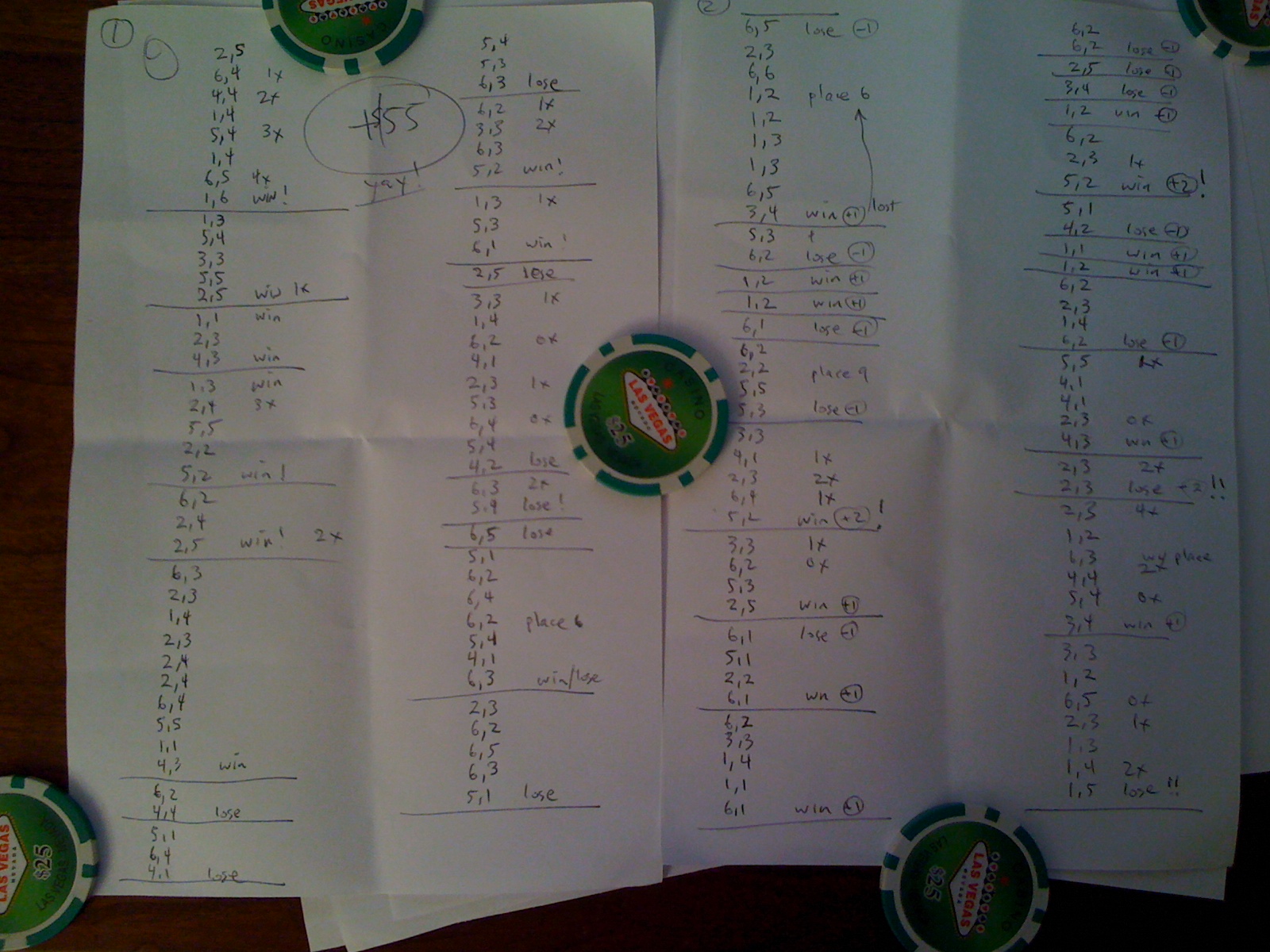
Card craps session notation, pages 1 & 2
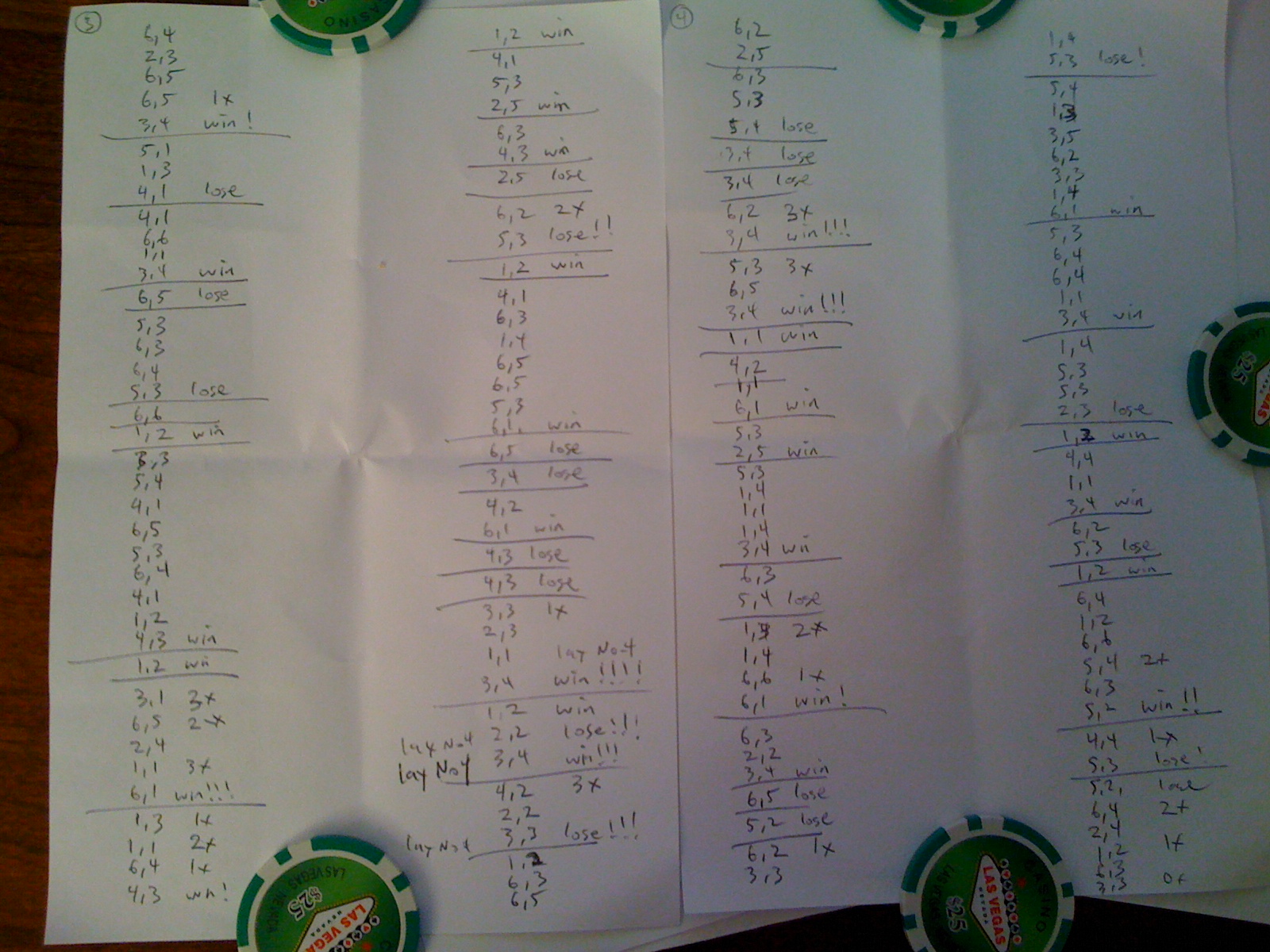
Card craps session notation, pages 3 & 4.
Improved CSM Craps Analysis @ Viejas Casino
After some debate and discussions with the (very cool) floor supervisors and dealers at Viejas Casino, I developed a much more accurate model for the CSM, and re-analyzed the effects of counting in the craps game. Initially, my model of the CSM was a conceptual one, and involved a random shuffling of cards in a reservoir, fronted by an continuous, 10 card deep buffer. In fact, after detailed discussions of how the CSM actually works, I re-modeled it after these mechanisms.
The CSM actually consists of an elevator shuffler, which uses 20 slots that holds from 0 to 14 cards. When the dealer feeds the muck into the hopper, it raises/lowers the elevator to select a random slot, then pushes a muck card into a random position within the chosen slot. The buffering consists of dropping an entire slot (of 0 to 14 cards) into the chute, from which the dealer pulls cards, until it empties. Then another random slot is dropped into the buffer for dealing.
Using this model, and the new, no accumulated muck dealing policy (the muck is fed back into the CSM after each roll), I determined that the actual window depth a counter should use is 4 rolls. I.e., your odds decisions should only be based on the last 4 rolls out of the CSM. Of course, if you could open the CSM and see how many cards are still left in the buffer (dropped slot), you’d know the exact distribution of the next roll. But, alas, that’s why there’s an opaque front panel cover, and we don’t know where we are in the dropped slot. So we just run simulations, and look for the best and simplest overall correlations we can devise.
I’m pretty pleased that a 4-roll windowed fair weighted count works out pretty well. The chart below shows an overall lower effect of the count, because we’re averaging in the variability of the buffer depth. But, the overall EV for laying 10x on a positive count is still +1.6% of the flat bet. It’s better than nothing, and the count is even simpler with the smaller window, and is still 100% fun.
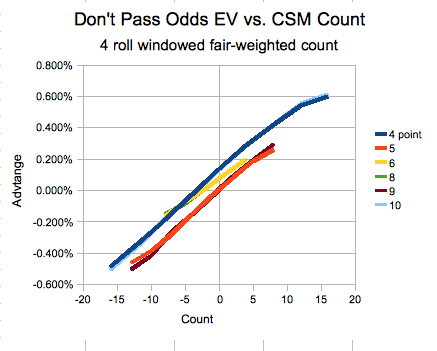
CSM Craps Counting Advantage
Strategy Card For Mississippi Stud @ Barona Casino
I finally got around to making a nice, colourful strategy card for Mississippi Stud, as it’s played at Barona Casino near San Diego (i.e., where you get to see all the players hands). I’ve been playing with an awful print out of my strategy table, and it would sometimes slow the game down. We won again last night, thanks to a full house on the last hand!

Mississippi Stud strategy table when all 6 hands seen.
PlayCraps™ @ Viejas: A Counter’s Dream
I’m loving the PlayCraps™ (cards-based craps) game @ Viejas Casino. I just love watching each roll out of the CSM change the EV of the odds bet on my Don’t Pass bet. For each +4 change in the count (e.g., a (1,2) roll against a 4 point), I increase my Don’t Odds by 1 unit. Of course, I could just lay 10x odds for any positive count, but I’m really conservative. Still, I often see +16 counts, which gives me over a 1% edge on whatever Don’t Odds I decide to lay.
Since it’s obvious to absolutely everyone that I’m counting (out loud), the casino changed the dealing policy to shuffle in the muck as often as every roll. This changes nothing for me, since I’m dealing with a CSM anyways. As I’ve shown in previous posts, the only important thing to track is a trailing window of approx. 6 rolls. This morning, I started some simulations before heading off to win $80 in 4 hours laying small (1x, 2x, occasionally 3x) odds.
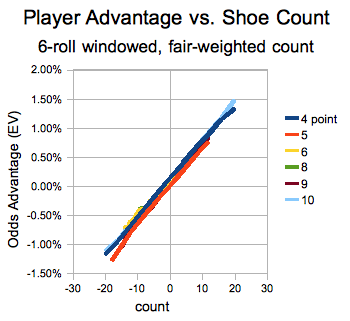
Player edge for laying Don't Pass Odds using a 6-roll windowed, fair-weighted count.
The graph shows the 6-roll windowed count using fair-weighted values (i.e., “good” rolls for the 4/10 points are 4x powerful than “good” rolls for the 6/8 points) is all the info you need for any point. This graph demonstrates the entire essence of advantage play for this game. It’s all you need to see to know the game is clearly beatable, and to see the inherent bias towards the Don’t Pass.
While the overall edge is small (laying 10x odds for any positive count yields 1% of the flat Don’t Pass bet per roll; i.e., $.05 per roll for a $5 Don’t Pass bet), the game is 100% fun. It’s really easy to estimate how good the count is from watching key cards for the point, and remembering back a few rolls. With practice, it’s just a matter of watching for a few key cards, and instantly pumping up, or backing off your Don’t Odds on a roll-by-roll basis. It’s much, much easier, faster, and rewarding than counting at blackjack, which requires an expertise few master. Watching for key dice combinations for a given point is child’s play comparatively.
I’m editing the main PlayCraps™ page, and I need to make some graphical example diagrams. We need more Don’t players at this game; all the pass line players are just donating to the house.
World Poker Tour All-In 3x Collusion Analysis
I wondered what advantage you could get by sharing hole card information against the bank hand in the house game World Poker Tour All-In 3x. For 6 players, you can net a +1.25% edge against the house. For 3 players, you get a small player edge (+0.05%) on an otherwise 0.74% house game. You can read about the full 3-player collusion strategy in my page for the game.
Mississippi Stud @ Barona Casino, CA
My nearby Barona Casino has been spreading the ShuffleMaster game Mississippi Stud face up for some time now. I finally looked at the game, as it’s played there. Here’s a strategy yielding a 1.5% player edge for a full game (6 seated players). Do not use this strategy unless playing at a full table. Otherwise, play basic strategy (4.91% house edge).
“high outs” means the number of cards in the deck that will give you a high pair (Js thru As)
“mid outs” are the number of cards in the deck that will give you a mid pair (6s thru Ts)
“low outs” are the number of cards in the deck that will give you a low pair (2s thru 5s)
2nd Street:
- 3x raise a high or mid pair
- 3x raise with 6 high outs, or with 5 high outs and suited
- 3x raise a small pair with both trips outs still in the deck
- 1x call with 3 or more high outs
- 1x call with 2 high outs if suited, OR at least 2 mid outs, OR at all 3 low outs
- 1x call with 1 high out if suited AND at least 2 mid outs
- 1x call with at least 5 mid outs, OR suited and 4 mid outs
- 1x call with all 3 mid outs and all 3 low outs
- else fold
3rd Street:
- 3x raise any made hand
- 3x raise a low pair if no outs seen (no cards of your hand are out)
- 3x raise if suited and 8 or more high outs
- 3x raise if suited and 7 or more high outs AND 7 suit outs
- 3x raise if suited and 6 or more high outs AND 8 suit outs
- 1x call if suited
- 1x call if low pair and 2 trip outs
- 1x call if low pair and 1 trip out and at least 2 other pair outs
- 1x call if no-gap straight draw > 456
- 1x call if 1-gap straight draw and at least 5 mid outs
- 1x call if 2-gap straight draw and at least 6 mid outs
- 1x call if at least 4 high outs
- 1x call if 3 high outs AND (at least 2 mid outs, OR 1 mid out and all 3 low outs, OR all 6 low outs, OR wheel draw and 3 low outs)
- 1x call if 2 high outs AND (at least 4 mid outs, OR all 3 mid outs and 2 low outs)
- 1x call if 1 high out AND 5 mid outs
- 1x call if 7 mid outs, OR all 6 mid outs and all 3 low outs
- else fold
4th Street:
- 3x raise any made hand
- 3x raise any flush draw
- 3x raise 8 straight outs
- 3x raise 7 straight outs AND (at least 3 high outs, or at least 4 mid outs)
- 3x raise 6 straight outs AND (at least 4 high outs, or at least 9 mid outs)
- 3x raise 5 straight outs AND (at least 6 high outs, or at least 12 mid outs)
- 3x raise 4 straight outs AND at least 8 high outs
- 3x raise 3 straight outs AND at least 10 high outs
- 1x call all other straight draws
- 1x call any low pair
- 1x call 5 or more high outs
- 1x call 4 high outs AND at least 2 mid outs
- 1x call 3 high outs AND at least 4 mid outs
- 1x call 2 high outs AND at least 6 mid outs
- 1x call 1 high outs AND at least 9 mid outs
- 1x call with all 12 mid outs, or at least 6 mid outs and a previous 3x raise
- else fold








 Discount Gambling
7 comments