Barred From Barona: A Win-Win Outcome
Well, I finally got barred from table games at my local Barona Casino. Some of you may have seen this coming, and I probably should have too, especially after the multiple private warnings from their director of table games. When they first came by to talk to me, I didn’t think they’d worry about a $5 player like me. I mean I don’t even take my $5 action seriously. So when they talked to me, I thought they were just stopping by to talk shop (they work in a casino, I live in a casino). But I eventually got the vibe that they were kind of watching me. Well, they were certainly reading this blog, and the day I posted the Mississippi Stud calculator (all 6 hands seen), they came by and nicely told me I couldn’t play tables games anymore.
I figured they wouldn’t like that post. The calculator showed all the players hands face-up, like it’s played at Barona, and showed you the exact value of your hand, and the best decision (3x, 1x, or fold). I guess if the regulars saw it, and all started playing optimally, it’d be a problem. But that will never happen; I’ll bet any amount of money on it. People don’t play optimal strategy, that’s not why they’re there. People play the way they want to, and that’s the way it should be. I pretty much just wrote the calculator for myself, and one or two guys who wanted to see it.
At any rate, someone at Barona thought it best to bar me, and I can’t argue with their decision. I doubt I influenced any players about the game, but everyone got the idea that I played tight. (People also thought I played too aggressively at Ultimate Texas Hold’Em.) Worse-case, I took up a weekend seat playing tight $5 Antes, and locked out a bigger player when the game was full. Best-case, I “prop’ed” up the game on weekday nights, when an additional player helps build up critical mass in the game. (Everyone agrees it’s better to have more players and see more cards per hand.)
Like I said, being barred is a “win-win” situation. They’re happy, and don’t have to worry about me meddling with their Mississippi Stud game. I’m happy, since getting barred was the only way I’d stop playing 60 hrs/week there. So instead of coming back from the casino every night until 3am, I go downstairs and take hour-long walks through Little Italy and Balboa Park. Although it was pointless, it was easy playing a game with a 1.5% tailwind. It’s like being the house, but without all the expenses, and with comp’ed food. But it was just an attractive nuisance, something that draws you in, but ends up harming you.
Grinding Outcomes for +EV Mississippi Stud
In case you’re thinking about grinding out a profit at +EV Mississippi Stud (all 6 hands seen @ Barona), I’ve plotted an outcome distribution curve to show you what to expect. The following curve shows the cumulative outcome distribution of playing 5000 hands of Mississippi Stud at a fixed Ante, with a 1000 Ante bankroll. At a $5 Ante, this is a bankroll of $5000, and it would take a month of full-time play to see 5000 hands.

You can see the game is slightly in your favour, because of the asymmetrical bias towards bigger wins than losses. There’s a nice long tail of huge wins (although rare). On average, the expected win is (5000)(+1.25%) = 62.5 Antes. (This used a slightly older strategy; it could be improved.) However, there’s still a 6% chance of busting out, and you still have a 50% chance of losing after 5000 hands!
So, your +EV lies in the asymmetry of the curve, and the long tail of big wins. Not to mention that playing 5000 hands of normal (-EV) Mississippi Stud would cost you (5000)(-4.5%) = 225 Antes, and the outcome distribution curve would look much worse (I don’t have Basic Strategy coded up, but imagine the curve shifted higher and to the left.)
The best way to look at the face-up game is that it’s gambling with a tailwind. Anything can happen, but overall, you’ll feel the help of the tailwind, especially over the long run. Before I was barred, I really enjoyed playing the game hour-after-hour, week-after-week, because it all worked out in the end. It was like playing cards for free.
Mississippi Stud Calculator (All Hands Seen)
At my local Barona Casino, Mississippi Stud is dealt with all player hands face up. I’ve posted many times about the +EV strategy used with this information. No one at the tables plays optimally (i.e., no one listens to me), so the game still retains a huge house edge. In fact, the house edge is probably much higher at Barona, because players tend to play loose on 3rd Street (i.e., “see the first card”, or “always see the first card”) as long as they can see some outs, or some ways to make a hand. These 3rd Street mistakes range from 10% to 50% of the Ante, and are pure house edge. At casinos where players only see their own hand (not allowed to share info), they release losers more quickly, and tend to converge on correct basic strategy.
Of course, the only real advantage to seeing all the players cards is being able to fold early. The other advantage is knowing when to raise draws, but these are fairly rare (e.g., small pairs with all outs remaining on 3rd and 4th Streets, 6 high outs or 5 high suited outs on 3rd Street, certain straight draws on 5th Street). So folding early is the main use of the other player card info.
I wrote a Java calculator for Mississippi Stud when you can see all 6 player hands. It shows you the best decision at each point of the hand. (It’s a huge .jar file and may take some time to load, sorry.) Click on the screenshot below to try it:
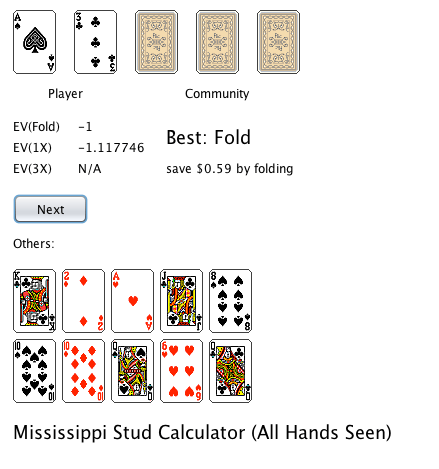
The EV numbers tell you the expected value of the hand if you Fold, 1x, or 3x the bet for the next card. The EVs are normalized to the Ante, and a positive EV means an expected profit, and a negative EV means an expected loss. If you’re playing $5 Antes, then multiply these numbers by $5 for the value of the Fold, 1x, and 3x decisions.
Counting The Royal Match Sidebet @ Barona Casino
 My local Barona Casino offers the Royal Match blackjack side bet which pays 75-to-1 when you’re dealt a suited K-Q on your first two cards, and 2-1 for any other suited hand. Normally, the house edge is 4.06% for this side bet, but as readers of this blog know by now, sucker bets are often countable. Using a simple true K-Q count, the bet yields an average 5.4% player edge.
I always play this bet for $1, and get really excited when I hit it for $75. The last time I hit it, I decided to analyze it’s countability.
I first looked at the bet’s distributions of EVs at the last hand of the shoe. This would show me if there was any potential for a counting scheme. I’d see how often and how strongly the bet went +EV. Here’s what it looks like with one deck remaining:

I could tell from the graph that the bet was exploitable. So I calculated the average profit per shoe, assuming heads-up play with the dealer. This theoretical limit comes out to a profit of +0.504 bets/shoe. That’s a really good profit rate (compare to the Dragon-7 profit rate of 0.54 bets/shoe). That means a player betting a fixed amount on the Royal Match will net an average profit equal to half his bet per shoe, when heads up with the dealer. On a per bet basis, the average Royal Match bet EV is +5.9%, assuming perfect knowledge of the dealt cards.
I then looked for a simple (practical) counting scheme that would capture most of the theoretical edge. As it worked out, the second idea that came to mind happened to be very effective. A simple true count of excess Kings and Queens yields about +0.43/shoe (85% of the theoretical edge):
trueCount = (8*decksDealt - countedKingsAndQueens)/decksRemaining
where decksDealt and decksRemaining are floating-point numbers.
The relationship between the true KQ-count and the Royal Match side bet EV is shown in the following graph:

Note that you should bet the Royal Match when the true count is >= 0.8.
In heads-up play, you’ll get an average of 8.0 bets/shoe, with an average bet EV of +5.4%. The scheme is very comparable with the highly profitable Dragon-7 counting scheme (EV +0.54/shoe), but it’s much faster, and has much lower variance.
So if you don’t find me at the full-exposure Mississippi Stud game, look for me in the i-Table pit counting the Royal Match.
Dragon-7 Shoe Simulator
Click on the screenshot below to run my shoe-by-shoe simulator for counting the EZ-Baccarat Dragon-7 side bet:

I’ve been playing the EZ-Baccarat lately, because it’s really easy to count for the 40-to-1 Dragon-7 side bet, and it gets pretty exciting when you’re betting for big payouts at the end of a shoe (each $10 pays out $400). I’m still a baccarat newbie, but I’m starting to appreciate the drama of the game. Most people record notation of the hands, and they all study the hand history displayed on the monitor. They’re looking for long runs of Banker or Player wins. On a Banker run, they increase their bets, and everyone makes a lot of money, and all are happy. When the Player is on a winning run, they wait until they think it’s impossible for the Player to win yet another hand. Then they bet big on the Banker. If the Player wins again, everyone is outraged, and they bet even more to win back their money. It gets pretty dramatic, especially when the Player wins yet again. People don’t think like this on blackjack, probably because there’s no hand history display, and because you can’t bet on the dealer. Baccarat is a very dangerous game that feeds off of people’s natural instincts to see patterns in nature.
Anyways, I don’t care at all about Player/Banker, I’m just tracking the Dragon-7 count, and waiting for the opportunity to bet it. Mostly, this comes at the end of the shoe, so I make minimum Player or Banker bets just to feel a part of the table. Overall, betting $10 Banker/Player every hand will cost an average $8/shoe. I make $10+ dragon bets when the count is good, so I’ll win back at least $5.30/shoe of that on average. Overall, it’s very cheap entertainment.
I use the baccarat recording cards provided by the casino to track the dragon. Everyone uses the cards in Landscape orientation, and draws red and blue circles. I turn the card 90° and write down the +/- running count for each hand. I use the unbalanced Dragon-7 count, starting the RC at -32, and updating it for every card seen, including the burn. When the RC is greater than 0, I bet the dragon on the next hand.
My Flash game simulates one shoe at a time, showing the unbalanced running count (RC) that I record on the baccarat cards. I indicate the outcome of +EV dragon bets with green for wins, and red for losses. When a dragon occurs while not betting, I note the “miss” in yellow. For example, in the screenshot above, 83 hands were played in the shoe, and 3 dragons hit (hands #41, #67, and #69). The count wasn’t good enough to bet on the first dragon, which we missed (yellow). The RC was > 0 for almost all of the hands from #61 – #75. We hit the dragon on hand #67 when the count was +7, and on hand #69 when the count was +8.
Play around with the simulator if you’re thinking about trying to make a profit at the bet. While it’s probably the best +EV game you’ll ever find (easiest to implement, and most average profit per shoe), the game is very slow at a full table. In order to try to make money, you’d need to get heads up with a dealer, which can yield up to 3 shoes an hour (optimal). Needless to say, the swings are huge, due to the nature of the 40-to-1 payout. However, (2 shoes/hr)($100 dragon bets)(0.53 profit/shoe) = $100 profit/hr looks pretty attractive.
Instant-18 Blackjack Side Bet Counting
I recently saw the Instant-18 blackjack side bet, and I thought it was funny. It’s an even-money side bet that plays against the dealer as a hand of value 18. Hence, the name “Instant-18”. You put up a bet, and it’s an 18. It has a 2.036% house edge for a 6-deck shoe, but it’s still kind of interesting. It’s an optional side bet where (typically) you can bet an amount less than or equal to your main blackjack bet. Of course, I had to see if this bet was countable.
First, I looked at the distribution of EVs after 5 of 6 decks were dealt from the shoe:
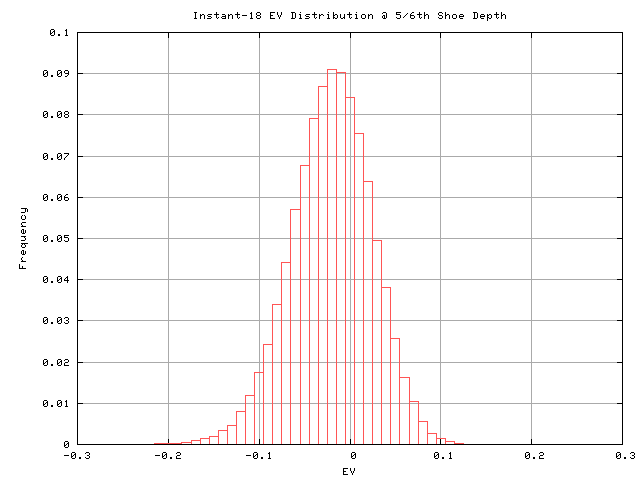
This looked promising, so I checked out the EORs for the bet:
| Card | ΔEV |
|---|---|
| Deuce | -0.001031 |
| Trey | -0.000634 |
| Four | -0.000252 |
| Five | +0.000038 |
| Six | -0.000371 |
| Seven | -0.001946 |
| Eight | -0.000649 |
| Nine | +0.000606 |
| Ten/Face | +0.000347 |
| Ace | +0.002849 |
From the EORs, I made a simple count system, where Aces are +3, Sevens are -2, and Deuces are -1. Then I plotted the EVs of the main and side bet vs. the true count:

Unfortunately, when the count for the side bet gets good (true count >= 4), the main bet is -EV. However, for a good enough count (true count >= 7), the combination of (main bet + side bet) is +EV. Also, for a bad enough count (true count <= -3), them main bet is +EV.
So, by itself, the Instant-18 side bet gets good (true count >= 4) about 7.8% of the time, with an average return of +1.53%.
Of course, you can’t just bet the side bet when it gets good. You have to have a main bet to bet the side bet. If you bet both when the combination gets good (true count >= 7), or just the main bet for true count <= -3, and Wong all others, you'll bet 13.9% of the time with an average EV of +0.47%.
As usual, these things are interesting, but not practical.
Panda-8 Bonus Bet @ EZ Baccarat
 Read all my posts on the Panda-8 sidebet.
There’s another bonus bet on the EZ Baccarat table, called Panda-8, that pays 25-1 for a 3-card player 8 win. Using the same methods as the prior posts on countable baccarat side bets, I came up with the following card count values:
| Card | Count Value |
|---|---|
| Ace | 1 |
| Deuce | 1 |
| Trey | -2 |
| Four | -2 |
| Five | -2 |
| Six | -1 |
| Seven | -1 |
| Eight | -2 |
| Nine | 4 |
| Ten/Face | 1 |
The player should bet the Panda-8 when the true count is ≥ 11. (The plot below shows the EV curve crosses the x-axis at a true count of 10.5):
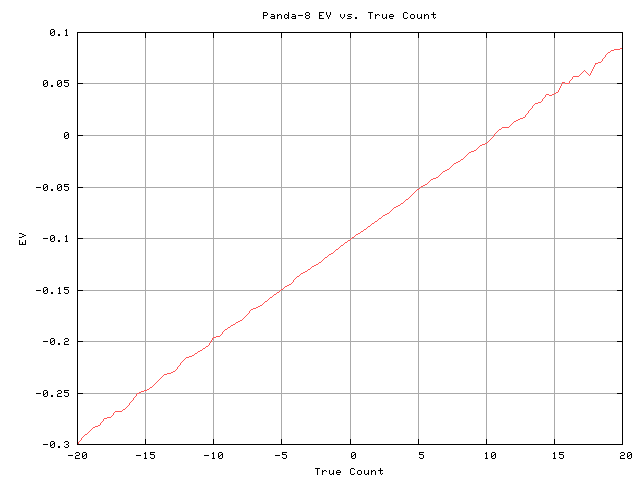
Use the following running count (RC) thresholds when betting the Panda-8 side bet:
| Hand # | RCMin |
|---|---|
| 55 | 31 |
| 56 | 29 |
| 57 | 28 |
| 58 | 27 |
| 59 | 26 |
| 60 | 25 |
| 61 | 24 |
| 62 | 23 |
| 64 | 21 |
| 65 | 20 |
| 66 | 19 |
| 67 | 18 |
| 68 | 17 |
| 69 | 16 |
| 70 | 15 |
| 71 | 14 |
| 72 | 13 |
| 73 | 12 |
| 74 | 11 |
| 75 | 10 |
| 76 | 9 |
| 77 | 8 |
| 78 | 6 |
| 79 | 5 |
| 80 | 4 |
| 81 | 3 |
| 82 | 2 |
| 83 | 1 |
| 84 | 0 |
Using the above RCmin thresholds, simulations showed a profit of 22% of a fixed bet per shoe, at an average 3.8 bets/shoe.
Player Dragon Bonus Tracking Sheet
I worked out a baccarat tracking sheet for counting the player dragon bonus available at my local Barona Casino. The tracking sheet simulates at +0.112 EV/shoe, gained from an average 3.9 bets/shoe. That means the count gets good enough to bet the player dragon about 3.9 times per shoe (4.8% of the time), and you’ll profit a total of 11.2% of a fixed bet, per shoe. So, if you’re betting the max $300 per dragon, you’ll make about $33.60/shoe, on average.
That’s not bad, since you’re allowed (encouraged, actually) to use tracking sheets while sitting at the Rapid Baccarat terminals. The player dragon has payouts ranging from 30-to-1 down to 1-to-1 and pushes, so you’ll win something about 30% of the time. This is much better than waiting for a 40-to-1 payout on an infrequent $100 dragon-7 bet.
The tracking sheet below helps you maintain the running count (RC) for each hand of the shoe, and lists the required minimum RC for betting the player dragon on any given hand:

You’ll see the minimum betting RCs decrease as more hands are played. Typically, you’ll probably only be able to bet the dragon for the last 8 hands of the shoe, if at all. Welcome to the world of baccarat.
Instructions
Use the following count values for each card:
| Card | Count Value |
|---|---|
| Ace | 1 |
| Deuce | 2 |
| Trey | 2 |
| Four | 1 |
| Five | 1 |
| Six | 0 (ignore) |
| Seven | -1 |
| Eight | -1 |
| Nine | -1 |
| Face/Ten | -1 |
The dealer pulls the first card out of the shoe, and turns it face up. Start the running count with the count value of the card. The following unseen burn cards do not affect the RC or the bet thresholds.
Make sure you only use this sheet for betting the player dragon bet (1-1 for natural player win, push for natural player tie, else 30-1 for player win by 9 points, 10-1 for win by 8 points, 6-1 for win by 7 points, 4-1 for win by 6 points, 2-1 for win by 5 points, 1-1 for win by 4 points, lose all others).
For each hand dealt, add up the count values of each card to get the count for the hand. Notice that 2’s and 3’s are +2, then “high cards” (7,8,9,10) are -1, and “low cards” (1,4,5) are +1. Write down the count for the hand in the sub-box, and add it to the running count (RC). Write the new RC value in the box.
If the new RC is greater or equal to the number printed in the next hand’s box, then bet the dragon. That’s it.
Examples
You’re at the start of the shoe. The dealer pulls out a 7, and burns seven cards. Start the running count at -1.
The first hand dealt is player (10,9) and banker (4,5). There are no 2’s or 3’s in the hand. The two high cards cancel out the two low cards, so the count for the hand is 0. The running count remains at -1, and write it in the box.
The next hand dealt is player (1,2) and banker (8,10). The count value of the hand is 1+2-1-1 = +1. Write the new RC of 0 into the box. The RC is less than 56, so don’t bet the player dragon the next hand.
The next hand dealt is player (3,1,5) and banker (4,10,5). The count value of the hand is 2+1+1+1-1+1 = +5. Update the running count by +5, and write the new RC of 5 in the box. The RC is less than 55, so don’t bet the player dragon the next hand.
Baccarat Dragon-7 Tracking Sheet
 Update: See the tracking sheet in action with my Dragon-7 shoe-by-shoe simulator. Also, check out the much easier-to-use unbalanced Dragon-7 count.
I tested out Eliot Jacobson’s true count system for the 40-to-1 baccarat dragon-7 bet (banker wins with 3 card 7), and got excellent results with the following tracking sheet:

The sheet helps you track the running count (RC) for each hand in the shoe. You just compare the running count (RC) to the minimum betting threshold for the next hand. When the RC is greater or equal to the number printed in next box, bet the dragon.
The tracking sheet simulates at an average profit of about $53 per shoe, for $100 dragon bets. On average, you’ll make about 5.2 dragon bets per shoe.
I put together this tracking sheet because I know no one is going to read the WoO post and implement the true count correctly at the table. Half the people around the baccarat table write down something complicated every hand, so this will be my craziness.
Instructions
Use the following count values for each card:
| Card | Count Value |
|---|---|
| Ace | 0 (ignore) |
| Deuce | 0 (ignore) |
| Trey | 0 (ignore) |
| Four | -1 |
| Five | -1 |
| Six | -1 |
| Seven | -1 |
| Eight | 2 |
| Nine | 2 |
| Face/Ten | 0 (ignore) |
The dealer pulls the first card out of the shoe, and turns it face up. Start the running count with the count value of the card. The following unseen burn cards do not affect the RC or the bet thresholds.
For each hand dealt, add up the count values of each card to get the count for the hand. Notice that 8’s and 9’s are +2, and 4-thru-7’s are -1. Ignore all other cards. Write down the count for the hand in the sub-box, and add it to the running count (RC). Write the new RC value in the box.
If the new RC is greater or equal to the number printed in the next hand’s box, then bet the dragon. That’s it.
Examples
You’re at the start of the shoe. The dealer pulls out a 7, and burns seven cards. Start the running count at -1.
The first hand dealt is player (10,9) and banker (4,5). The count value of this hand is 2-1-1 = 0. The RC doesn’t change, so write the RC of -1 in the box. The RC of -1 is less than the minimum 40 required to bet the dragon on the next hand.
The next hand dealt is player (1,2) and banker (8,10). The count value of the hand is +2. Write the new running count of +1 in the box. Again, the RC of +1 is too low to bet the dragon on the next hand (need at least 40).
Keep filling in the hand boxes, from left to right, and down the page. There are about 80.9 hands/shoe on average. There’s room for 88 hands, which occurs very infrequently. You can track two shoes per sheet. You’ll see as you get deeper into the shoe, the minimum RC for betting the dragon decreases. This follows from true count = RC/(decks remaining).
+EV Rapid Baccarat Dragon @ Barona Casino
 OMG, did you see the recent WoO post on counting the baccarat dragon bet?! That bet gets so +EV that a simple counting scheme yields an average +4% edge over 7.5% of the time. Betting $100 dragons yields an average $25 profit per shoe with the simple count.
Update: use my simple dragon tracking sheet that simulates at an $53 profit/shoe (betting $100 dragons 6.4% of the time).
I had never looked into counting for the dragon, because I assumed the 7.611% house edge was too big to overcome. However, given the 40-to-1 payout odds, a 0.25% (quarter percent) change in the dragon frequency yields a 10% change in the bet EV. And it works out that the effect-of-removal (EOR), i.e. the sensitivity, of a card to the dragon-7 EV is rather large.
So I looked into other countable dragon opportunities at my nearby Barona Casino. They have a Rapid Baccarat bank of player consoles, with the following dragon bet:
| Hand | Payout | Frequency | Return |
|---|---|---|---|
| Non-natural winner by 9 points | 30-to-1 | 0.003683 | 0.110492 |
| Non-natural winner by 8 points | 10-to-1 | 0.006822 | 0.068217 |
| Non-natural winner by 7 points | 6-to-1 | 0.017924 | 0.107543 |
| Non-natural winner by 6 points | 4-to-1 | 0.028257 | 0.113027 |
| Non-natural winner by 5 points | 2-to-1 | 0.033244 | 0.066489 |
| Non-natural winner by 4 points | 1-to-1 | 0.037368 | 0.037368 |
| Natural winner | 1-to-1 | 0.162589 | 0.162589 |
| Natural tie | push | 0.017871 | 0.000000 |
| All Others | -1 | 0.692242 | -0.692242 |
| Total | 1.0000 | -0.026517 | |
The sensitivity of the player dragon bet to any given card is listed in the following EOR table (8 deck shoe):
| Card | EOR |
|---|---|
| Face/Ten | -0.000530 |
| Ace | +0.000777 |
| Deuce | +0.001160 |
| Trey | +0.001273 |
| Four | +0.000470 |
| Five | +0.000172 |
| Six | +0.000053 |
| Seven | -0.000563 |
| Eight | -0.000619 |
| Nine | -0.000604 |
The result is that the player dragon bet on the Rapid Baccarat machines at Barona is countable (you can calculate when the bet is +EV). Here’s a baccarat tracking sheet that tells you when to make the dragon bet. Below are the theoretical distributions of the dragon-7 and the player dragon EVs after 7 decks are dealt.

The graph shows that the dragon-7 (banker wins with a 3 card 7) often gets very advantageous at the 7th-deck point of the shoe. This graph shows the actual EV of the bets, independent of counts. You’ll need a mobile app to track the shoe exactly to get this calculation. In the next posts, I’ll compare the return using a simple count to these ideal returns.
The graph of the Rapid Baccarat Player Dragon shows a much narrower distribution, which still yields a player advantage. The player dragon compares favorably to the dragon-7, in a few important aspects. First, you can sit around at a Rapid Baccarat terminal all day, without any floor person even noticing you. You can use your mobile device at a Rapid Baccarat terminal. Secondly, the variance of the player dragon is much, much less than the dragon-7, because you hit something 30% of the time, more than 10x as often as the dragon-7’s infrequent 2.5% hit rate. The Kelly criterion will allow you to bet much more on the player dragon than the dragon-7 for any given bankroll. (Think about it, you’re still betting on a 40-to-1 longshot on the dragon-7. On the other hand, the player dragon pays even money for a natural winner.)
Would I sit around all day at a Rapid Baccarat terminal waiting for the count to go +EV on the player dragon? While listening to my podcasts and music on my iPhone? Probably not, unless the numbers work out amazing well. I’d need the shoe to be +EV around 10% of the time. Otherwise, I’d rather play the fun -EV carnival games.








 Discount Gambling
16 comments