World Poker Tour All-In 3x Collusion Analysis
I wondered what advantage you could get by sharing hole card information against the bank hand in the house game World Poker Tour All-In 3x. For 6 players, you can net a +1.25% edge against the house. For 3 players, you get a small player edge (+0.05%) on an otherwise 0.74% house game. You can read about the full 3-player collusion strategy in my page for the game.
Simulations For PlayCraps™ @ Viejas Casino, CA
Using the improved don’t pass counting system, using a trailing six roll window, as described in the previous post:
| Point | Conditions to lay (max) don’t pass odds |
|---|---|
| 4 | running count over the last 6 rolls <= -2 |
| 5 | seen at most 2 fives or sixes in the last 6 rolls |
| 6 | seen at most 1 six in the last 6 rolls |
| 8 | seen at most 1 ace in the last 6 rolls |
| 9 | seen at most 2 aces or deuces in the last 6 rolls |
| 10 | running count over the last 6 rolls >= 2 |
where the running count is incremented when both die are high (>= 4), and decremented when both die are low (<= 3).
Applying 10x don't pass odds, I simulated the game using my model for the CSM (continuous shuffling machine), and I got the following results:
Macintosh:Debug show$ ./playcraps -a -m14 -n100000000 -r
max muck depth: 14, CSM buffer depth: 10, rolls: 1.0e+08
net: +584729, EV: +0.58% per roll

Macintosh:Debug show$ ./playcraps -a -m20 -n100000000 -r
max muck depth: 20, CSM buffer depth: 10, rolls: 1.0e+08
net: +621717, EV: +0.62% per roll

Macintosh:Debug show$ ./playcraps -a -m20 -b6 -n100000000 -r
max muck depth: 20, CSM buffer depth: 6, rolls: 1.0e+08
net: +646693, EV: +0.65% per roll, +2.18% per come out
meaning that the dealer shuffles the muck back into the CSM when it’s more than 14 cards deep. The CSM is modeled with a buffer depth of 10, meaning that the earliest a card can come back out of the shoe is 10 rolls after any shuffle.
The results show that you’ll win +0.58% of your don’t pass bet, on average, per roll. So, for a $5 don’t pass bet, you’ll make $.029/roll, when laying 10x don’t pass odds according to the above table. Note the results improve a little if the dealer allows the muck to collect a little longer (+0.62%/roll for a 20 max card muck).
Note how the count scheme is insensitive to the buffer depth modeled in the CSM. When I decreased it to 6 rolls (12 cards), the return actually improved a little. In the last simulation, I also calculated the return per come out, which came out to +2.18% of the don’t pass bet. Again, that’s only about $0.10 per $5 don’t pass bet.
It’s not a lot of money. Even at a fast 500 roll/hr, you’re only making $14.50/hr. The bankroll requirements for this strategy are large, because you’re laying $100 to win $50 against the 4/10. It’s probably not an option to try and grind this game out. However, if you like playing don’t pass craps, then at least you’re getting the psychological benefit of a $14.50/hr tailwind 🙂
Note that just playing blind 10x don’t pass odds gives you the same ~2% EV. Employing a count scheme is just reducing your 10x odds variance a little from ~35 to ~32 (its still huge). I enjoy varying my odds with every roll. It only takes a small amount of effort, and it makes me feel like I’m in control.
Count System for PlayCraps™ @ Viejas Casino, CA
I wanted to quantify the edge of a count system for the “dice” dealt out of the CSM for the PlayCraps™ game I’ve been talking about. I tried a few simple ideas, based on how I actually play the game at the table. A good method needs to be practical and not mentally taxing. After all, we’re playing craps, and we want to have fun.
I know when a large run of high rolls (both die are >= 4) occurs, the distribution for the next “roll” is skewed towards the 4/5/6, and away from the 8/9/10 points. If the point is on 10, I jack up my don’t pass odds. (See below how I play the 5/9 and 6/8 points.)
In the graphs below, don’t worry about the negative parts of the curves. These are times you’re not laying don’t pass odds. Your flat bet is still a 6:5 favorite on the 6/8, a 3:2 favorite on the 5/9, and a 2:1 favorite on the 4/10, minus the delta shown in the graph. Plus, these are good times to take pass odds on the point (e.g., your friend is pass line, and he jacks up the odds when you take them down).
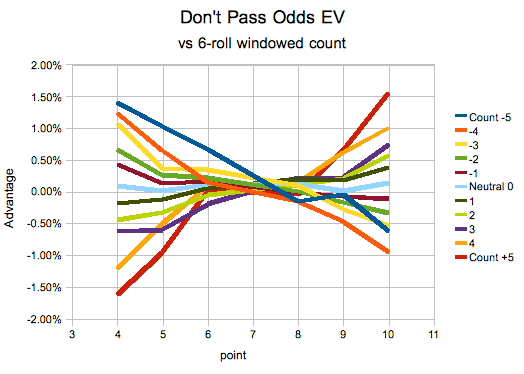
Don't Pass Odds Advantage vs. Shoe Count
I formalized the strategy by keeping a running count of the last 6 rolls. A roll is high if both die are ⚃, ⚄, or ⚅. A roll is low if both die are ⚀, ⚁, or ⚂. All other rolls are neutral. Then I just keep the hi/lo total for the last 6 rolls. It’s pretty much what we naturally do in our heads anyway. Since every low or high roll significantly distorts the distribution, you get pretty excited to see one. (My eyes perk up every time I see a ⚀ ⚀, or ⚀ ⚁, or ⚁ ⚁, etc. I start looking to lay the no-4. Conversely, if I see ⚅ ⚄ then ⚃ ⚄ then ⚄ ⚄ I get pretty excited about lay no-10, or jacking up my don’t-10 odds.)
This above plot shows the results of simulating this count system, and tracking the distribution of the next “roll” out of the CSM. It clearly shows that the player gains a huge advantage by increasing his don’t pass odds when the count is good, and taking down the don’t pass odds when the count is bad. (The converse applies to the pass line bet. Just flip the graph to get the advantage of taking odds on the point for a given count. When laying don’t pass odds are bad, taking pass odds are good, and visa-versa.) Sometimes, I adjust my don’t pass odds bet on every roll.
This makes for a very good craps game, since this dirt-simple count system buys you from 0.5% to 1.5% on your 4/10 odds bet. The 5/9 aren’t too bad either. See below for the count system for the 6/8 points. The 6-roll window does not need to be exact, by any means. A 5,6,7, or 8 roll wide window produces similar results. They say people can remember about 7 numbers (e.g., telephone numbers). So you’ll end implementing this naturally anyways. Note that the simulation assumed the dealer let about 7 rolls accumulate in the muck before shuffling it into the CSM.
This strategy lets you lay/take odds only when you get an advantage for doing so. Normally, people lay/take odds on the point, and wait until the roll ends (hit the point, or 7-out). But with this counting method, you watch the “rolls” out of the shoe, and change your pass / don’t pass odds accordingly. You get to predict the future, and you actually have a little insight into it.
Update: Here’s how to play the 6/8 points.
The key card for the 6 point is the ⚅. This card can make a 7, but cannot make the point. Just keep track of how many of them you’ve seen in the last 6 or so rolls. Use this count as an index into the below graph. You’ll see that as long as the count is below 3, you still have an edge laying odds against the 6. For counts >= 3, you’d be laying odds at a disadvantage. Take them down, and wait for the count to go back below 3.
A similar approach is used for the 8 point. Here, the key card is the ⚀. This card can make a 7, but cannot make the point. Again, keep track of how many you’ve seen in the last 6 rolls or so. The more that are out, the worse off your don’t-8 odds bet is. See how the return changes from about +0.3% to -1.2% as the count increases from 0 to 7. Again, back off your don’t-8 odds bet when you see too many ⚀ come out.
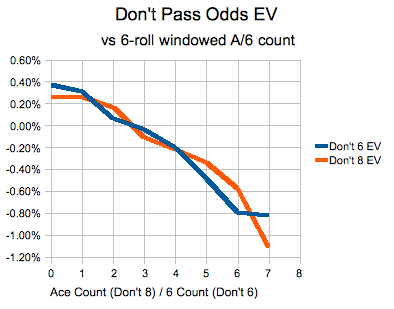
A/6 Count System for 6/8 Points
2nd Update: Here’s better way to play the 5/9 points.
The key cards for the 5 point are the ⚄ and ⚅. These cards can make a 7, but not the point. So count the number of these cards you see in the last 6 rolls. When the count gets to 5, take your don’t pass odds down. Wait for the neutral (other) cards to flush down the count to 4 or below, then lay your don’t-5 odds again.
The situation is similar for the 9 point, where the key cards are the ⚀ and ⚁.

Don't Pass Odds Advantage vs. Count for 5/9 Points.
Mississippi Stud @ Barona Casino, CA
My nearby Barona Casino has been spreading the ShuffleMaster game Mississippi Stud face up for some time now. I finally looked at the game, as it’s played there. Here’s a strategy yielding a 1.5% player edge for a full game (6 seated players). Do not use this strategy unless playing at a full table. Otherwise, play basic strategy (4.91% house edge).
“high outs” means the number of cards in the deck that will give you a high pair (Js thru As)
“mid outs” are the number of cards in the deck that will give you a mid pair (6s thru Ts)
“low outs” are the number of cards in the deck that will give you a low pair (2s thru 5s)
2nd Street:
- 3x raise a high or mid pair
- 3x raise with 6 high outs, or with 5 high outs and suited
- 3x raise a small pair with both trips outs still in the deck
- 1x call with 3 or more high outs
- 1x call with 2 high outs if suited, OR at least 2 mid outs, OR at all 3 low outs
- 1x call with 1 high out if suited AND at least 2 mid outs
- 1x call with at least 5 mid outs, OR suited and 4 mid outs
- 1x call with all 3 mid outs and all 3 low outs
- else fold
3rd Street:
- 3x raise any made hand
- 3x raise a low pair if no outs seen (no cards of your hand are out)
- 3x raise if suited and 8 or more high outs
- 3x raise if suited and 7 or more high outs AND 7 suit outs
- 3x raise if suited and 6 or more high outs AND 8 suit outs
- 1x call if suited
- 1x call if low pair and 2 trip outs
- 1x call if low pair and 1 trip out and at least 2 other pair outs
- 1x call if no-gap straight draw > 456
- 1x call if 1-gap straight draw and at least 5 mid outs
- 1x call if 2-gap straight draw and at least 6 mid outs
- 1x call if at least 4 high outs
- 1x call if 3 high outs AND (at least 2 mid outs, OR 1 mid out and all 3 low outs, OR all 6 low outs, OR wheel draw and 3 low outs)
- 1x call if 2 high outs AND (at least 4 mid outs, OR all 3 mid outs and 2 low outs)
- 1x call if 1 high out AND 5 mid outs
- 1x call if 7 mid outs, OR all 6 mid outs and all 3 low outs
- else fold
4th Street:
- 3x raise any made hand
- 3x raise any flush draw
- 3x raise 8 straight outs
- 3x raise 7 straight outs AND (at least 3 high outs, or at least 4 mid outs)
- 3x raise 6 straight outs AND (at least 4 high outs, or at least 9 mid outs)
- 3x raise 5 straight outs AND (at least 6 high outs, or at least 12 mid outs)
- 3x raise 4 straight outs AND at least 8 high outs
- 3x raise 3 straight outs AND at least 10 high outs
- 1x call all other straight draws
- 1x call any low pair
- 1x call 5 or more high outs
- 1x call 4 high outs AND at least 2 mid outs
- 1x call 3 high outs AND at least 4 mid outs
- 1x call 2 high outs AND at least 6 mid outs
- 1x call 1 high outs AND at least 9 mid outs
- 1x call with all 12 mid outs, or at least 6 mid outs and a previous 3x raise
- else fold
Triple-Down BJ @ Texas Station, Las Vegas
I’m finally getting to a reader’s request about a triple-down blackjack game at the Texas Station casino in North Las Vegas. Here are the relevant rules:
- triple-down on first two cards totals of 9, 10, 11 (including soft totals)
- blackjack pays even money (1:1)
- blackjack is an automatic winner, if you stay
- normal double-down rules
- no triple after split
- double-deck
The overall house edge for this game is 0.83%. The triple-down rule gives the player a +1.62% boost, but it’s not enough to overcome the even money blackjacks. The basic strategy is the same as double-deck, except that doubles on hard 9, 10, 11 are replaced by triples. Also, 9 vs a 7 upcard, and A-9 vs 4/5/6 are triples.
Interestingly, tripling a blackjack against a dealer 6 upcard isn’t too bad of an option. The EV is .998, instead of the 1.0 automatic winner for staying. It’s worth a gamble, if you feel like it. Tripling a blackjack against a dealer 5 upcard isn’t as good, as the EV here is only .946. That’s giving up 5.4% of your original bet, on average.
Someone should petition Texas Station to allow triple-down on any two cards. This still leaves the house edge at 0.59%, which is about equal to a liberal shoe game.
Easy Way To Beat PlayCraps™ @ Viejas Casino
Ok, I just got straightened out on what the actual lay 4/10 vig is. You put up $41 to win $20, so this is better than I previously thought. So I fixed the OpenOffice spreadsheet, and my simulations:
Macintosh:Debug show$ ./laycraps -n 100000000000 -r -t 2 -m 15
max muck depth: 15, CSM buffer depth: 10, threshold: 2, seed: 1249092576
...  ...
roll: 61970000, net: 40131.900, return: +0.15%
roll: 61980000, net: 40184.350, return: +0.15%
roll: 61990000, net: 40218.950, return: +0.15%
roll: 62000000, net: 40254.550, return: +0.15%
roll: 62010000, net: 40231.850, return: +0.15%
roll: 62020000, net: 40243.700, return: +0.15%
Where the 0.15% edge is on the total action, which includes $41 for each roll the lay is ON. This is a pretty conservative way to state the return.
Another way to look at it is the edge for any given roll:
| Running Count | Lay 10 Player Edge |
|---|---|
| 0 | -0.29% |
| 1 | -0.04% |
| 2 | +0.23% |
| 3 | +0.48% |
| 4 | +0.76% |
| 5 | +1.01% |
So, the easy way to play this is to lay the 4 and 10 when the count is good (at Viejas, you pay the vig up front). Then, while the count is good (i.e., RC >= 2 for the lay 10, and RC <= -2 for the lay 4), you leave the lay bet ON. When the count isn't good, you turn the appropriate lay bet OFF. Usually, this means both the lay bets are OFF, then when one of the counts gets good, that bet goes ON. When the count goes bad, both bet OFF. When the count is neutral (0), the distribution shows the odds are greater then 2:1 to hit the 4/10. However, the odds aren't good enough to overcome the vig. But, you can gamble, and turn both bets ON, and if 7 comes up, you win both bets.
It’s a little strange to have both lay bets up there, and turning them ON/OFF with every roll. The dealers might get a little irritated, and you’re only picking up a small edge. (While a lay bet is ON, you’re picking up from approx. 0.25 – 1.0% edge.) Too bad it’s not an electronic game 😦
PlayCraps™ @ Viejas Casino, CA
There’s a new craps game at Viejas Casino, that I’ve been playing lately. It’s definitely my new favorite game, since it’s dealt to players seated at a table, and it provides the best odds in the casino. In fact, it’s a winning game for a player using basic strategy (yes, I know, sounds impossible, but read my full analysis). Although the game is beatable, you can only make a killing the normal way, by gambling and getting lucky. However, it’s always good to know the odds are in your favor.
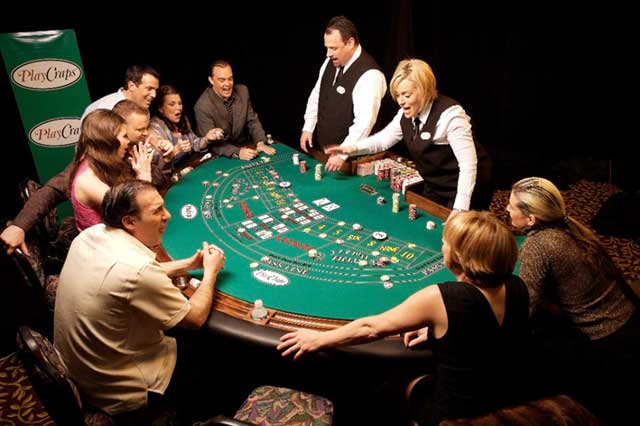
PlayCraps™
If you haven’t read my full analysis yet, you’ll first need to know the player edge is on the don’t pass / don’t come side, and the house’s edge on the pass odds are higher than usual. So don’t rush out here and start betting the pass line and taking odds like you normally do. Switch over to the Dark Side first, if you’re not already over there.
If you like taking a shot a craps, come on out to Viejas, and have some fun. The layout of the game is really enjoyable, because it promotes fast action, and you get to sit while you play. It’s very relaxing, and there’s no stress of rolling the dice in front of a bunch of angry players. It’s just you watching the cards that come out, and deciding to increase/decrease your don’t pass or don’t come odds. Even for the best counts, you’re not really justified in buying any No-4’s or No-10’s, but at times, the odds overcome the vig.
If you like advantage play, and can enjoy playing the Don’ts, read up on this game, and come on out. It’s not every day that a game is beatable by basic strategy.
Self-Bar @ Sycuan Casino, CA
Finally, after years of low-limit, “advantage-play”, life-in-a-casino degeneracy, I figured out the ultimate way to beat the casino this afternoon.
Of course, the story starts off that I was minding my own business, playing $5 Spanish 21 in pit 3 (non-smoking) at my nearby Sycuan Casino. I’d been doing this every weekend since I started this blog 5 months ago. I’d already played 10 hours for the weekend, which would likely total up to 20+ hours by Sunday night. Like clockwork, I’d also been toking out $10 per hour, giving each dealer $3 or $4 in $1 chips at the beginning of their push, and letting them play it anyway they wanted to.
I played at Sycuan an average of 4 days a week, for 30-40 hours a week, losing an average of $2/hr, plus toking out $10/hr to the dealers. So it cost me about $400/week, but I considered it cheap entertainment. The casino won $70/week from me, but they threw me about $10/week in loyalty rewards, and another $20-$30/week in food comps. So, my net donation to the casino was about $35/week, or $1/hr. However, there was no getting around the $350/week in dealer tokes ($10/hr). I was there for the socialization, and I wanted to treat the dealers fairly for standing up, dealing 400 hands/hr, putting up with the Idiots who somehow find it eminently reasonable to blame the dealer for their losing the rent money on their bad decisions, like playing with it in the first place. And the casino forces them to be nice to the Morons, by spying on them with secret shoppers, even though they need to be nice to customers to make a living anyways (their paychecks are essentialy $0 after taxes, benefit deductions, and 401k).
In the thousand hours I sat playing Spanish 21 @ Sycuan, I never found a single player that employed basic strategy, or for that matter logical thought, to their gambling. All my publishing of the odds, and my practical examples of 21 hour straight sessions, sometimes coming out ahead, could not convince people to hit a 14 against a dealer 2 or 3, or even to hit a 13 against a dealer 5. Instead, I’d see the same thing that the dealers see every day. People actually trying to figure out what the next card coming out of the shoe would be, or trying to figure out what the dealer down card was. E.g., they say “she (the dealer) doesn’t have it”, and they stay on 15 against a dealer 9. Or they think the dealer “has it”, and they surrender. They clearly know they won’t improve their hand by hitting.
So anyways, I see this crazy behaviour every day, the way the players blame the dealer for drawing to 20, or 21, or otherwise not busting. They anthropomorphize the cards coming out of the shoe as being controlled by the dealer, or the dealer’s properties at the time. “The dealer is hot. I’m going to sit out a few hands.” Or, “the dealer isn’t busting”. But while I enjoyed watching all of this (ok, I felt better about myself when I was playing with these people), I found out that the anger the losing players throw at the dealers ends up being rather hurtful, no matter how experienced the dealer is at handling it. I think a particularly hateful way to treat the dealer is to sarcastically blame them for the losing hands, like “of course you make 21 when I have 20”, and disgustingly and dismissively violently gesture at them. There’s a certain type of personality that ends up doing this when the losses get bad.
Anyways, the dealer has to make a living too, and I could afford to toke, so I do. As I understand it, they’re taxed on about $18/hr in expected tokes, so for a 6-spot table, this works out to be about $3/hr per person. Okay, so I toke at 3x the average. But there’s a lot of people that don’t toke anything, so the average is made up by the people who do. So since I toked $3-$4 on every down, and I could care less what the outcome of a $5 hand was, and I’d have reasonably intelligent discussions with the dealers about anything other than the game itself, and always had a good time playing, it made me a very good customer from the dealer’s perspective. And, as they said, “especially in this economy.”
Ok, so finally, here’s the story I’m trying to get to. No matter how good of a customer you think you are, an occasional moronic floor supervisor will do something completely stupid, and walk over with another floorperson, from another pit in another room, and indiscretely pull you out of your game in front of all the players to warn you about something minor you did in the previous week, or 35 playing hours, and 4 sessions ago. The floor super told me I couldn’t buy surrenders from people, like I’ve described in my previous post. I know they told me not to do this. I refrained from doing it in general. However, when you’re in the middle of a 21 hour session, in graveyard, and you’ve been friendly with the players for hours, and you’re trying to educate them about the game (i.e., teach them not to over-surrender), it feels like a pretty minor offence. Oh, and did I mention, I toke out $10/hr, win or lose?
So, I got pretty angry when they did this happened to me today. I was really tired from my 7 hour session that ended at 3am the night before. I was beside myself that they’d bring up something minor from last week and make a deal out of it. I didn’t like being treated poorly for all the toking that I go out of my way to do. I always state that I’m going to lose $1/hr to the house, and spend $10/hr on the dealers. It’s been my stated policy all the while I’d been putting my 35 hrs/week into the place.
So I got indignant, and sarcastic. I dismissingly agreed that I shouldn’t do it, and returned to my table, upset. Everyone wanted to know what the fuss was about, and I said bad things about the way the house was treating the customers. I told my fellow players that the house treats us poorly, and consider us suckers. So the floor comes back into the picture, and tells me that if I say anything disparaging about the casino, she’ll bar me from playing. Then I said, “please, bar me, throw me out”. She told me just to sit down and play. But I decided right then and there, that was the last thing I was going to do. It was clear that I called her bluff, since they were way out of line relative to my good behaviour, as an extremely loyal regular customer. What casino treats their regular donors like this?! So she walked away, but I remained agitated.
Now, here’s the best angle to shoot when if you’re upset with the casino. Threaten them that you’ll officially self-bar yourself. By law, they have to take you seriously, and they’re all trained how to handle the request, and there’s a formalized procedure for processing it. And the best part is that it’s irrevocable, except for a complicated appeals process that has to go through a state gaming commission hearing. If you’re a good regular, the casino does not want to you threaten the nuclear option. Sign the paper, and they lose revenue. Do it in front of all the other customers, and it’ll put dangerous ideas in their heads. Maybe it is a good idea to self-bar yourself from the casino. I’d probably be better off, and save thousands.
Don’t threaten “I’m never coming back here”. It doesn’t mean much coming from a degen gambler. They send you some loyalty rewards in the mail, and you’re back the next day to redeem them. Sign the “Sycuan Security Self-Exlusion Form”, say for a year, or 5 years, or permanently, and by law, they’ve lost all revenues from you during the exclusion period, or they’re liable for damages and penalties from lawsuits or the state gaming commission. Thank g*d for consumer protection laws.
After the idea came to my mind, it sounded better and better as I thought it over for 30 seconds. I asked the floor supervisor in my pit to sign me up. I could tell he wasn’t happy with my decision, but he had to obey my request. I was going to save countless hours and money, and do something better with my time. After all, there are 10 other places to gamble in town, and most of them are much nicer than Sycuan. It was win-win for me. Why the hell was I toking out so much money in the first place? That visit from the floor supervisor was a wake up call to me. Why was I wasting so much time in that casino? How could I continue donating to a place that scolds you for your loyalty?! I had no choice but to come to my senses. I never would have thought of the self-bar unless I had been riled up by the confrontation, and I never would have executed it unless I did it on the spot, half in anger, half in brilliant insight.
They Sycuan staff were very nice as we started the ball rolling on the self-exclusion process. Security staff came by with the forms, and had me cash out my chips at the table. I think I’m the only person who enacted a one year self-exclusion from the premises while they were winning. I won about $35 in my final session, and $45 from the night before. After coloring-out at the table, security walked me over to the cage to cash out. I toked the cashier as I put my $336 back in my wallet (I bought in for $300). We walked outside, and I filled out the self-exclusion form, and they took a picture of me for their files. Then one of the guards suggested I should cash out whatever cashback I’ve earned on my Club Sycuan loyalty rewards card before they confiscated it. So, they walked me back into the casino, and in fact, we moved to the front of the line at the Club Sycuan desk. They swiped my card, verified my picture ID, and filled out a voucher for $35 cashback. Then security walked me over to the cage again to cash the voucher. A lady saw my security escort and the voucher, put two and two together, and asked me how much I won (she thought the escort was for some big payout). I told her it was for $35, and that she should check her card for cashback awards. The security guard agreed with me, and told her that you never know what you might have accumulated. We didn’t tell her that I was being escorted out of the building, for good.
I knew that security wouldn’t let me make a big show out of walking out with my hands/fist up in the air, celebrating my victory over the g**damn casino, but I knew they knew I was polite, and making the move out of principle. In fact, the guard gave me a few Customer Satisfaction Survey forms, since they knew I wanted to file the reason for my self-bar from the casino. So, I just walked by the tables in pit 3 for a last time, said “goodbye” to the dealers (I know them all on a first-name basis), and waved the Self-Exclusion Form in the air. Everyone in-the-know is familiar with the nuclear option, but I’m sure they’re just a little shocked that I exercised it.
As I walked out of the casino, and through the parking lot for the last time, along the same path I’d followed over a hundred times in the last five months, I breathed in the warm summer afternoon air for the first time. Usually, I made the walk in the dark, cold hours before dawn, after wasting a day or two at the Spanish 21 table. With every step, I was feeling free again, and hours later, I would feel immensely grateful for the day.
Buying Surrenders @ Spanish21
I’ve been shooting an angle at the Spanish21 blackjack tables at my nearby Sycuan Casino for the past few weeks, but finally “management” got wise to it, and shut me down 😦 However, it’s still good, and you’ll probably have the chance to do it yourself, provided your casino isn’t retentive about these types of things.
Here’s how it works. I noticed that people tend to over-surrender at Spanish21, because they get used to surrendering from rescue after double, and they figure if its good then, it must always be good. Of course, there are people that never surrender, even after double (they’d rather redouble a 14 against a dealer Ace), but that’s a different story. So I’d see people surrendering 14 against a dealer Face, and all kinds of nonsense. It was okay to pass chips around the table to back someone’s double, and play someone else’s match, so I figured they’d let me “buy” people’s would-be surrender hands. So, they surrender to me, I pay them half their bet, and they play the hand out for me. I own the hand at this point, and if it wins, I get all the proceeds, including the original bet. It’s very simple in practice. When you see someone start to signal for surrender, you say “I buy” and show them the money. They say, “ok, you buy”, take the chips, and now its your hand. Of course, they have to signal to the dealer for the hit, because of the house rules. Hopefully, you improve the hand with the hit, and stand. If you bust, the player feels good about their surrender. If you win, make sure the player doesn’t feel like a sucker (say something like “I gambo”). This transaction is somewhat normal for the Asian players, because of the concept of “color buy” in Paigow. They’re also very adept at keeping track of various intra-player transactions (e.g., “come-come” bets). With American players, hopefully you can simply explain the proposition. Usually though, just have the right amount of chips ready, and use hand gestures to demonstrate your intentions.
Of course, every such opportunity (except for the 16 & 17 against a dealer Ace) is positive EV. Here’s a few examples of what I was getting before they put the kibash on it:
| Hand | EV(hit) | Cost | Profit |
|---|---|---|---|
| 16 vs Dealer Face | .516306 | 0.5 | 3.26% |
| 15 vs Dealer Face | .566478 | 0.5 | 13.3% |
| 14 vs Dealer Face | .61956 | 0.5 | 23.9% |
| 16 vs Dealer 9 | .546484 | 0.5 | 9.30% |
| 15 vs Dealer A | .543541 | 0.5 | 8.71% |
| doubled 13 vs Dealer 7 | .532753 (stand) | 0.5 | 6.55% |
There’s one guy (an Italian guy named Robert), who surrender more than anyone could fathom. We got along well, so he’d gladly surrender to me. Unfortunately, he’s a bad chronic donor, so I didn’t see him enough. Besides, he would have caught on sooner or later.
From the table, the worst offer is the 16 vs. the dealer Face. Of course, it’s the most common opportunity, and only yields 3.26%. That’s a great return, but might be more variance than you like to assume. Maybe you can only buy the small bets on these hands. Anything else is pure gold.
Anyway, the retard floor manager on the day-shift saw me doing it, and sternly told me I couldn’t do it. I guess that means if I continue doing it, I’ll get in more serious trouble. Plus, they’ll probably have a staff meeting / memo on the issue, and all the dealers will be instructed to prohibit it. Geez, what a bunch of killjoys. This was the best thing ever.
Caribbean Stud Overlay @ Sycuan Casino, CA
Update:
There’s no actual overlay for this game 😦 When I first saw the high hand bonus, I asked all the rules concerning it, and was assured twice by the floor that I didn’t need to make the $1 progressive jackpot bet to qualify. Well, the next day as I was playing (the only person not making the progressive bet), the dealer told me I needed to bet the jackpot to qualify for the high hand bonus. They checked with the shift supervisor, who confirmed the rule. That killed the overlay, because the progressive was really low @ $87,000. I wish they told me the right rule before I did all the work on this post 😦
Strangely enough, there’s a weekly high-hand prize in the Caribbean Stud Game at my nearby Sycuan Casino that makes the game profitable to play. Of course, we know Caribbean Stud is a game with about a 5.25% house edge, but the overlay (additional favorable odds, e.g., through a promotion, or an exceptionally large progressive jackpot) makes the game profitable. Here’s how it works: Sycuan offers a weekly prize of $1500 for the highest hand made in Caribbean Stud, $1000 for the 2nd highest, and $500 for the 3rd highest hand. They post the three highest hands next to the game, so you can see what you’re up against. When the high hands aren’t so high, and it’s late in the week (the contest starts and stops at midnight Sundays), the added expectation value from the high-hand prizes makes it a winning game.
To calculate the overlay, you need to calculate the probability of making a high hand. We’ll assume it’s late enough in the week, so that if you make a high hand, it’ll stand up (i.e., no one will push your hand down, or off the high hand list). First, we need to know the probabilities of making the following hands:
| Hand | Probability |
|---|---|
| Straight Flush | 1.54 x 10⁻⁶ per hand (e.g., 6-high straight flush) |
| Four-of-a-Kind | 1.85 x 10⁻⁵ per hand (e.g., quad Tens) |
| Full House | 9.24 x 10⁻⁶ per hand (e.g., 44433) |
Then, take the current high hands in the contest, and calculate the probability and EV for beating them. Let’s take the following example, which were the high hands at the time of this post, with 24 hours left in the weekly contest:
| Place | Prize | Hand | Pr(beat) | EV |
|---|---|---|---|---|
| 1st | $1500 | 8-8-8-8-J | 2.65 x 10⁻⁵ | .00795 |
| 2nd | $1000 | K-K-K-A-A | 2.22 x 10⁻⁴ | .04437 |
| 3rd | $500 | J-J-J-T-T | 2.40 x 10⁻⁴ | .02402 |
| total | 4.885 x 10⁻⁴ | .07634 |
First, we see we need to beat quad 8’s for first place. Any straight flush is good, or quads 9’s or better. The probability of making such a hand is (10)(1.54e-6) + (6)(1.85e-5) = 2.65e-05, for an overlay of ($1500/$5)(2.65e-5) = .00795.
For 2nd place, we calculate the probability of making a hand between the current 1st and 2nd place hands. These are Ace’s full of anything, and quad 2’s thru 7’s. The probability is (12)(9.24e-6) + (6)(1.85e-5) = 2.22e-4, for an overlay of (2.22e-4)($1000/$5) = .04437.
Finally, we can make 3rd place with any full house between JJJTT and KKKAA. There are 26 of them, for a probability of (26)(9.24e-6) = 2.40e-4, and an overlay of (2.40e-4)($500/$5) = .02402.
Adding this all up, we see we get an total 7.634% overlay for this set of current high hands. This more than overcomes the inherent 5.25% house edge for the game, leaving us with a net of almost 2.4%! Of course, this is only valid until someone makes a high hand (possibly us), and changes the probabilities. Don’t get too excited, because your chances of making the high hand board is pretty slim, at about 1-in-2000 hands. Overall, the game is slow and pleasant. Using the conservative strategy of playing only pairs or better, or even playing AKJ or better is a pretty slow bleed at about $.25/hand house edge. Its a fun, communal game at a full table.







 Discount Gambling
leave a comment